The Emergence of Landscape: From Decorative Backdrop to Independent Genre
In the early stages of Western art, the natural world rarely held the center of attention. For much of the Renaissance and the periods preceding it, mountains, forests, and rivers functioned primarily as secondary elements. These landscapes served as the stage for religious narratives or mythological dramas, providing a sense of place for figures like those found in the works of Giotto. The scenery was a vehicle for moral preaching or a decorative foil to the human drama, rather than a subject worthy of study in its own right.
This changed as the concept of mimesis—the imitation of nature—gained traction. As artists began to look more closely at the world around them, the landscape began to move from the periphery to the foreground. By the seventeenth century, the genre had begun to flourish as an independent form of expression. What was once a mere setting became a subject of profound technical skill, where the arrangement of light and shadow was used to define the physical reality of the earth rather than just the spiritual weight of a saint.
The transition from background to subject marks the first major shift in how we perceive the natural world through paint. It represents the moment when the eye began to value the texture of a leaf or the curve of a hill as much as the face of a protagonist.
The Romantic Impulse: Constable and the Pursuit of Natural Truth
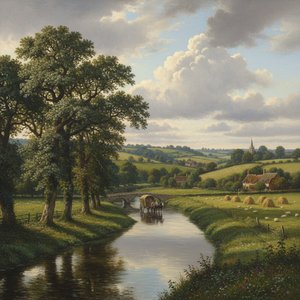
The desire to capture the essence of the countryside reached a turning point in the early nineteenth century. John Constable, an English painter, moved away from the rigid formalism that had dominated academic traditions. His work was characterized by a commitment to drawing inspiration directly from nature, a practice that challenged the idea that landscapes should be idealized or overly composed. Instead, he sought to record the specific, lived reality of the English countryside.
Constable’s influence was profound, acting as a catalyst for younger generations of artists who felt the need to abandon the artificiality of the studio for the unpredictability of the outdoors. His approach was not about creating a perfect, polished scene, but about capturing the movement of clouds and the moisture in the air. This shift toward naturalism laid the groundwork for a more direct, observational way of seeing that would define much of the century to follow.
By prioritizing the actual appearance of the land over a stylized version of it, Constable helped establish the landscape as a site of sincere observation.
The Barbizon School: Realism and the Spirit of the Forest
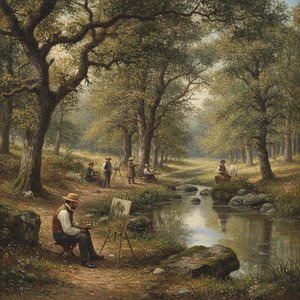
As the nineteenth century progressed, a group of artists gathered in the village of Barbizon, on the edge of the Forest of Fontainebleau. This movement, active roughly between 1830 and 1870, sought to bring a sense of Realism to the genre. These painters were not interested in the grand, sweeping vistas of the past; instead, they focused on the quiet, often humble details of village life and the dense, shaded interiors of the forest. Jean-Baptiste-Camille Corot was an early presence in this region, painting in the forest in 1829 and creating studies that possessed a certain poetic quality.
The Barbizon painters, including Théodore Rousseau and Jean-François Millet, often included farmworkers in their compositions, grounding their landscapes in the reality of human labor. Their technique was marked by loose brushwork and a focus on tonal qualities that emphasized the atmosphere of the woods. They moved away from the "Shakespearean" or tragic scenery favored by some Romantics, opting instead for a more grounded, sincere depiction of the French landscape. This focus on the immediate environment helped bridge the gap between the idealized landscapes of the past and the radical observations of the future.
The Barbizon School proved that the quiet, everyday reality of a forest or a farm could hold significant artistic weight.
Impressionist Light: Capturing the Atmosphere of the Countryside
The evolution of rural scenery reached a point of intense sensory focus with the Impressionists. If the Barbizon painters sought to capture the truth of the land, the Impressionists sought to capture the truth of light as it hit that land. Pierre-Auguste Renoir, for instance, approached the landscape with a focus on tranquility and pastoral life. In works such as Rural Scene, the emphasis shifts toward the interplay of light and color, using loose brushwork to suggest the fleeting nature of a moment.
This period saw a departure from the heavy, dark tones of earlier realism in favor of a lighter, more atmospheric palette. The goal was to record the sensation of a place—the way sunlight filters through trees or how the air changes at dusk. This was not a depiction of a permanent, unchanging landscape, but a record of a specific, passing instant. This technique required a new way of applying paint, where the brushstroke itself became a visible part of the subject, conveying the energy of the environment.
Through this lens, the countryside became a study in light and movement, forever changing the way we perceive the passage of time in art.
The Abstract Horizon: Landscape as Emotional Resonance
As the twentieth century arrived, the representation of the landscape underwent a radical transformation. The subject was no longer required to be a literal depiction of trees, hills, or rivers. In the hands of Expressionists like Mark Rothko, the concept of a "rural scene" could be stripped of its recognizable imagery and reduced to its emotional core. In his Rural Scene, the landscape is expressed through color field painting, using large planes of color to evoke feelings of solitude, grief, or resilience.
This approach moves beyond the visual and into the psychological. The barn structure or the flight of a bird might be suggested through a gesture of color rather than a detailed rendering. The landscape becomes an internal state, a way to communicate the human condition through the abstraction of the natural world. It is a departure from the external observation of the Impressionists, moving instead toward a profound, meditative experience that bypasses intellectual analysis to touch the viewer's emotions directly.
In this stage, the landscape is no longer something we look at, but something we feel, translated through the language of pure color and form.
The Enduring Legacy of Rural Imagery
The history of rural scenery in art is a history of our changing relationship with the earth. From the decorative backgrounds of the Renaissance to the emotional abstractions of the modern era, the way we paint the land reflects our own shifting values and perceptions. We see a movement from the religious and the mythological toward the real, the atmospheric, and finally, the psychological.
Today, we continue to find value in these representations. Whether it is through the meticulous detail of a hand-painted oil reproduction or the quiet contemplation of a print, these works offer a connection to a world that feels increasingly distant. They remind us of the dignity of labor, the beauty of the changing seasons, and the profound solitude found in the open air. This enduring connection stems from a reverence for nature’s rhythms and an acknowledgement of our fundamental origins, ensuring that the depictions of the landscape remain as relevant now as they were when the first artists moved beyond mere formalist traditions to draw inspiration directly from the natural world.