The Language of Power: Decoding Regalia and Royal Iconography Regalia Regalia ( rə-GAY-lee-ə, -GAYL-yə) is the set of emblems, symbols, or paraphernalia indicative of royal status, as well as rights, prerogatives and privileges enjoyed by a sovereig...
To gaze upon a royal portrait is to read a silent, sophisticated language composed of gold, silk, and stone. Long before the advent of photography, the legitimacy of a monarch was communicated through regalia—the carefully curated emblems and paraphernalia that signaled divine right and earthly authority. These were not merely ornaments; they were the visual manifestations of sovereignty. The scepter, representing the rod of justice, and the orb, symbolizing dominion over the world under Christian influence, held a weight far beyond their material value.
In the ancient traditions of Pharaonic Egypt, this symbolic vocabulary was even more profound. The use of the pschent, or double crown, represented the unification of Upper and Lower Egypt, while the uraeus—the protective cobra upon the brow—served as a magical amulet against chaos. This tradition of using physical objects to convey abstract virtues persists through various cultures, such as in the Imperial Regalia of Japan, where the mirror, the jewel, and the sword represent wisdom, benevolence, and valor. When we observe these items, we witness the intersection of art and political theology, where a single piece of jewelry can carry the weight of an entire empire's history.
Tudor Iconography: The Complex Visual Story of Elizabeth I
The portraiture of Queen Elizabeth I (1533–1603) spans the evolution of English royal portraits in the early modern period (1400/1500–1800), from the earliest representations of simple likenesses to the later complex imagery used to convey the power ...
The portraiture of Queen Elizabeth I marks a fascinating evolution in English art, moving from simple likenesses to complex imagery designed to convey the power and aspirations of the state. Early representations often featured modest symbols like roses and prayer books, but as her reign progressed, the iconography grew more layered. Later portraits utilized globes, crowns, swords, and columns alongside representations of purity, such as moons and pearls, to present a narrative of the "Virgin Queen."
The technical execution of these works varied significantly. While artists like Nicholas Hilliard, the official limner and goldsmith to the Queen, specialized in portrait miniatures—watercolors on vellum glued to playing cards—other painters worked on larger scales. The influence of Hans Holbein the Younger was particularly profound; his work accustomed the English court to full-length, life-size portraits. Over time, a shift occurred from the realistic depth seen in Holbein’s Jane Seymour toward a flatter, more decorative pattern. This transition favored an effect of splendid majesty over anatomical volume, using intricate patterns to create a sense of awe.
Baroque Grandeur: Power and Lineage in the Courts of France and England
A Grand Tapestry of Lineage and Power To stand before this monumental depiction of Louis XIV and his royal family is to be enveloped in an atmosphere of unparalleled grandeur. This painting is not merely a portrait; it is a meticulously constructed t...
As the centuries progressed, royal portraiture moved from the symbolic patterns of the Tudor era toward the atmospheric drama of the Baroque. In the late 17th century, works like Jean Nocret’s depiction of Louis XIV and his family demonstrated how art could serve as a meticulously constructed testament to absolute power and dynastic continuity. These large-scale oil paintings on canvas used dramatic lighting to carve out the three-dimensionality of velvet draperies and polished jewels, creating a controlled spectacle of status.
The inclusion of numerous children and extended family members in such compositions was a potent symbol of enduring bloodlines, suggesting that power was not merely surviving but flourishing across generations. This era emphasized lineage as the primary currency of existence. Similarly, in the Austrian monarchy, Josef Kriehuber’s 1828 portrait of Ferdinand I utilized lithography and fine brushwork to capture the textures of metallic armor and rich embroidery, presenting the sovereign as a symbol of stability within the Habsburg Empire. Through these works, the heavy, symbolic grandeur of the past began to blend with a more nuanced, psychological approach to leadership.
Maritime Might: Naval Supremacy and the Royal Standard
English Royal Yachts at Sea in a Strong Breeze, in Company with a Ship Flying the Royal Standard Willem van de Velde the Younger’s “English Royal Yachts at Sea, in a Strong Breeze, in Company with a Ship Flying the Royal Standard” is more than just a...
Power was not always expressed through the stillness of a courtly portrait; sometimes, it was found in the movement of fleets across turbulent seas. Willem van de Richelde the Younger’s depiction of English Royal Yachts at Sea captures the political landscape of the late 17th century. The presence of a ship flying the Royal Standard of Charles II served as a deliberate assertion of legitimacy and continuity following years of exile and the era of Oliver Cromwell.
The painting uses the technique of the Dutch Baroque, employing layers of oil paint to create an illusion of depth and atmospheric perspective amidst crashing waves and towering clouds. This maritime imagery underscores the importance of naval power in securing national interests. The turbulent sea itself acts as a metaphor for the political uncertainty and danger that characterized the era, making the sturdy, royal vessels symbols of much-needed stability.
Ceramic Diplomacy: Porcelain as a Tool of National Pride
A Legacy Etched in Porcelain: The Royal Copenhagen Story The story of the Royal Copenhagen Porcelain Company is more than just a tale of exquisite craftsmanship; it’s a reflection of Denmark's cultural identity, its embrace of artistry, and its endur...
The pursuit of prestige often extended into the decorative arts, where porcelain became a medium for expressing national identity and economic independence. In 1775, the Royal Copenhagen Porcelain Company was founded under the patronage of Queen Caroline Amalie, with the explicit goal of rivaling European manufacturers in France and Germany. This was a declaration of Danish artistry, moving away from a reliance on imported luxury goods toward a uniquely Danish aesthetic.
A defining moment in this history was the 1779 development of the Blue Fluted pattern. Inspired by Chinese porcelain brought by the East India Company, the design—created by Johann Christian Fines—distilled Eastern aesthetics through a Danish lens. Similarly, in France, the Manufacture Royale de Sèvres became a symbol of 18th-century ambition. Under the direction of Robert Du Paquier and later the direct control of Louis XV, the factory moved from imitating Chinese soft-paste porcelain to innovating with signature colors like *bleu celeste* and *rose pompadour*. These ceramics were not merely functional; they were instruments of cultural diplomacy and royal patronage.
The Collector's Legacy: Curating Authority through the Royal Collection
A Legacy of Majesty: Exploring The Royal Collection Within the venerable walls of Buckingham Palace and scattered across thirteen historic residences throughout the United Kingdom lies a treasure unlike any other – The Royal Collection. More than sim...
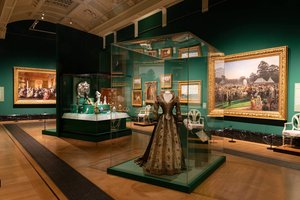
The accumulation of art by monarchs has created some of the most significant repositories of human creativity in existence. The Royal Collection, spread across thirteen historic residences like Buckingham Palace and Windsor Castle, serves as a living chronicle of British monarchy. The foundations were laid by Henry VIII, whose Renaissance-driven hunger for Italian masters like Botticelli, Leonardo, and Raphael established a standard of excellence that would endure for centuries.
Later, the acquisitions of Charles I brought the energy of the Mantuan school to England, forever altering the nation's artistic sensibilities. This collection is a continuous dialogue between eras, transitioning from the heavy symbolism of the Tudor period to the light-drenched elegance of later centuries. These objects—paintings, sculptures, and textiles—were never merely adornments; they were chosen to express authority and celebrate dynastic achievements. Today, this treasury remains a profound visual record, offering a window into the human condition through the lens of royal splendor.
At OriginalUniqueArt.com, we appreciate the enduring impact of these historical narratives. Whether you are looking to transform a personal memory into a custom oil painting or seeking a high-impact reproduction of a classical era, our mission is to bring the depth and texture of art history into your modern space.

 Sovereign Symbols: The Artistry and Hidden Iconography of Iconic Royal Portraits
 Portraiture of Elizabeth I
 Louis XIV and the royal family
 English Royal Yachts at Sea in a Strong Breeze, in Company with a Ship Flying the Royal Standard
 Royal Copenhagen Porcelain Company
 Royal Collection


