In art, chiaroscuro (English: kee-AR-ə-SKOOR-oh, -SKURE-, Italian: [ˌkjaroˈskuːro]; lit. 'light-dark') is the use of strong contrasts between light and dark, usually bold contrasts affecting a whole composition. It is also a technical term used by a...
To look at a portrait from the High Renaissance is to witness the moment paint ceased to be a flat application of pigment and began to breathe with weight. Before the masters perfected the art of light, figures often appeared as mere silhouettes against a backdrop. The introduction of chiaroscuro changed this entirely, providing artists with a technical vocabulary to sculpt flesh and fabric using nothing but the tension between shadow and illumination. This was not merely an aesthetic choice; it was a mathematical and physical pursuit of truth.
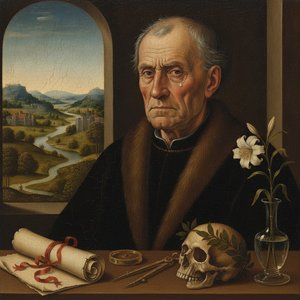
In the works of Giovanni Girolamo Savoldo, we see this Lombard tradition refined into something deeply atmospheric. He did not simply illuminate his subjects; he used light to carve them out of the darkness. By employing subtle gradations of tone, Savoldo achieved a sense of three-dimensional presence that made the sitter feel tangible, as if one could reach out and touch the heavy weave of a sleeve or the warmth of a cheek. This technique of modelling figures through value gradation allowed for a quiet lyricism, where the light seems to emanate from within the subject itself.
This pursuit of volume finds an echo in the later, more intense applications of shadow seen in the works of Rembrandt. In his etchingA Jew with the High Cap, the use of hatching and crosshatching mimics the very contours of the face, using darkness to define the structure of bone and skin. The transition from the soft, sculptural light of the Renaissance to the structural shadows of the Dutch Golden Age shows a continuous obsession with making the two-dimensional plane yield to the three-dimensional world.
Symbols of Authority: Iconography and the Language of Power
The portraiture of Queen Elizabeth I (1533–1603) spans the evolution of English royal portraits in the early modern period (1400/1500–1800), from the earliest representations of simple likenesses to the later complex imagery used to convey the power ...
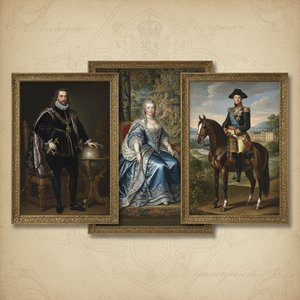
A portrait in the sixteenth century was rarely just a record of a face; it was a carefully constructed manifesto. For the ruling classes, every object held a specific weight of meaning. To look upon a royal likeness was to read a political document. In the English court, the portraiture of Elizabeth I evolved from simple representations into complex webs of iconography. A pearl was not merely a piece of jewellery; it was a signifier of purity. A globe or a crown spoke of an empire’s reach and the monarch's divine right.
This use of symbolic objects to communicate status was a standard practice across Europe, though the methods varied by region. In the Tudor court, artists like Nicholas Hilliard worked within a tradition where the external trappings of power—the textures of silk, the glint of gold—were as important as the sitter's features. The goal was to present an image of unshakeable authority through a curated collection of emblems that any educated viewer could decode.
We see a different kind of symbolic construction in the masculine portraits of the Italian Renaissance. Here, power was often communicated through posture and physical presence rather than just objects. A pointed elbow or a broad-shouldered stance served as signifiers of assertiveness and responsibility. Much like the Elizabethan use of pearls to denote virtue, these anatomical exaggerations were used to broadcast a specific type of social identity, ensuring that the sitter's place in the hierarchy was understood at a single glance.
The Humanist Lens: Capturing Individual Psyche through Technique
Introduction Step into the frame. Portraiture has never been just about capturing a likeness; it is about the raw, unfiltered energy of human identity. It is the original high-definition capture, long before pixels and sensors existed. From the heavy...
The intellectual heartbeat of the Renaissance was Humanism, a movement that shifted the focus of art from the purely divine to the complexities of the human experience. This era brought an interest in the relationship between man, the universe, and God, demanding that painters capture not just the exterior likeness, of a person, but their internal landscape. The challenge for the artist was to move beyond the "idealized" face—which can often feel hollow or emotionless—to find the specific, idiosyncratic truth of an individual.
While some artists, such as Leonardo da Vinci, utilized sfumato to create soft, dreamlike transitions that blurred the edges of reality, others sought a more psychological realism. The goal was to find the "soul" within the features. When done correctly, a portrait becomes a window into a personality, capturing a fleeting thought or a heavy emotion through the slight tension in a brow or the direction of a gaze.
This search for the individual is perhaps most poignantly felt when we contrast the era's greatest achievements with its more rigid moments. While some critics have found certain idealized Renaissance works to lack true character, the true power of the period lies in those rare instances where the technique allows the person to emerge from the paint. It is a pursuit of the unique, ensuring that if one were to pluck a face from a crowd of a thousand, the portrait would allow them to identify the man by his very essence.
Beyond the Surface: The Influence of Northern Realism on Italian Form
Early Netherlandish painting is the body of work by artists active in the Burgundian and Habsburg Netherlands during the 15th- and 16th-century Northern Renaissance period, once known as the Flemish Primitives. It flourished especially in the cities ...
While the Italian masters were perfecting the geometry of perspective and the grace of form, a different kind of intensity was developing in the North. Early Netherlandish painters, often referred to as the Flemish Primitives, brought a preoccupation with meticulous detail and texture that would eventually transform the entire continent. Their mastery of oil on panel allowed for a level of naturalism—the glint of light on a metal goblet or the microscopic detail of a velvet cloak—that was previously unimaginable.
This Northern influence acted as a vital counterpoint to the more idealized Italian styles. As trade routes expanded between the Low Countries and Italy, these two traditions began to bleed into one another. The result was a synthesis of Italian structural integrity and Northern descriptive precision. This fusion allowed artists to create environments that were both architecturally sound and richly textured, breathing life into every corner of the canvas.
The legacy of this exchange is visible in the way later Renaissance painters approached texture. The ability to render the tactile reality of the world—the weight of cloth, the roughness of stone—became a standard of excellence. This movement toward a more grounded, descriptive realism ensured that art was not merely an intellectual exercise in geometry, but a sensory experience that engaged the viewer's sense of touch and sight.
Theatrical Shadows: Tenebrism and the Evolution of Narrative Drama
A Dramatic Encounter: Gerard van Honthorst’s “Christ Before the High Priest” Gerard van Honthorst's "Christ Before the High Priest," painted in 1617, is more than just a biblical scene; it’s a masterclass in Baroque drama rendered in oil on canvas. C...
As the Renaissance gave way to the Baroque, the controlled use of chiaroscuro evolved into something far more theatrical: tenebrism. If the High Renaissance used light to model form, the masters of the following era used darkness to command attention. This extreme contrast, where deep, velvety blacks collide with sudden, piercing highlights, turned the canvas into a stage. The shadows became active participants in the story, hiding secrets and heightening the tension of the scene.
Gerard van Honthorst, heavily influenced by Caravaggio’s revolutionary approach, utilized this technique to create moments of profound spiritual and human drama. In his depictions of biblical encounters, a single, unseen light source might illuminate a face, casting the rest of the room into an impenetrable gloom. This use of shadow does not merely obscure; it focuses the viewer's eye with surgical precision on the emotional crux of the narrative, making the vulnerability of the subject feel almost overwhelming.
This evolution from subtle shading to dramatic, high-contrast storytelling represents the ultimate expansion of the artist's toolkit. From the soft transitions of the Renaissance to the cinematic tension of the Baroque, the manipulation of light has always been the primary tool for directing the human heart. Whether through the quiet glow of a Savoldo or the intense, flickering candlelight of a Dutch master, the power of art remains rooted in our ability to find meaning within the interplay of light and dark.
At OriginalUniqueArt.com, we celebrate this profound history by offering hand-painted reproductions that honor these classical techniques. Whether you are looking for a custom portrait that captures a loved one in the style of Rembrandt or a large-scale mural to bring the drama of Tintoretto into your home, our artists use traditional methods on 100% cotton canvas to ensure every brushstroke carries the weight of tradition. Explore our collection to find the perfect piece for your space, and discover how the shadows of the past can illuminate your modern world.
Explore the fascinating history of aristocratic status depicted through European art (16th-19th centuries). Discover how artists reflected—and shaped—societal hierarchies. Expert insights for discerning collectors.
Explore the profound mastery of Northern Renaissance art. Discover the technical brilliance of Flemish oil painting, the intricate symbolism of Bosch and Bruegel, and the revolutionary realism that redefined European art history through an expert historical lens.
Explore the profound evolution of figurative art, from Ancient Egyptian portraiture to Renaissance mastery. Discover the history, techniques, and emotional depth behind the world's most iconic human forms in this definitive guide for art enthusiasts and collectors.
Explore the captivating history of shadow in art! Discover chiaroscuro & tenebrism techniques used by masters like Caravaggio & Rembrandt. Uncover symbolism, emotional impact & enduring legacy with OriginalUniqueArt.

 Chiaroscuro
 Portraiture of Elizabeth I
 Beyond the Face: 10 Iconic Masterpieces That Redefine Portraiture
 Early Netherlandish painting
 Christ before the High Priest