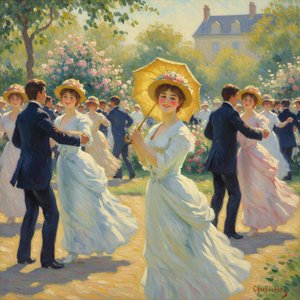
Arrival at the Riverbank: The Dawn of a New Vision
Impressionism
The morning air near Le Havre carries a specific weight, a dampness that clings to the skin before the sun has fully cleared the horizon. It was in this precise, fleeting atmosphere that a new way of seeing began to take shape. When Claude Monet presented Impression, Sunrise in 1872, he was not merely documenting a harbor; he was capturing the very breath of the dawn. The world was changing, moving away from the controlled, studio-bound traditions of the Academy toward something far more immediate and unscripted.
To look closely at these early works is to see the rejection of hard outlines. Instead of precise silhouettes, we find short, broken brushstrokes that allow colors to vibrate against one another. There is no heavy black or somber gray used to define a shadow here; instead, the shadows are composed of deep blues and violets, reflecting the sky above. This approach required a certain courage, as contemporary critics often mistook this lack of finish for a mere sketch. Yet, it was this very lack of rigid definition that allowed the light to feel alive, as if the painting might shift if you were to blink.
--- title: Impressionism - Wikipedia author: Authority control databases url: https://en.wikipedia.org/wiki/Impressionism hostname: wikipedia.org sitename: Wikimedia Foundation, Inc. date: 2001-10-19 --- # Impressionism | Impressionism | | |---|---| ...
Reflections in Motion: The Shimmering Seine
Moving further inland along the banks of the Seine, the landscape opens into spaces of leisure and light. At places like La Grenouillère, the water becomes a mirror for the movement of human life. Pierre-Auguste Renoir captured this spirit with a particular ease, using dappled sunlight to break up the surface of the river. The figures in his work are not posed subjects of a formal portrait; they are part of the landscape, their forms loosely defined by the play of light filtering through the trees. The technique used here relies heavily on the use of pure, unblended colors. By placing patches of bright yellow next to strokes of pale blue, the artist creates an optical flicker that mimics the actual sensation of sunlight hitting moving water. This method avoids the muddying effect of traditional blending, maintaining a clarity that feels spontaneous. It is a scene of movement, where the boundary between the river and the sky is blurred by the constant, rhythmic application of paint.Under the Canopy: Finding Solitude in Sunlit Gardens
Away from the bustling riverbanks, there exists a more intimate version of the pastoral. In the enclosed spaces of a garden, the scale shifts from the expansive to the personal. Berthe Morisot’s The Garden at Bougival invites us into a world of lush foliage and soft, filtered light. Here, the brushwork becomes even more energetic, almost breathless, as if trying to record the way a breeze moves through the leaves before it passes. In these garden scenes, the focus is often on the interplay between shadow and warmth. The shadows are not dark voids but are instead filled with reflected greens and soft ochres. This creates a sense of depth that feels organic rather than constructed. There is a profound quietude in these works, a feeling of stumbling upon a private moment in a sun-drenched corner of the world. It is an art of intimacy, where the texture of the canvas and the thickness of the paint contribute to the physical sensation of being present in the garden.The Weight of Water: Capturing Atmospheric Change
Not all pastoral scenes are defined by sunlight; some find their power in the heavy, moisture-laden air of a changing season. Alfred Sisley possessed a rare sensitivity to these atmospheric shifts. In Flood at Port-Marly, we see a landscape transformed by the elements. The village is submerged, and the water reflects a muted palette of soft grays and pale blues. There is a certain melancholy in this view, yet it remains grounded in the beauty of the natural cycle. The skill lies in rendering the texture of the floodwaters—the way they swallow the edges of buildings and reflect the heavy sky. Sisley uses delicate, fine strokes to convey the stillness of the inundated streets. It is a study in how light changes when the sun is obscured by clouds, moving away from the brilliance of summer toward something more somber and reflective. This ability to capture the transient nature of weather is perhaps the greatest gift of the Impressionist approach.The Distant Chimney: Nature Amidst Encroaching Industry
Impressionism: Art and Modernity
As we look toward the edges of these idyllic scenes, a tension begins to emerge between the pastoral and the modern. The landscape was not a static entity; it was being reshaped by the arrival of railways and factories. Edgar Degas, in works such as Landscape with Smokestacks, does not shy away from this juxtaposition. He places the soft, rolling fields in direct conversation with the vertical, industrial presence of chimneys.
This tension does not destroy the serenity of the scene but rather updates it for a new era. The use of new synthetic pigments—vivid blues, bright yellows, and deep greens—allowed artists to depict this changing world with a clarity that felt modern. Even as the landscape changed, the fundamental interest remained the light. Whether looking at a field or a factory, the artist’s eye was always searching for how the sun interacted with the surface of the earth, capturing a moment in time that was simultaneously ancient and brand new.
--- title: Impressionism: Art and Modernity - The Metropolitan Museum of Art author: Margaret Samu url: https://www.metmuseum.org/essays/impressionism-art-and-modernity hostname: metmuseum.org description: In addition to their radical technique, the ...