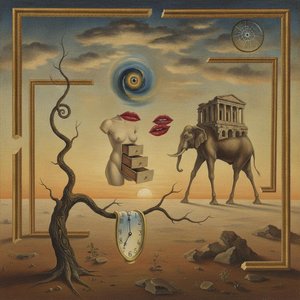
Perceptual art is a form of art that can trace its roots to the art history concepts of perceptualism as well as to twentieth century inventions of conceptual art and performance art. == Perceptualism == The concept of perceptualism has been discusse...
The impulse to trick the eye is as old as the medium of painting itself. Long before the term trompe l'oeil was formalized in the nineteenth century, artists sought to bridge the gap between a flat surface and the three-dimensional world. This pursuit often began with a simple contest of skill. Ancient Greek lore recounts the rivalry between Zeuxis and Parrhasius, where one painter rendered grapes so convincingly that birds descended to peck at them, only to be defeated by a rival whose painted drapery was so realistic that it could not be pulled away from the canvas. This fundamental tension—the struggle between what we know to be paint and what our eyes insist is real—remains the core of perceptual art.
Modern science suggests these illusions are not merely errors in sight but rather the result of the brain using efficient shortcuts. When we encounter a visual paradox, our minds attempt to resolve the discrepancy by applying learned logic to an atypical situation. This process reveals the strengths and limitations of our biological hardware. Whether it is a physical distortion like a stick appearing bent in water or a cognitive trick involving geometric patterns, the goal remains the same: to understand how much we can trust our own senses.
Foundations in Perspective: The Renaissance Pursuit of Depth
Trompe-l'œil (French for 'deceive the eye'; tromp-LOY; French: [tʁɔ̃p lœj] ) is an artistic technique that creates a highly realistic optical illusion of three-dimensional space and objects on a two-dimensional surface. Trompe-l'œil, which is most of...
During the Renaissance, the development of linear perspective transformed the canvas from a symbolic plane into a window. Artists began to apply mathematical rigor to the depiction of space, using vanishing points to organize the composition. This era saw the rise of di sotto in sù, or "from below, upward," a technique used primarily in ceiling paintings to create the impression that the viewer is looking directly into an infinite sky. By manipulating foreshortening and light, painters like Andrea Mantegna and Melozzo da Forlì forced the eye to accept a depth that did not physically exist within the architecture of the room.
This historical mastery of perspective finds a modern echo in the way we engage with contemporary optical illusions. While the Renaissance focused on the structural logic of space, modern perceptual art often focuses on the psychological response to pattern and light. Both eras share a common objective: the use of technical precision to expand the boundaries of the visible world. The disciplined application of shadow and line allows the artist to dictate how a viewer occupies a space, whether that space is a literal cathedral ceiling or a conceptual geometric field.
Architectural Expansion: The Legacy of Quadratura and Ceiling Frescoes
Trompe-l'œil is a 112-meter-long color field painting created in 1998 by Maria Bettina Cogliatti. It overlooks the Katastrophenbucht ("disaster bay") in Zug, Switzerland. == Description == Cogliatti painted Trompe-l'œil in 1998 with acrylic paint on ...
The seventeenth century introduced quadratura, an advanced form of architectural illusionism designed to "open up" walls and ceilings. Through this method, painters like Andrea Pozzo created seamless transitions between real masonry and painted heavens. In the Jesuit churches of Rome, the ceiling appears to dissolve, replaced by a soaring vista of clouds and saints ascending into the divine. This technique requires an absolute command of light and scale, as any error in the vanishing point would instantly shatter the illusion and reveal the flat surface beneath.
This architectural ambition continues in much larger scales today. Consider the work of Maria Bettina Cogliatti, who in 1998 transformed a massive concrete bridge in Switzerland into a color-field mural. By arranging warm and cool tones to simulate a sky transitioning from dusk to dawn, she used trompe l'oeil to create imaginary niches and windows within a solid structure. Just as the Baroque masters used paint to expand the interior of a chapel, modern muralists use it to soften the harshness of urban infrastructure, proving that the desire to find "living space" within a wall is a permanent human instinct.
The Tactile Reality of Still Life: Dutch and Flemish Mastery
A Masterstroke of Illusion: Examining Samuel Dirksz van Hoogstraten’s Trompe-l'oeil Still Life Samuel Dirksz van Hoogstraten (1627 – 1678), a luminary of the Dutch Golden Age, stands as an unparalleled innovator in artistic representation. More than ...
In the Dutch Golden Age, the focus of illusion shifted from the heavens to the tabletop. The development of still life painting allowed masters like Samuel Dirksz van Hoogstraten to explore the textures of the everyday. His work often featured a heavy, ornamented wooden cabinet upon which items like brass lamps, crumpled papers, and draped towels were rendered with such precision that they seemed to occupy the same physical plane as the viewer. This style relied heavily on chiaroscuro—the dramatic contrast between light and shadow—to give weight and volume to inanimate objects.
This dedication to the tactile finds a direct parallel in the work of the American artist William Michael Harnett. Working much later, Harnett applied these seventeenth-century Dutch principles to the mundane objects of his own era: pipes, newspapers, and tobacco pouches. His paintings possess an extraordinary level of realism that borders on the hallucinatory, yet they rely on the same fundamental mechanics of shading and texture as his predecessors. By elevating a simple apple or a worn violin to the status of a focal point, Harnett proves that the power of trompe l'oeil lies not in the grandeur of the subject, but in the precision of the execution.
Surrealism and the Subconscious: Using Realism to Render Dreams
A Doorway to the Subconscious: Exploring Dalí’s “Overture in Trompe l'Oeil” Salvador Dalí, a name synonymous with surrealism, possessed an unparalleled ability to unlock the hidden landscapes of the mind and translate them onto canvas. “Overture in T...
The Surrealist movement took the technical tools of illusion and applied them to the irrational landscapes of the mind. Rather than using trompe l'oeil to replicate the physical world, artists like Salvador Dalí used it to make the impossible feel tangible. In his 1972 work, Overture in Trompe l'Oeil, Dalí presents an arched doorway that appears solid and substantial, yet leads not to another room, but to a psychological threshold. By rendering a metal handle or a stone arch with such photographic accuracy, he anchors the viewer in reality just long enough to make the surreal elements—like a melting clock or a floating bird—feel deeply unsettling.
This use of hyper-realism to serve a dreamscape mirrors the earlier traditions of the Renaissance, though the subject matter has shifted from the divine to the subconscious. Where Mantegna used perspective to show the heavens, Dalí uses it to show the depths of the psyche. The technique remains a vehicle for exploration; the more "real" the objects appear, the more effectively they can disrupt our sense of logic. It is a deliberate use of technical mastery to bypass the conscious mind and tap into the raw imagery of our dreams.
Pop Art and Graphic Deception: Reinterpreting Illusion in the Modern Era
A Playful Deception: Roy Lichtenstein’s “Trompe L'oeil with Leger Head and Paintbrush” Roy Lichtenstein’s 1973 painting, "Trompe L'oeil with Leger Head and Paintbrush," is a dazzling exercise in illusion and a quintessential example of the artist’s e...
In the twentieth century, Pop Art reinterpreted these ancient deceptions through the lens of mass media and consumer culture. Roy Lichtenstein, for instance, utilized the trompe l'oeil tradition to play with the aesthetics of comic books and commercial printing. In works like Trompe L'oeil with Leger Head and Paintbrush, he employs subtle Ben-Day dots and bold color palettes to create an illusion of depth and floating forms. His work does not seek to replicate nature, but rather to mimic the artificial textures of the printed page, turning the "fake" into a subject of serious study.
This modern engagement with artifice completes a long cycle of visual experimentation. From the grapes of Zeuxis to the printed dots of Lichtenstein, the core of the movement remains an investigation into the boundary between the image and the object. Whether through the meticulous glazing of Vermeer or the graphic precision of Pop Art, these artists remind us that the eye is a fallible instrument, and that art's greatest strength lies in its ability to challenge our certainty about what is real.
For those seeking to bring these historical wonders into their own collections, we offer high-quality, hand-painted oil reproductions of these canonical works. Each piece is meticulously crafted on 100% cotton canvas by trained artists, ensuring that the texture and depth of the original are preserved for generations. Whether you desire a classical Dutch still life or a bold Surrealist vision, our studio provides professional customization and global shipping to ensure your investment is handled with museum-grade care. Visit OriginalUniqueArt.com to explore our full catalog of fine art reproductions.
Immerse yourself in the vibrant world of Pop Art with our curated guide to Roy Lichtenstein's top 25 masterpieces. From Ben-Day dots to iconic comic aesthetics, explore the stories behind these legendary works and find museum-quality reproductions. Discover all masterpieces on OriginalUniqueArt.com.
Step into the dreamscape of Salvador Dalí. Explore our curated guide to 25 iconic Surrealist masterpieces, from melting clocks to surreal landscapes. Find inspiration and museum-quality art reproductions for your space. Discover all masterpieces on OriginalUniqueArt.com.

 Trompe-l'œil
 Trompe-l'œil (mural)
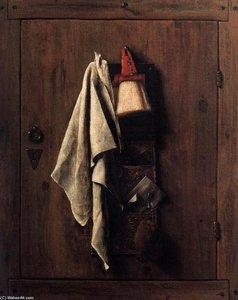 Trompe-l'oeil Still-Life
 Overture in Trompe l'Oeil
 Trompe L'oeil with Leger Head and Paintbrush