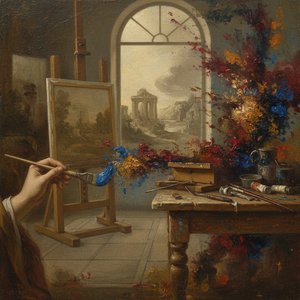
Memento mori (Latin for "remember [that you have] to die") is an artistic symbol or trope acting as a reminder of the inevitability of death. The concept has its roots in the philosophers of classical antiquity and Christianity, and appeared in funer...
To understand the Baroque era, one must first grasp a fundamental Latin injunction that permeated every corner of seventeenth-century life: Memento mori. This phrase, translating to "remember that you must die," was far more than a morbid preoccupation; it was a moral compass. In an age shaped by the religious upheavals of the Counter-Reformation, death was not viewed as a distant event but as a constant, looming presence that demanded immediate spiritual readiness. The Baroque masters did not shy away from this reality; instead, they utilized it to create art that functioned as a visual sermon, urging viewers to look past the fleeting glitter of earthly success toward the permanence of the soul.
This historical impulse finds a modern echo in our contemporary relationship with time and legacy. While we may no longer use skulls as frequent moral warnings, we still seek ways to anchor ourselves against the rapid pace of change. Just as the Baroque painter used the symbol of the hourglass to denote the depletion of life, we look to art to provide a sense of continuity. The tension between the ephemeral moment and the enduring record remains the core of why we preserve these images today.
Visualizing the Inessential: The Iconography of Decay
Skull symbolism is the attachment of symbolic meaning to the human skull. The most common symbolic use of the skull is as a representation of death. Humans can often recognize the buried fragments of an only partially revealed cranium even when other...
The visual language of mortality in Baroque painting is remarkably specific. Artists employed a repertoire of motifs—skulls, bones, wilting flowers, and extinguished candles—to signify the impermanence of all things. A skull, for instance, serves as a dual symbol; it represents both the end of life and the memory of the person who once inhabited that bone. Interestingly, the human brain possesses a specific region for recognizing faces, making the hollow eye sockets of a cranium particularly striking to the viewer, as we instinctively attempt to find a familiar human expression within the bone.
We see this same fascination with symbolic objects in our modern era, though often stripped of their religious weight. Today, we might use photography or digital archives to capture the "vanishing" moments of life, much like the 16th-century Venetian painters used moral allegories to remind patrons of their mortality. The object remains a vessel for meaning, even as the cultural context shifts from theological warning to historical preservation.
A Portrait of Decline: Examining Rubens’ “The Dying Seneca” Sir Peter Paul Rubens' "The Dying Seneca" stands as a monumental achievement in Baroque portraiture, capturing not merely an image but an essence—the poignant confrontation between intellect...
In the works of Peter Paul Rubens, particularly his depiction of The Dying Seneca, the concept of death is elevated from mere decay to a profound philosophical struggle. Rubens captures the Roman philosopher at the moment of his end, utilizing intense chiaroscuro to sculpt the physical toll of mortality upon the body. Here, the decline of the flesh is not presented with horror, but with a heavy, intellectual dignity. The painting reflects the Stoic tradition, where contemplating death was a disciplined practice intended to cultivate resilience and detachment from worldly desires.
This intersection of intellect and mortality mirrors the way we engage with history through classical studies today. When we examine the works of thinkers like Seneca or Marcus Aurelius, we are participating in that same dialogue between the fragility of the human condition and the strength of the human mind. Rubens reminds us that even as the physical form fails, the ideas held by the individual can remain structurally sound within the narrative of art.
The Light of Faith: Aging as a Spiritual Transition
Guido Reni’s *Sts Peter and Paul*: A Baroque Masterpiece of Dramatic Emotion Guido Reni's *Sts Peter and Paul*, painted around the early 17th century, is a profoundly moving work that exemplifies the height of Baroque art. Measuring 197 x 140 cm, thi...
For many Baroque artists, the process of aging was not merely a biological decline but a spiritual progression. In works such as Guido Reni’s Sts Peter and Paul, we see the weight of years reflected in the postures of the saints. St. Peter is often depicted leaning heavily, embodying a sense of earthly weariness and contemplation, while the light illuminates his features to suggest a soul focused on the divine. In this context, the physical thinning of skin or the graying of hair was seen as a shedding of the superficial to reveal the essential.
This perspective offers a profound contrast to modern ageism, which often views the later stages of life through the lens of loss or diminished utility. While contemporary society frequently focuses on the physiological decline of organ function or muscle mass, the Baroque tradition invites us to consider what is gained in wisdom and spiritual depth. The transition into older age, as seen in these sacred canvases, is a movement toward clarity rather than a simple retreat from life.
The Texture of Time: Capturing Physiological Change through Brushwork
The technical mastery of the Baroque period allowed artists to render the physical realities of aging with startling accuracy. Through the use of thick impasto—the application of paint in heavy, textured layers—artists like Rubens could mimic the very texture of weathered skin or the brittleness of bone. The manipulation of light and shadow allowed for a three-dimensional quality that made the wrinkles, shadows, and physical fatigue of an aging subject feel palpable to the viewer.
This dedication to tactile realism is something we still seek in fine art reproductions today. A high-quality oil painting on cotton canvas, with its visible brushstrokes and deep tonal range, provides a depth that a flat digitalprint cannot replicate. When we look at a hand-painted work, we are not just seeing an image; we are seeing the physical accumulation of pigment, much like the accumulated years of a life lived.
Enduring Legacies: The Eternal Presence of the Mortal Image
Paolo Veronese’s "Mortal Man Guided to Divine Eternity" – a stunning Renaissance fresco! Explore its classical beauty, dramatic composition & rich colors. A masterpiece of Venetian art.
Ultimately, the Baroque fascination with memento mori and the gravity of old age serves to immortalize the very subjects it depicts as mortal. By capturing the precise moment of decline or the dignified weight of advanced years, artists like Carlo Maratta and Andrea Sacchi ensured that the essence of their sitters would endure long after their physical forms had returned to dust. The art becomes a bridge between the fleeting present and an eternal history.
As we navigate our own era of rapid technological change, these paintings offer a sanctuary of order and reflection. Whether through a custom portrait commission that transforms a modern memory into a classical style or through the careful preservation of a historical original, the goal remains the same: to find meaning in the face of destiny. The beauty of the Baroque lies not in ignoring death, but in finding the profound dignity within it.
Explore the profound beauty of Memento Mori art. Discover how Baroque masters used symbols of mortality to inspire reflection, and learn to curate meaningful, timeless masterpieces for your home with expert guidance from OriginalUniqueArt.
Immerse yourself in the dramatic splendor of Baroque master, Peter Paul Rubens. Explore 25 iconic paintings, from mythological epics to vibrant portraits. Find inspiration for museum-quality art reproductions and luxury decor. Discover all masterpieces on OriginalUniqueArt.com.
Explore the rich history & techniques of impasto painting – from Renaissance masters to Van Gogh's expressive strokes. Discover how artists use texture to convey emotion and create lasting impact. Learn more!

 Memento mori
 Human skull symbolism
 The Dying Seneca
 Sts Peter and Paul
 Mortal Man Guided to Divine Eternity