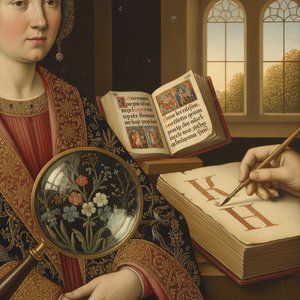
Italian Renaissance painting is the painting of the period beginning in the late 13th century and flourishing from the early 15th to late 16th centuries, occurring in the Italian Peninsula, which was at that time divided into many political states, s...
To understand the weight of a painting, one must first look at how its smallest parts relate to its whole. In the Italian Peninsula, particularly within the cradle of Florence, the transition from the Proto-Renaissance to the High Renaissance was marked by an increasing demand for structural clarity and ornamental depth. This era was not merely about larger subjects, but about a more rigorous way of seeing. Artists began to move away from the flat, symbolic arrangements of previous centuries toward a style where every element possessed its own weight and place within a logical, mathematical space.
This drive toward complexity finds an echo in the way we approach design today. Just as the Early Renaissance masters like Masaccio and Paolo Uccello used geometry to ground their figures, modern architectural design relies on precise proportions to create stability. When we look at a well-constructed room, we are responding to that same fundamental need for order. The complexity of the past was never meant to confuse; it was intended to provide a sense of completeness, where every line and shape contributed to a unified reality.
Chiaroscuro: The Technical Architecture of Light and Volume
In art, chiaroscuro (English: kee-AR-ə-SKOOR-oh, -SKURE-, Italian: [ˌkjaroˈskuːro]; lit. 'light-dark') is the use of strong contrasts between light and dark, usually bold contrasts affecting a whole composition. It is also a technical term used by a...
The mastery of light is perhaps the most significant technical achievement of the Renaissance. Chiaroscuro, derived from the Italian words for light and dark, emerged as a canonical mode alongside techniques like sfumato and cangiante. It is an architectural tool used by painters to build three-dimensional volume on a two-dimensional surface. By managing the gradation of tones, an artist can allow a limb or a cheekbone to emerge from the canvas with a palpable sense of weight. This technique does not rely on harsh outlines but on the soft transition of values that suggests the presence of physical mass.
We see this same principle in the way light interacts with modern sculpture and even photography. The use of light to define form is a universal language. When a photographer uses a single light source to create depth in a portrait, they are utilizing the very same logic established by the Renaissance masters. The goal remains unchanged: to use the contrast between light and shadow to move beyond a mere flat image and toward a sense of true, physical presence.
Microscopic Precision: Capturing Texture and Identity in Portraiture
Bernardino Campi Painting Sofonisba Anguissola is an oil on canvas double portrait from the late 1550s by Sofonisba Anguissola, in which she depicts herself being painted by her teacher, Bernadino Campi. Whitney Chadwick has called this "the first hi...
In the realm of portraiture, complexity often manifests as an intense focus on the minute. A profound example is found in the late 1550s work by Sofonisba Anguissola, specifically her double portrait of Bernardino Campi. In this piece, the level of detail reaches a point of near-microscopic precision. The artist captures the texture of newly sprouted gray hairs on Campi’s head and even the minute amount of gold present on the tip of the brush. Such detail serves to ground the subjects in a tangible reality, making the likeness feel breathing and alive.
This dedication to the small scale finds its parallel in the fine jewelry of the Renaissance, such as intricate filigree work. In both painting and metalwork, the ability to render tiny, complex elements requires immense discipline. When we view these works today, we are not just looking at a face or an object; we are witnessing a celebration of craftsmanship. This level of care is what allows a portrait to transcend a simple likeness and become a historical record of texture, wealth, and individual identity.
Tenebrism: The Dramatic Use of Shadow as Narrative Force
The Grammar of Light: Distinguishing Chiaroscuro from Tenebrism Tenebrism Tenebrism, from Italian tenebroso ('dark, gloomy, mysterious'), also occasionally called dramatic illumination, is a style of painting using especially pronounced chiaroscuro, ...
As the art world moved into the Baroque era, the subtle gradations of chiaroscuro gave way to something more forceful: tenebrism. Derived from the Italian tenebroso, meaning dark or gloomy, this style uses extreme contrasts to focus the viewer's attention with surgical precision. In a tenebrist work, shadows are not merely absences of light; they are active, heavy presences that swallow the background. Caravaggio utilized this technique to direct the eye, using sudden, theatrical beams of light to highlight specific figures and create an immediate sense of religious or emotional drama.
This dramatic use of shadow finds a modern counterpart in the way we perceive tension in visual media. Much like a film noir uses high-contrast lighting to signal danger or mystery, the Baroque painter used darkness to dictate the narrative flow. The difference lies in the intensity. While chiaroscroll builds form through soft light, tenebrism uses the intrusion of darkness to strip away the unnecessary, leaving only the most vital, emotionally charged elements of the composition for the viewer to encounter.
The Language of Ornament: Cartouches and the Evolution of Design
A cartouche (also cartouch) is an oval or oblong design with a slightly convex surface, typically edged with ornamental scrollwork. It is used to hold a painted or low-relief design. Since the early 16th century, the cartouche is a scrolling frame de...
Complexity also flourished in the decorative borders and frames that housed great works. The Renaissance introduced the cartouche, a scrolling frame device derived from the Italian cartuccia. These were more complex than their ancient ancestors, often appearing as symmetrical ovals with elegant scrolls. As time progressed into the Baroque and even the Rococo periods, these devices became increasingly elaborate. Artists like Nicolas Pineau would later take this love for ornamentation to new heights, using intricate carvings to transform static interiors into fluid, organic expressions of luxury.
The evolution of the cartouche demonstrates how ornament can define a space. In contemporary design, we see this in the use of motifs to create brand identity or architectural character. Whether it is a carved wooden panel or a modern graphic element, the use of structured, complex patterns provides a sense of continuity and history. The cartouche reminds us that the frame is never just a border; it is an integral part of the story being told, providing the necessary context for the art it protects.
Discover the enduring elegance of Florence. Explore how Renaissance masterpieces and Italian craftsmanship inspire timeless art collections through museum-quality, hand-painted oil reproductions and bespoke commissions for the discerning collector.
Explore the captivating history of detail in art – from Renaissance masterpieces to modern movements like Precisionism. Discover how specificity shapes narrative, value & collector appeal. Expert insights at OriginalUniqueArt.

 Italian Renaissance painting
 Chiaroscuro
 Portrait of Bernardino Campi Painting Sofonisba Anguissola
 Shadow and Substance: The Technical Precision of Chiaroscuro and Tenebrism in Baroque Painting
 Cartouche (design)