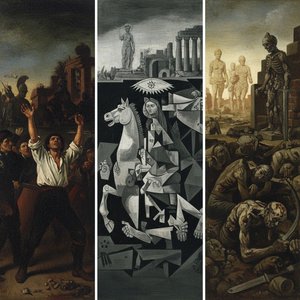
History painting is a genre in painting defined by its subject matter rather than any artistic style or specific period. History paintings depict a moment in a narrative story, most often (but not exclusively) Greek and Roman mythology and Bible stor...
To understand the weight of a canvas, one must first understand the intent behind its creation. For centuries, the genre of history painting was regarded as the highest form of artistic achievement, a status defended by theorists like Leon Battista Alberti in his 1436 treatise De Pictura. He argued that multi-figure narratives were the noblest form of art because they required a mastery of gesture and expression to communicate complex stories. In its earliest iterations, this "story painting" did not focus on recent human events but rather on the eternal truths found in Greek and Roman mythology or the sacred chronicles of the Bible. These works were designed to move the viewer through intellectual contemplation of divine or heroic archetypes.
This tradition finds a distant echo in the way we perceive modern historical records. Just as an ancient viewer sought moral lessons in a depiction of a mythological struggle, we look to contemporary documentation to find meaning in the chaos of the present. The transition from these sacred narratives to more secular subjects marks a profound shift in the human experience. While the Renaissance focused on clarity and proportion, later movements began to use the same narrative structures to explore the grit of human history.
Baroque Drama: Chiaroscuro and the Chaos of Combat
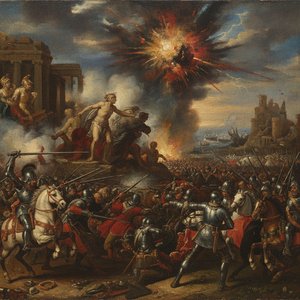
A Symphony of Chaos and Courage: Exploring Salvator Rosa’s “Heroic Battle” Salvator Rosa's "Heroic Battle," painted in 1652, isn't merely a depiction of warfare; it’s a visceral plunge into the heart of conflict—a brutal ballet of desperation and fle...
As the 17th century emerged, the stillness of the Renaissance gave way to a period defined by tension and movement. The Baroque era was an artistic earthquake, fueled by the religious fervor of the Counter-Reformation and the political ambitions of absolute monarchies. Artists no longer sought to present a balanced, static scene; instead, they embraced the theatrical. This was achieved through chiaroscuro—the intense interplay between deep shadows and piercing light—and tenebrism, where darkness becomes a physical presence on the canvas. In battle scenes, this technique allowed painters to thrust the violence of combat into the viewer's immediate space.
The energy of this period is visible in the way figures seem to spiral or explode from a central point, much like the figura serpentina found in Baroque sculpture. When observing a work like Salvator Rosa’s Heroic Battle, one does not see a tidy record of conflict but a visceral plunge into a brutal ballet of desperation. The loose brushwork and vibrant palette of reds and ochres create an immediacy that makes the viewer feel as though they are witnessing the clash unfold. This dramatic intensity mirrors the way we experience sudden, life-altering events today—not as a sequence of facts, but as a sensory overwhelm of light, sound, and motion.
The Romantic Shift: Emotional Truths in the Aftermath of War
The Field of Waterloo is an 1818 history painting by the English artist J. M. W. Turner. It portrays the aftermath of the Battle of Waterloo which took place on 18 June 1815. Rather than the triumphal depictions commonplace in portrayals of the battl...
By the 19th century, the focus of history painting underwent another transformation. The Romantic movement moved away from the structured drama of the Baroque to embrace individual emotion, imagination, and the sublime. While the Baroque artist might use light to highlight a divine victory, the Romantic artist often used it to illuminate tragedy or the haunting silence of loss. This era saw an increased interest in depicting recent history, focusing on the human cost of conflict rather than just the strategic triumph.
A poignant example is J.M.W. Turner’s 1818 work, The Field of Waterloo. Rather than a triumphalist depiction of victory, Turner presents an elegy for the unknown victims of the battle. The background features the ruined farmhouse at Hougoumont, serving as a silent witness to the carnage. This approach finds a modern parallel in the way we process contemporary tragedies through photography and film—not by looking for glory, but by searching for the quiet, human moments left in the wake of destruction. The Romantic masters taught us that the true history of a battle lies in its aftermath and the emotional residue it leaves upon the landscape.
Spiritual Warfare: Biblical Triumphs through a Baroque Lens
Dynamic Depiction of a Biblical Triumph Experience the visceral energy of this powerful Baroque masterpiece, which vividly captures the historic and spiritual victory of Gideon over the Midianites. The scene is alive with movement and emotion, immers...
Even within the realm of secular conflict, the influence of religious narrative remained profound. During the Baroque period, many artists used historical or biblical battles to convey messages of faith and divine intervention. The Counter-Reformation encouraged the Catholic Church to use art as a visual tool for devotion, creating works that were emotionally charged and persuasively grand. These paintings often depicted moments where human bravery intersected with spiritual destiny.
Nicolas Poussin’s 1626 painting, Battle of Gideon Against the Midianites, exemplifies this intersection. The work captures a pivotal biblical victory through a dynamic composition filled with densely packed figures. Through the use of light and shadow, Poussin emphasizes the heroism and faith required to face overwhelming odds. The warm sunset backdrop, blending pinks and golds, symbolizes hope and divine light amidst the chaos. This way of seeing—where a physical struggle is simultaneously a spiritual one—reminds us that even in our most secular conflicts, we often search for a deeper sense of purpose or a higher justice.
The Artist as Witness: Documenting Modern Conflict through Classical Techniques
Kristopher J. Battles: A Marine’s Brushstrokes – Capturing the Essence of War Staff Sergeant Kristopher J. Battles stands as a singular figure in contemporary American art, recognized as one of the last remaining USMC combat artists actively serving ...
The tradition of the artist as a chronicler did not end with the 19th century; it evolved into a specialized role within modern military structures. In the United States, figures like Staff Sergeant Kristopher J. Battles continue this legacy. As one of the remaining combat artists actively serving in the USMC, Battles utilizes representational painting to document the realities of military life. His approach is rooted in the philosophy that true authenticity comes from seeing and experiencing the subject firsthand.
His methodology mirrors the dedication seen in the works of 17th-century military painters like Sauveur Le Conte, who created epic panoramas for the House of Orléans. Both the historical master and the modern combat artist use meticulous detail—from the texture of gear to the expression on a soldier's face—to translate tactical awareness into emotional weight. While the technology of warfare has changed, the fundamental human need to translate the feeling of combat into a permanent, visual record remains unchanged.
The Evolution of Scale: From Monumental Altarpieces to Battlefield Panoramas
A Baroque Masterpiece: The Soul of Schleissheim Nestled within the breathtaking grandeur of the New Schleissheim Palace near Munich, the Staatsgalerie Schleissheim offers far more than a mere viewing of canvases; it provides an immersive descent into...
The physical scale of history painting has always been tied to its ambition. In the Baroque era, large-scale works were often commissioned for grand architectural settings, such as the Staatsgalerie Schleissheim in Germany or the Sint-Jacobskerk in Antwerp. These paintings were designed to interact with their surroundings, sometimes fusing with architecture or utilizing concealed lighting to create a transformative experience. The sheer size of these canvases was intended to overwhelm the viewer, much like the monumental sculptures of Bernini.
This evolution from the intimate religious icon to the massive, multi-panel battlefield panorama reflects a growing desire to capture the breadth of human experience. Whether it is the intricate, small-scale ivory carvings of the Southern Netherlands or the sprawling, multi-figure compositions of the 19th century, the scale serves the story. As we look back on these works through our collection at OriginalUniqueArt.com, we see that whether a painting covers a single saint or an entire battlefield, its true purpose is to provide a window into the enduring drama of the human condition.
Explore the profound depth of historical conflict through masterworks of art. From Baroque drama to Romantic realism, discover how legendary painters captured the essence of struggle and human resilience in breathtaking oil reproductions.
Journey through the Golden Age with our guide to the Top 10 Dutch Baroque masterpieces! Explore iconic paintings by Rembrandt, Vermeer & Frans Hals. Find museum-quality art reproductions and elevate your home decor at OriginalUniqueArt.com.
Embark on a visual journey through history's most powerful war paintings. Explore the dramatic mastery of Romanticism and Realism through expert analysis of epic battle scenes on canvas, celebrating the profound emotion and artistry behind art history's greatest military masterpieces.

 History painting
 Heroic Battle
 The Field of Waterloo (painting)
 Battle of Gideon Against the Midianites
 Staff Sergeant Kristopher J. Battles Usmcr
 Staatsgalerie Schleissheim