The Poetry of Grey: Mastering Atmosphere and Light in the Hague School Art Movement
Explore the soulful essence of the Hague School. Dive into a masterclass on 19th-century Dutch realism, uncovering how masters like Anton Mauve captured the 'Poetry of Grey' through atmospheric light and moody landscapes. Discover timeless beauty for your modern collection.
The Poetry of Grey: Defining the Hague School's Atmospheric Essence Capturing the Grey Light: A Journey Through the Soulful Atmosphere of the Hague School The Poetry of Grey: Discovering the Soulful Essence of the Hague School Capturing the Grey Ligh...
To step into a landscape painted by the Hague School is to enter a world where the air itself possesses weight, moisture, and a profound sense of quietude. Emerging in the mid-1 and 9th century, this movement did not merely seek to document the scenery of the Low Countries; it sought to translate the very breath of the nation onto canvas. There is a certain melancholy, yet a profound peace, found in these works. Unlike the vibrant, sun-drenched celebrations often found in Mediterranean art, the Hague School finds its heartbeat in the overcast. It is a movement that invites the viewer to slow down, to breathe with the rhythm of the tides and the swaying reeds. The essence of this era lies in what critics famously called the Poetry of Grey. These artists mastered the ability to find beauty not in the spectacular or the bright, but in the subtle, the muted, and the understated. In their hands, a silver-toned haze becomes a medium for emotion, where the boundary between earth and sky often dissolves into a seamless, ethereal mist.
Beyond the Golden Age: The Shift from Meticulous Detail to Realist Emotion
The Rise of Realism: Challenging Tradition in Dutch Art Wikipedia: Hague School The Hague School (Dutch: Haagse School) is a group of artists who lived and worked in The Hague between 1860 and 1890. Their work was heavily influenced by the realist pa...
For centuries, Dutch art had been synonymous with meticulous detail, with the Golden Age masters celebrated for their precise renderings of everyday life and biblical scenes. However, by the mid-19th century, a quiet revolution was brewing that would challenge these established norms and pave the way for a new era in Dutch painting: the rise of Realism. This wasn’t a sudden upheaval, but rather a gradual shift away from idealized representations towards a more honest depiction of the world—a desire to capture not just what things looked and looked like, but how they felt. The Hague School artists sought something more immediate, more grounded in their own experiences and surroundings. They looked not to grand narratives, but to the quiet beauty of the Dutch countryside, the ruggedness of the coastline, and the dignity of labor. This movement was heavily influenced by the realist painters of the French Barbizon school, moving away from historical or literary themes toward an authentic portrayal of life as it truly was, driven by a growing sense of social consciousness and an interest in the lives of ordinary people.
Masters of the Mist: Key Artists and Their Visual Legacy
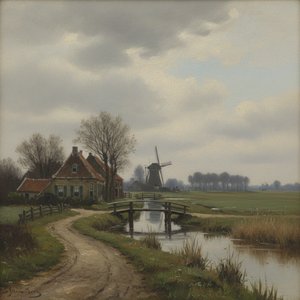
A Dutch Road by Anton Mauve: Echoes of Impressionism in Rural Tranquility Led by Anton Mauve, the group of Dutch painters known as the Hague School distinguished itself by its exceptional rendering of moody atmosphere and light. As a Dutch critic wro...
The movement was anchored by a group of brilliant minds who lived and worked in The Hague between 1860 and 1890. Led by figures such as Anton Mauve, the group distinguished itself through its exceptional rendering of moody atmosphere and light. Mauve’s work, such as his iconic A Dutch Road, exemplifies an unwavering commitment to capturing the essence of nature, using a characteristic palette that reveals the profound emotional resonance of a solitary road winding into the distance beneath an overcast sky. Alongside him, artists like Willem Maris brought a stunning sense of rural life and serene beauty to the canvas, while Jan Weissenbruch utilized watercolors to capture the romantic mood of twilight scenes. Even though some figures, like Jan Willem van Borselen or the tragically short-lived Johan Daniel Koelman, may be overshadowed by the giants of the era, their serene canvases offer vital glimpses into Holland's tranquil beauty. These artists collectively created a visual language that prioritized tone over color, ensuring their legacy would remain etched in the silver-toned textures of the Dutch landscape.
Capturing the Soul of the Landscape: Technique, Tone, and Light
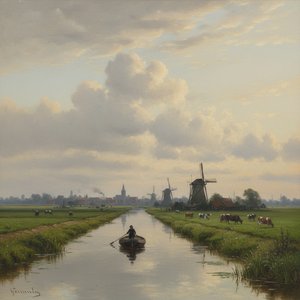
Discover "A Dutch Landscape" by Willem Maris – a stunning Hague School painting of rural life, light, and serene beauty. Explore this timeless masterpiece.
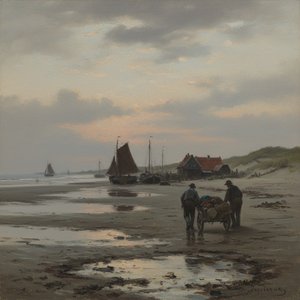
The technical brilliance of the Hague School lies in its mastery of atmospheric perspective—the art of placing distant objects in paler, more muted hues to simulate depth and create a sense of vastness. These painters preferred to work out-of-doors, remaining true to the tonality of the Dutch countryside, which is perpetually affected by a moist, heavy climate. Their technique often involved loose and expressive lines that suggest brushstrokes rather than precise detail, allowing the texture of the paint to contribute to the sense of moisture and weight in the air. By prioritizing tone above color, they achieved a level of realism that felt tactile; you can almost feel the damp earth and the chill of the mist. This focus on the subtle gradations of light—the way it pierces through heavy clouds to touch the ground—creates a sense of Impressionistic Light that bridges the gap between pure Realism and the dawn of Impressionism, making every canvas an invitation to find solace in the soft edges of a world caught in transition.
Modern Remixes: Bringing the Hague School Aesthetic into Contemporary Interiors
The Essence of the Hague School: Atmospheric Depth for Sophisticated Hospitality Interiors Capturing the Grey Light: A Journey Through the Soulful Atmosphere of the Hague School The Poetry of Grey: Discovering the Soulful Essence of the Hague School ...
While the Hague School is rooted in the 19th century, its aesthetic remains incredibly potent for the modern, design-conscious collector. The "Grey School" offers a sophisticated, calming energy that serves as a perfect anchor for contemporary spaces. In an era of high-impact, digital saturation, the understated elegance of a Hague School reproduction provides a much-needed moment of quietude and luxury. For those looking to bridge the gap between historical depth and modern flair, we offer the ability to remix art history. Imagine transforming a personal photograph into a piece that carries the heavy, textured impasto of these Dutch masters, or applying a "Period Shift" to bring a contemporary subject into the moody, silver-toned atmosphere of the 1870s. Whether through large-format murals for premium hotel designs or custom multi-panel sets that flow across a modern staircase, the soulful essence of the Hague School continues to find new life, proving that true atmospheric beauty is timeless.
Discover Johan Hendrik Weissenbruch (1824-1903), a leading Dutch Hague School painter renowned for his atmospheric watercolours & oil landscapes. Explore his beautiful depictions of the Dutch countryside and skies – a master of light & detail.
Explore the captivating world of Jan Hendrik Weissenbruch, a master of Dutch Realism. Discover his atmospheric landscapes, influences, and legacy within the Hague School. Learn about this 19th-century artist's unique style & enduring impact.
Explore the captivating world of Jacob Henricus Maris, a leading figure of the Dutch Hague School. Discover his atmospheric landscapes, signature brushstrokes & lasting influence on 19th-century art. Learn more at OriginalUniqueArt.
Elevate hospitality interiors with the atmospheric beauty of Hague School landscapes. APS offers premium, hand-painted Dutch art reproductions for professional designers. Benefit from custom sizing, bulk order reliability, and seamless global shipping for large-scale hotel projects.

 The Hague School: Capturing the Atmospheric Soul and Grey Light of the Dutch Landscape
 The Hague School: Realism, Atmosphere & the Dawn of Dutch Impressionism
 A Dutch Road
 A Dutch Landscape
 The Hague School: Integrating Atmospheric Dutch Landscapes into Premium Hotel Design Projects