The Dawn of a New Era: From Romanesque Shadows to Gothic Light Shadows & Splendor: A Journey Through the Soul of Gothic Art and Architectural Grandeur The Divine Ascent: From Romanesque Shadows to Gothic Light The Shadow of Faith: Exploring Gothic Ar...
Before the twelfth century, the European landscape was defined by a sense of heavy, earth-bound permanence. The Romanesque style, with its thick limestone walls and narrow windows, created interiors of profound shadow and monastic seclusion. These structures functioned almost as stone fortresses, designed to shield the faithful from an uncertain world through sheer mass and impenetrable strength. In this era, the divine was felt through the weight of the architecture itself, a somber stability that mirrored the gravity of existence.
As the High Middle Ages progressed, particularly in the Île-de-France, a fundamental shift in human consciousness began to stir. This was not merely a change in masonry but a theological revolution. Architects sought to bridge the gap between the earthly and the eternal through the medium of light. The heavy shadows of the Romanesque gave way to an ambition where light itself was viewed as a divine presence. This transition marked the birth of the Gothic, an era where the boundaries of stone seemed to dissolve, allowing the soul to ascend toward the heavens alongside the eyes.
The Sacred Crucible: Scriptoriums and the Preservation of Eternal Truths
Origins and the Dawn of Illuminated Script Within the shadowed halls of medieval monasteries, a remarkable tradition blossomed – the art of the scriptorium. More than simply a room for copying manuscripts, it was a crucible where faith, scholarship, ...
Within the shadowed halls of medieval monasteries, a remarkable tradition blossomed in spaces far removed from the noise of the physical world. The scriptorium was more than a room for transcription; it was a sacred crucible where faith, scholarship, and artistry converged. In institutions such as the North Western Italy Scriptorium, the act of copying text was viewed as a liturgical performance. Every stroke of the quill was an exercise in spiritual endurance, a way to etch eternal truths onto the very fabric of history.
This monastic labor finds its echo in the meticulous care we bring to art today. Just as the medieval scribe prepared parchment with precise tools and ruled lines to ensure alignment, the modern preservation of beauty requires a similar disciplined stillness. The monks sought to protect classical knowledge from the erosion of time, much like how we strive to maintain the integrity of historical aesthetics in our contemporary reproductions. The legacy of these workshops remains etched not just on parchment, but in the very idea that meticulous craftsmanship is a form of devotion.
Defying Gravity: Structural Innovations in Stone and Page
Gothic architecture is an architectural style that was prevalent in Europe from the late 12th to the 16th century, during the High and Late Middle Ages, surviving into the 17th and 18th centuries in some areas. It evolved from Romanesque architecture...
The transition from Romanesque solidity to Gothic aspiration was made possible by a series of brilliant structural innovations that allowed architects to defy gravity. The defining characteristic of this movement, the pointed arch, was far more than a stylistic choice; it was a mathematical necessity that supported heavier loads than its rounded predecessors. When combined with rib vaults—where the ceiling surface is divided into webs by a framework of diagonal arched ribs—and flying buttresses, which pushed the weight of upper walls outward, the heavy stone began to feel weightless.
We see this same pursuit of structural elegance in the miniature world of manuscript illumination. In works like the Bifolium with the Decretals of Gratian, created around 1290 by Master Honoré, the artist uses an elegant line and a clear, almost cartoonlike presentation to create a legible narrative. Just as the flying buttress supports the soaring height of a cathedral, the careful composition of a miniature supports the weight of complex theological commentary. Both the architect and the illuminator use geometry to transform heavy materials into something that appears to reach toward the infinite.
Luminous Alchemy: The Interplay of Stained Glass and Page
The Silent Crucible: Entering the Medieval Scriptorium North Western Italy Scriptorium Origins and the Dawn of Illuminated Script Within the shadowed halls of medieval monasteries, a remarkable tradition blossomed – the art of the scriptorium. More t...
In the heart of the Gothic era, light was far more than a physical phenomenon; it was a manifestation of the divine. This luminosity was achieved through a sophisticated alchemy of minerals and metals. In cathedrals, expansive stained-glass windows, made possible by new stone tracery, transformed the interior into a celestial glow. Sunlight filtering through these windows bathed the nave in color, turning heavy stone into a luminous vessel.
This same transformative power is found in the pages of illuminated manuscripts. The term illumination itself refers to the ability to make a page glow as if caught in a permanent state of dawn. This was achieved by layering gold leaf to catch flickering candlelight, creating a shimmering effect that suggested the divine was physically present within the text. Whether it is the light through the Rose Window of Notre-Dame de Paris or the gold leaf in a Gradual from Santa Maria degli Angeli, the goal remains the same: to use light to bridge the gap between the earthly realm and the celestial.
Narratives in Miniature and Stone: The Human Face of the Divine
A Sacred Moment Captured in Gold and Silk In the quiet, hallowed atmosphere of a fourteenth-century Florentine scriptorium, a master was at work, weaving divinity into the very fibers of parchment. Don Silvestro dei Gherarducci , a monk whose name ca...
Despite the grand scale of cathedrals, Gothic art often found its most intimate expressions in small, detailed figures. In sculpture, such as Claus Sluter’s work, biblical figures were rendered with life-sized presence and expressive facial emotions, ranging from sorrow to ecstasy. Similarly, in the pages of a Book of Hours, miniature illustrations provided a personal way for laypeople to engage with sacred stories through delicate, humanized imagery.
This intimacy is mirrored in the fine details of manuscript painting, where the flesh-tints are often laid over a ground of olive or green to create depth. In the works of Don Silvestro dei Gherarducci, such as the depiction of the Birth of the Virgin, we see a mastery of both the monumental and the minute. The artist captures profound cosmic significance within the small scale of an initial letter, using flowing drapery and expressive gestures to remind the viewer that the divine is intimately connected to the human experience. Through these windows of art, the grand history of the Gothic era remains accessible, personal, and profoundly moving.
Explore the luminous elegance of Late Gothic art. Discover a profound journey through illuminated manuscripts, sacred architecture, and the transition from medieval symbolism to Renaissance naturalism with our expert-led historical exploration.
Explore the spiritual majesty of High Medieval art. From Gothic cathedral architecture to the luminous gold of Byzantine-inspired masterpieces, discover the history, theology, and breathtaking craftsmanship that defined an era of divine light and architectural innovation.
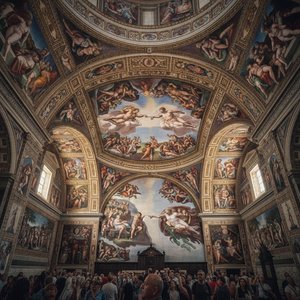
Step into the divine beauty of the Sistine Chapel. Explore 25 iconic Renaissance masterpieces by Michelangelo and beyond. From breathtaking frescoes to timeless legends, find inspiration for museum-quality art reproductions and decor. Discover all masterpieces on OriginalUniqueArt.com.

 Gothic Grandeur: Exploring the Spiritual Majesty and Architectural Innovation of Medieval Masterpieces
 North Western Italy Scriptorium
 Gothic architecture
 Gilded Glory: The Intricate Craft and Spiritual Power of Medieval Illuminated Manuscripts
 Manuscript Illumination with the Birth of the Virgin in an Initial G, from a Gradual