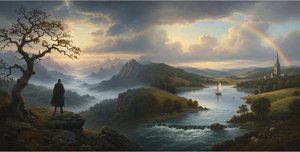
German Romanticism (German: Deutsche Romantik) was the dominant intellectual movement of German-speaking countries in the late 18th and early 19th centuries, influencing philosophy, aesthetics, literature, and criticism. Compared to English Romantici...
The late eighteenth century brought with it a profound shift in European thought, a movement that sought to reclaim the mysteries lost to the cold logic of the Enlightenment. As scientific rationalism began to map the physical world with increasing precision, a growing sense of disillusionment took hold among those who felt that the soul was being left behind. This era, known as German Romanticism, did not merely seek to decorate the canvas; it sought to re-enchant the world. It was a revolt against the encroating soot of the Industrial Revolution and the rigid structures of capitalism, favoring instead the intuitive, the irrational, and the spiritual.
This cultural tension finds its historical echo in the Sturm und Drang movement, which preceded the height of Romanticism. Just as the early writers of that era criticized the limitations of pure reason through works like Goethe’s The Sorrows of Young Werther, the Romantic painters turned their gaze toward the untamed and the unknown. They moved away from the manicured, orderly gardens of Neoclassicism to find truth in the ruggedness of a mountain peak or the obscurity of a morning mist. In doing this, they established a new way of seeing, where the objective fact of a tree was secondary to the emotional weight it carried within the human heart.
Nature as Divine Mirror: The Symbolic Landscapes of Caspar David Friedrich
A Solitary Vision: The Life and Art of Caspar David Friedrich Born in the Baltic port city of Greifswald in 1774, Caspar David Friedrich’s life was steeped in a melancholic atmosphere that would profoundly shape his artistic vision. His early years w...
For Caspar David Friedrich, the natural world was never a mere backdrop for human activity; it was a sacred text waiting to be read. Born in Greifswald, his early encounters with loss and the stark beauty of the Baltic coast shaped a vision where every element of the landscape functioned as a symbol of the divine. In his work, a barren tree or a crumbling Gothic ruin is not simply an object of decay, but a meditation on mortality and the persistence of spirit. He viewed nature as a revelation of God, a belief nurtured by his studies under theologians and artists who saw the landscape as a conduit for spiritual connection.
We see this profound symbolic language mirrored in the works of later artists like Friedrich Carl Albert Schreuel, who, while favoring a softer, more intimate palette, shared this preoccupation with the sublime. Where Friedrich might use a towering fir tree to represent resilience, Schreuel utilized mist-shrouded valleys to evoke a similar sense of spiritual yearning. Both artists understood that to paint a landscape was to map the interiority of the human condition, using the external world to articulate truths that words often fail to capture.
Technique and Atmosphere: Capturing Light and Mist in the Romantic Tradition
A Frozen Psalm: Unveiling Caspar David Friedrich’s ‘Winter Landscape’ Caspar David Friedrich's 'Winter Landscape,' painted in 1811, isn’t merely a depiction of snow and trees; it’s an invitation to contemplate the sublime—a profound meditation on nat...
The power of a Friedrich painting lies as much in its technical execution as in its subject matter. He moved away from the meticulous, literal detail of his predecessors, opting instead for a technique that prioritized atmosphere over precise representation. In works such as Winter Landscape, painted in 1811, he employed delicate layers of thin washes and the translucent blue of smalt pigment to mimic the dissolving textures of melting snow and the ethereal quality of distant mountains. His use of light was not merely a tool for visibility but a primary subject in itself—a way to illuminate the boundary between the physical and the metaphysical.
This mastery of atmosphere finds a technical parallel in the English watercolor traditions that influenced many of his contemporaries. Artists like J.M.W. Turner pushed the boundaries of light and color even further, dissolving form into pure atmospheric effect. While Friedrich’s approach remained more structured and symbolic, both shared a commitment to conveying the sensation of weather, temperature, and light. This dedication to the sensory experience ensures that when we view these works, we do not just see a scene; we feel the dampness of the fog and the biting chill of the winter air.
The Shadow of the Soul: Exploring Dark Romanticism and Human Fragility
Dark Romanticism is a literary sub-genre of Romanticism, reflecting popular fascination with the irrational, the demonic and the grotesque. Often conflated with Gothic fiction, it has shadowed the euphoric Romantic movement ever since its 18th-centur...
While much of Romanticism celebrates the sublime beauty of nature, there exists a darker, more unsettling current within the movement. Dark Romanticism emerged as a fascination with the irrational, the grotesque, and the psychological weight of human fallibility. This sub-genre explored themes of guilt, sin, and the terrifying aspects of the psyche, often utilizing imagery of ghosts, ruins, and shadows to provoke a sense of dread. It was a recognition that the same nature that inspires awe can also inspire terror.
This fascination with the darker side of existence finds its literary counterpart in the works of Edgar Allan Poe. Much like Poe’s exploration of madness and the macabre, Dark Romantic painters utilized the landscape to reflect the fractured state of the human soul. They embraced the tension between the conscious and the subconscious, using the shadows of a forest or the gloom of a graveyard to represent the unseen forces that govern human destiny. In these works, the sublime is not found in light, but in the overwhelming weight of the unknown.
Spiritual Solitude: The Role of the Rückenfigur in Viewer Engagement
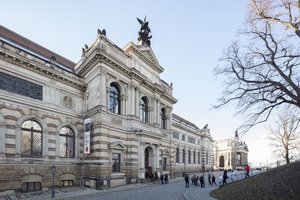
A Sanctuary of German Art: Exploring the Albertinum Nestled within the magnificent Renaissance Revival building on Brühl’s Terrace – affectionately known as the “Balcony of Europe” for its breathtaking views over the Elbe River – the Albertinum in Dr...
One of Friedrich’s most significant contributions to the language of painting was the use of the Rückenfigur—a figure seen from behind, looking into the landscape. By placing a solitary individual with their back to the viewer, Friedrich creates a compositional bridge. We do not merely observe the character; we are invited to inhabit their perspective. This technique reduces the human figure to a scale that directs our gaze toward the metaphysical, forcing us to share in their moment of profound contemplation and isolation.
This invitation to participate in the artwork is echoed in the way we interact with modern museum spaces like the Albertinum in Dresden. The museum does not simply present objects for observation; it curatorialy arranges them to foster a dialogue between the viewer and the history of German art. Just as the Rückenfigur pulls us into the mist of a Friedrich landscape, the thoughtful arrangement of works in a gallery encourages an internal journey, prompting us to consider our own place within the vastness of time and nature.
Enduring Legacies: From the Albertinum to Modern Interpretations of Nature
Romanticism (also known as the Romantic movement or Romantic era) was an artistic and intellectual movement that originated in Europe towards the end of the 18th century. The purpose of the movement was to advocate for the importance of subjectivity,...
The influence of German Romanticism extends far beyond the nineteenth century, leaving an indelible mark on the trajectory of modern art. The movement’s emphasis on subjectivity and emotion paved the way for Expressionism and even Surrealism, as artists continued to explore the boundaries between reality and the imagination. Even today, in an age defined by rapid technological advancement and digital connectivity, the themes explored by Friedrich—solitude, the search for meaning, and our relationship with the natural world—remain deeply resonant.
We see this enduring relevance in the way contemporary society grapples with environmental change and the loss of wild spaces. The Romantic impulse to protect and reverence the natural world is a direct ancestor to modern conservation efforts. As we navigate a world that often feels increasingly disconnected from the physical earth, the quiet, steadfast landscapes of the German Romantics serve as a necessary reminder of the enduring power of the sublime and the necessity of looking inward to find our way back to the world around us. For those seeking to bring this sense of historical depth into their own environments, OriginalUniqueArt.com offers a curated selection of hand-painted reproductions that honor these classical traditions.
Journey through the sublime beauty of Romantic landscape paintings. Explore 10 iconic masterpieces, from Caspar David Friedrich to dramatic nature scenes, perfect for museum-quality decor. Discover the stories and techniques behind these timeless works on OriginalUniqueArt.com.
Explore the profound emotional power of Romantic landscape art. Discover how masters like Friedrich captured the sublime through breathtaking nature, and learn to curate these evocative masterpieces for your luxury interior collection.
Explore the profound emotional power of Romanticism. From the sublime landscapes of Paul Huet to Goya's dramatic mastery, discover how this era revolutionized art through passion, intuition, and nature. Expert insights for classic art enthusiasts and collectors.

 German Romanticism
 Caspar David Friedrich
 Winter landscape
 Dark Romanticism
 Albertinum
 Romanticism