--- title: France, 1800–1900 A.D. | Chronology | Heilbrunn Timeline of Art History | The Metropolitan Museum of Art url: https://www.metmuseum.org/toah/ht/10/euwf.html hostname: metmuseum.org description: “At the turn of the nineteenth century, Franc...
To understand the seismic shifts of the nineteenth century, one must first stand before the rigid, polished surfaces of the Académie Royale de Peinture et de Sculpture. Established in 1648, this institution functioned as the arbiter of French taste, enforcing a standard where clarity, historical gravity, and idealized forms reigned supreme. The art of this era was not meant to reflect the messy particulars of a single moment, but to reach for the eternal truths found in Greek and Roman antiquity.
At the center of this disciplined world stood Jacques-Louis David. His canvases, such as The Oath of the Horatii (1784-85), utilized precise brushwork that effectively hid the artist's hand, presenting a finished surface that felt as immutable as stone. There was a profound sense of balance and moral weight in these works; every line served a purpose, and every composition adhered to the strictures of linear perspective. Even when David turned his gaze toward the immediate chaos of the French Revolution with The Death of Marat (1793), he did so through a lens of stark, sculptural clarity.
This period was defined by an obsession with the ideal. Artists like Jean-Auguste- Dominique Ingres continued this lineage, often pushing the boundaries of anatomical accuracy to achieve a more graceful, albeit impossible, elegance, as seen in La Grande Odalisque (1814). It was a world of controlled light and heavy shadows, where the subject matter was elevated by its connection to classical myth and historical significance.
A Surge of Emotion: The Romantic Rebellion
As the nineteenth century progressed, the rationalism of Neoclassicism began to feel insufficient for an era defined by social upheaval and the weight of human experience. A new movement, Romanticism, emerged not as a rejection of skill, but as a redirection of intent. Where the Academy sought order, the Romantics sought the sublime. They turned away from the cold perfection of ancient statues toward the turbulent energy of nature and the raw intensity of the human psyche.
Theodore Géricault provided one of the most visceral departures from academic tradition with The Raft of the Medusa (1818-19). This work did not offer a sanitized historical lesson; instead, it presented the harrowing, unvarnified reality of a contemporary shipwreck, heavy with political critique and physical desperation. The composition was no longer a stable triangle of figures but a dynamic, swirling mass of limbs and struggle.
Following this path, Eugène Delacroix infused his work with a different kind of energy. In La Liberté guidant le peuple (1830), the allegorical figure of Liberty is not a distant, marble goddess, but a gritty, moving force amidst the smoke of Parisian streets. The brushwork became more expressive, and the palette more emotive, allowing the artist to capture the heat of revolution and the unpredictable movement of life itself.
Unvarnished Truth: Realism and the Contemporary Lens
By the mid-nineteenth century, the romanticized drama of the previous generation faced a new challenger: Realism. This movement stripped away layers of myth and allegory to focus on the tangible, often difficult, realities of the present day. The goal was no longer to depict how the world should be, but to document exactly how it appeared to those living through it, particularly the working classes and the rural landscape.
Gustave Courbet became the face of this uncompromising approach. His work, such as The Origin of the World (1866), challenged the very foundations of what was considered "appropriate" for fine art. By focusing on contemporary subjects without the softening lens of idealization, Courbet forced the public to confront the physical truth of their own era. This period saw a shift in focus from the grand historical stage to the dirt, the labor, and the everyday existence of the common person.
This movement acted as a necessary bridge, breaking the monopoly of the Academy's themes and preparing the ground for even more radical departures. It introduced a level of social honesty that would eventually allow later artists to abandon representational accuracy altogether in favor of pure sensory experience.
The Play of Light: Impressionism’s Fleeting Vision
Impressionism was a 19th-century art movement characterised by visible brush strokes, open composition, emphasis on accurate depiction of light in its changing qualities (often accentuating the effects of the passage of time), ordinary subject matter...
The late nineteenth century brought about perhaps the most recognizable revolution in French art history: Impressionism. Moving away from the dark, studio-bound traditions of the past, a group of artists including Claude Monet, Pierre-Auguste Renoir, and Alfred Sisley took their easels outdoors. They practiced en plein air painting, an approach that allowed them to observe the rapid, transient changes in light and atmosphere as they actually occurred.
The name itself was born from a moment of critique. When Louis Leroy viewed Monet’s Impression, Sunrise (1872), he used the term "Impressionism" as a slight, mocking the lack of detail and the seemingly unfinished nature of the work. Yet, it was precisely this "unfinished" quality that defined the movement. These artists utilized short, broken brushstrokes and unblended colors to capture the vibration of light on water or the soft glow of dusk.
In works like Renoir’s Bal du moulin de la Galette (1876), we see a celebration of modern Parisian life, where dappled sunlight filters through trees to dance across moving figures. There is an obsession with optical truth—the way the eye perceives color in motion rather than how the mind knows a shape to be structured. This era transformed the canvas from a window into a historical narrative into a surface that records the very sensation of sight.
Beyond the Surface: Post-Impressionism and the Architecture of Form
Post-Impressionism (also spelled Postimpressionism) was a predominantly French art movement which developed roughly between 1886 and 1905, from the last Impressionist exhibition to the birth of Fauvism. Post-Impressionism emerged as a reaction agains...
As the century drew to a close, a sense of dissatisfaction began to grow among artists who felt that Impressionism, while masterful at capturing light, had lost the structural integrity of the subject. The movement of Post-Impressionism emerged between 1886 and 1905 as a collection of individualistic responses to this perceived lack of permanence. These artists sought to move beyond mere naturalism to find something more symbolic or structured.
Paul Cézanne, often regarded as the father of modern art, attempted to "make of Impressionism something solid and durable." He did not abandon the bright palette of his predecessors, but he applied it to a rigorous study of form, reducing objects to their fundamental geometric essences. His work laid the groundwork for the fragmentation that would later define Cubism.
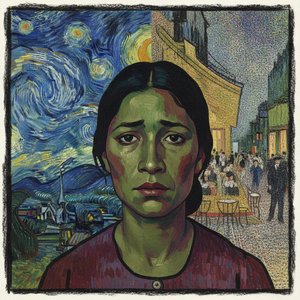
Others took different paths toward abstraction. Georges Seurat pioneered Neo-Impressionism through Pointillism, using tiny, systematic dots of color to create a scientific, luminous effect. Meanwhile, Vincent van Gogh used thick, impasto brushstrokes and emotive colors to convey his internal psychological state, moving the focus from the external world to the landscape of the soul. This period acted as the final bridge, connecting the sensory observations of the nineteenth century to the conceptual revolutions of the twentieth.
Dive into the high-energy revolution of Post-Impressionism. Discover how masters like Cézanne and Van Gogh traded fleeting light for bold colors and raw emotion, forever recharging modern art with the vibrant, structural intensity that defines today's most iconic visual aesthetics.
Explore the captivating world of 19th-century painting! Discover Realism & Impressionism's revolutionary techniques, key artists like Manet and Monet, and their lasting impact. A comprehensive guide for art enthusiasts.
Explore the world of Academic Art! Discover its history, key artists like Ingres & Bouguereau, defining techniques, and lasting influence on 19th-century painting. Learn about the Salon system and its legacy.

 Impressionism
 Post-Impressionism