The Humanist Revolution: Rediscovering Classical Antiquity
 Renaissance
The Renaissance (UK: rin-AY-sənss, US: REN-ə-sahnss) was a European period of history and cultural movement taking place at the end of the Late Middle Ages and the beginning of the early modern era. It is variously defined as covering the 15th and 16...
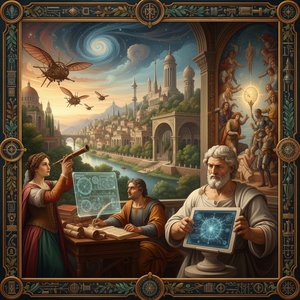
To understand the dawn of realism, one must first look back to the shadows of the Late Middle Ages, a period where art often served as a symbolic, flattened window into the divine rather than a mirror of our physical world. The Renaissance emerged not merely as a change in style, but as a profound intellectual rebirth known as Humanism. This movement, rooted in the rediscovery of classical Greek and Roman philosophy, shifted the focus of the universe from the purely celestial to the human experience. As scholars like Petrarch breathed life into ancient texts, artists began to embrace the concept that man is the measure of all things. This was a seismic shift in consciousness; the divine was no longer found only in gold-leafed icons, but in the anatomical precision of a muscle, the weight of a draped cloth, and the palpable emotion of a human face.
This era of rediscovery brought with it a renewed reverence for the achievements of antiquity. The Florentine masters did not merely copy the ancients; they engaged in a sophisticated dialogue with them. By studying the proportions of Roman sculpture and the architectural logic of classical ruins, painters and sculptors began to imbulate their works with a sense of dignity and permanence. This intellectual fervor transformed the artist from a mere craftsman into a philosopher of sight, capable of capturing the very essence of humanity through the lens of classical wisdom.
The Science of Sight: The Emergence of Linear Perspective
--- title: Early Applications of Linear Perspective (article) | Khan Academy url: https://www.khanacademy.org/humanities/renaissance-reformation/early-renaissance1/beginners-renaissance-florence/a/early-applications-of-linear-perspective hostname: kh...
If Humanism provided the soul of the Renaissance, then the development of linear perspective provided its skeleton. Before this mathematical revolution, depth in painting was often intuitive or hierarchical, with importance denoted by size rather than distance. However, the early 15th century witnessed a breakthrough that would forever alter the viewer's relationship with the canvas. Through the experimental brilliance of figures like Filippo Brunelleschi, the concept of a single vanishing point was established, allowing artists to construct a mathematically coherent three-dimensional space on a two-dimensional surface.
This was more than a technical trick; it was a way of organizing reality itself. The application of linear perspective allowed for the creation of deep, receding landscapes and architectural vistas that invited the viewer to step into the painting. As the eye traveled along orthogonal lines toward a central point, the boundary between the real world and the painted world began to dissolve. This scientific approach to art demanded a new level of precision, bridging the gap between the artist's studio and the laboratory, and ensuring that every element within a composition occupied its rightful place in a logical, measurable universe.
Florentine Innovation: The Legacy of the Bottega and Italian Manufacture
 italian manifacture
Italian Manufacture: A Legacy of Renaissance Craftsmanship Italian manufacture represents more than just a production process; it embodies centuries of artistic tradition and meticulous skill—a cornerstone of European culture during the Renaissance. ...
The breathtaking beauty of the Renaissance was not born in isolation but within the vibrant, industrious atmosphere of the Florentine bottega. These artisan workshops were the crucibles of innovation, where the traditions of Italian manufacture flourished. In these bustling spaces, the distinction between fine art and high craftsmanship was beautifully blurred. A workshop was a place of rigorous apprenticeship, where masters oversaw the training of young talents, passing down secrets of pigment preparation, marble carving, and textile weaving. It was here that the meticulous skill required to transform raw materials—be it Carrara marble or precious silk—into objects of breathtaking sophistication was perfected.
This culture of excellence extended far beyond the canvas. The Florentine tradition prioritized a dedication to disegno, or design, emphasizing structural integrity and preparatory drawing as the foundation of all great works. This commitment to handcrafted excellence ensured that every piece emerging from the Italian peninsula carried a legacy of prestige. From the intricate gold leafing in Milanese metalwork to the sumptuous, patterned fabrics produced by Florentine weavers, the Renaissance was characterized by a pervasive standard of quality that elevated even the most functional objects into the realm of high art.
Mastering Light and Form: From Giotto’s Naturalism to Da Vinci’s Sfumato
 italian production cat
Francesco Bacchiacca: The Shadowed Master of Florentine Mannerism Born in Florence around 1494 and tragically dying there in 1557, Francesco Bacchiacca remains a figure shrouded in intriguing mystery. His life was marked by both artistic brilliance a...
The journey toward realism is perhaps most visible in the evolution of light and shadow. The seeds of this movement were sown by Giotto, whose early works broke away from Byzantine flatness by introducing a sense of weight and volume to his figures. He began the arduous task of sculpting with paint, giving his subjects a physical presence that felt grounded in gravity. This trajectory reached its zenith with polymaths like Leonardo da Vinci, who introduced the revolutionary technique of sfumato. By utilizing subtle, smoky gradations of tone, Da Vinci eliminated the harsh outlines of his predecessors, allowing forms to emerge from the shadows with an almost ethereal softness.
Complementing this was the mastery of chiaroscuro, the dramatic interplay between light and dark used to create a sense of three-dimensional relief. Artists learned to manipulate light not just to illuminate, but to evoke mood and psychological depth. Through the careful observation of anatomy and the atmospheric effects of light, they could capture the fleeting tension of a muscle or the melancholic gaze of a subject. This mastery over the physical properties of light allowed for a level of emotional resonance that made the painted figures feel as though they possessed a soul, breathing within their captured moments.
The Enduring Impact: How Early Renaissance Realism Shaped Western Art
 Giovanni Fattori: Realism, Identity & the Tuscan Landscape – A Macchiaioli Master
The Rise of Realism: Challenging Academic Tradition in 19th-Century Italy Wikipedia: Macchiaioli The Macchiaioli (Italian pronunciation: [makkjaˈjɔːli]) were a group of Italian painters active in Tuscany in the second half of the nineteenth century. ...
The innovations of the Early Renaissance established a visual language that would dominate Western art for centuries. The principles of perspective, anatomical accuracy, and light manipulation became the very foundation upon which the High Renaissance, Mannerism, and even the later Baroque movement were built. While subsequent generations would occasionally rebel against these academic traditions—as seen in the 19th-century Macchiaioli movement's pursuit of raw light—the standard of excellence set by the Florentine masters remained the ultimate benchmark for artistic achievement.
Today, we continue to find profound inspiration in these masterpieces. They serve as a testament to what can be achieved when scientific inquiry meets boundless creativity. For the modern collector and history lover, owning a piece that evokes this era is more than an aesthetic choice; it is an engagement with the very moment when art learned to truly see the world. At OriginalUniqueArt.com, we honor this legacy by offering exquisite, hand-painted reproductions that capture the soul of these canonical works. Whether through a meticulous oil painting on canvas or a high-quality Giclée print, our mission is to bring the profound beauty and historical weight of the Renaissance into your personal space, preserving the brilliance of the Old Masters for generations to come.