
The Studio Walls Fall: The Revolutionary Shift to En Plein Air
 Capturing Ephemeral Light: A Comprehensive Exploration of Plein Air Painting's History & Enduring Legacy
The Dawn of Direct Observation: From Studio Tradition to En Plein Air For centuries, the act of painting was inextricably linked to the studio—a controlled environment where artists meticulously crafted illusions of reality. Light was not experienced...
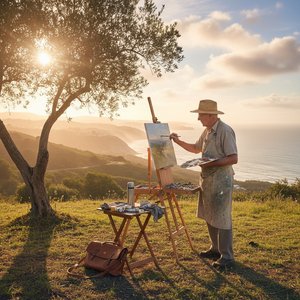
For centuries, the sanctity of the artist's studio served as a controlled sanctuary, a place where light was not experienced but meticulously recreated through layers of varnish and academic convention. Within these quiet walls, landscapes were often mere concepts—idealized visions born from memory and sketches rather than the raw, breathing reality of the world outside. The air in the studio was still, much like the compositions themselves, striving for a permanence that ignored the subtle, shifting truths of nature. However, as the nineteenth century dawned, a quiet rebellion began to stir within the hearts of those who felt the call of the horizon.
This profound shift toward en plein air—the practice of painting outdoors—was more than a change in location; it was a fundamental reimagative of the artist's relationship with existence. Pioneers like Pierre-Henri de Valenciennes laid the intellectual groundwork, advocating for a "landscape portraiture" that demanded direct observation. Before the convenience of portable paint tubes, this endeavor was an arduous labor of passion, requiring artists to grind their own pigments and manage heavy materials under the unpredictable whims of the sky. Yet, the allure of the open air was irresistible. It offered a chance to move away from the static, polished illusions of the academy and toward an authenticity that could only be found by standing amidst the wind, the rain, and the sun.
Chasing the Ephemeral: How Impressionists Captured Fleeting Light
 The Seine at Caudebec-en-Caux
The Seine at Caudebec-en-Caux: A Breath of Impressionist Light Eugène Louis Boudin’s “The Seine at Caudebec-en-Caux,” completed in 1889, isn't merely a depiction of a riverside town; it’s an embodiment of the Impressionist ethos—a fervent pursuit to ...
To understand Impressionism is to understand the pursuit of the ephemeral. The movement, led by luminaries such as Claude Monet and Pierre-Auguste Renoir, sought to freeze those microscopic moments of beauty that vanish almost as soon as they arrive. They were not interested in the permanent structure of a tree or the heavy weight of a stone, but rather in how the light of a setting sun might turn a leaf into a shard of gold, or how a morning mist might soften the edges of a distant river.
This obsession with light transformed the canvas into a living entity. In works like Eugène Louis Boudin’s The Seine at Caudebec-en-Caux, we see the very embodiment of this ethos. The water does not merely sit upon the canvas; it shimmers with reflected sunlight, capturing the hazy, atmospheric breath of the French coastline. By focusing on the sensory experience of light and color rather than precise, photographic detail, these artists invited us to see through a subjective, dreamlike lens. They taught us that truth is found not in the rigid outlines of objects, and but in the way light dances across them, creating a transient magic that defines our most cherished memories.
A Symphony of Brushstrokes: Texture and Movement in the Masterworks
 Painting
Painting is a visual art, characterized by the practice of applying paint, pigment, color, or other medium to a solid surface. The medium is commonly applied to the base with a brush. Other implements, such as palette knives, sponges, airbrushes, the...
The physical act of painting during this era became as expressive as the subject matter itself. Gone were the smooth, invisible transitions of the Old Masters, replaced by a vibrant, energetic application of pigment. The Impressionist brushstroke is a rhythmic, visible pulse on the canvas—a series of short, thick strokes that build texture and depth. This technique, often referred to as impasto, allows the paint to catch the light physically, adding a three-dimensional vitality to the work.
When we observe the works of Renoir, particularly his depictions of rural life, we encounter a sense of spontaneity that feels almost breathless. His use of loose, expressive brushwork creates a lively movement, as if the scene is still in the process of unfolding before our eyes. This texture serves a higher purpose: it mimics the vibration of light and the rustle of leaves. The colors are not merely placed side by side; they are layered and blended with a tactile urgency that invites the viewer to feel the warmth of a sunset or the coolness of a shaded grove. It is a symphony of motion, where every stroke contributes to a larger, breathing composition.
Beyond the Horizon: The Emotional Resonance of Natural Landscapes
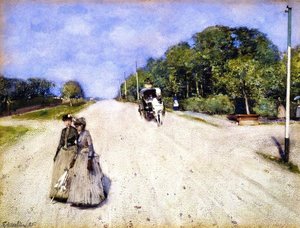 En Plein Air
Discover 'En Plein Air' by Edward Arthur Walton (1885). This Impressionistic landscape showcases rural beauty with loose brushstrokes & soft light. A captivating piece of Scottish art.
While the technical innovations of Impressionism were groundbreaking, the movement’s true soul lies in its emotional depth. These landscapes were never just scenery; they were meditations on the human connection to the earth. As the Industrial Revolution began to transform the European landscape with smoke and steel, the Impressionists offered a sanctuary of natural beauty and spiritual harmony. They elevated the landscape from a mere backdrop for historical or mythological drama to a subject worthy of profound reverence.
Preserving the Moment: Bringing the Impressionist Spirit into the Modern Home
 White House
Captivating Rural Scene in Impressionist Style This enchanting landscape captures a serene countryside at sunset, rendered in the luminous and vibrant style of Impressionism. The scene features a quaint cluster of trees and rustic buildings, evoking ...
In our fast-paced, digital age, the enduring appeal of Impressionism lies in its ability to slow us down. These masterpieces serve as windows into a more deliberate way of seeing, reminding us to cherish the fleeting beauty in our own lives. To bring an Impressionist work into one's home is to invite a sense of light, color, and tranquility into your personal sanctuary.
For those who hold a lifelong passion for this era, there is a profound joy in surrounding oneself with the textures and tones of the masters. Whether through a meticulously hand-painted oil reproduction that captures the thick, tactile brushstrokes of a Van Gogh or a luminous landscape reminiscent of Monet, these works offer more than mere decoration; they offer an emotional experience. They allow us to preserve the dance of light within our own walls, ensuring that the ephemeral beauty captured over a century ago continues to inspire and illuminate our modern lives.


