Introduction Close your eyes for a moment and imagine the scent of damp earth after a summer rain, or the way the golden light of a setting sun dissolves the sharp edges of a distant forest into a soft, amber haze. To gaze upon a landscape is to do m...
To gaze upon a landscape is to witness a conversation between the earth and the sky, a silent dialogue that has occupied the human soul since we first learned to translate our surroundings onto canvas. For centuries, the horizon served as a boundary of certainty, a line where the tangible world met the infinite. We are accustomed to landscapes that celebrate the warmth of a recognizable meadow or the rhythmic pulse of a mountain range. However, as the twentieth century progressed through profound uphements, this horizon began to fracture. The landscape, once a vessel for capturing naturalistic beauty, transformed into something far more introspective.
This shift was not a sudden abandonment of skill, but a redirection of it. Where earlier movements sought to master external light and atmospheric truth, later developments sought to illuminate the shadows within. The ground beneath our feet began to dissolve into liquid; mountains might appear suspended in skies of bruised violet. This evolution did not discard the landscape; rather, it reimagined it as a stage for the profound mysteries of the human psyche. We moved away from the sensory delights of the visible meadow toward a realm where the laws of physics are merely suggestions, and the very fabric of reality feels subject to change.
Foundations of Fantasy: Joachim Patinir and the World Landscape
A Pioneer of the Northern Renaissance Landscape Joachim Patinir, a name often whispered alongside that of Albrecht Altdorfer as a foundational figure in landscape painting, emerged from the artistic milieu of the Low Countries during the early 16th c...
Long before the Surrealists sought to unlock the subconscious, the seeds of the impossible were sown in the early sixteenth century. Joachim Patinir, a foundational figure of the Northern Renaissance, began to alter the way we see the earth. While his contemporaries often relegated scenery to a mere backdrop for religious or historical drama, Patinir established the "world landscape" as an independent entity. He possessed a unique ability to blend naturalistic detail with a lyrical fantasy that felt both grounded and otherworldly.
Patinir’s work suggests that the landscape has always held the capacity for symbolic depth. By expanding the scale of his vistas, he created spaces that felt larger than life, imbuing them with a narrative power that transcended simple topography. He did not rely on the overt moralizing allegories found in the works of Hieronymus Bosch; instead, he used the vastness of the terrain to convey meaning. This tradition of using expansive, often strange vistas to suggest a deeper reality provided the structural blueprint for much later explorations into the oneiric.
Atmospheric Dissolution: Leonardo’s Sfumato and the Oneiric Blur
In film theory, the term oneiric ( oh-NY-rik, adjective; "pertaining to dreams") refers to the depiction of dream-like states or to the use of the metaphor of a dream or the dream-state in the analysis of a film. The term comes from the Greek Óneiros...
The boundary between the human and the earth has often been blurred by the mastery of light and shadow. Leonardo da Vinci, through his use of sfumato, introduced a way of seeing where edges dissolve into a smoky haze. In his works, particularly when viewing the landscapes behind his subjects, the world becomes a dreamlike realm of winding paths and jagged peaks that seem to emerge from a mist. This technique does not merely depict distance; it creates an atmosphere of uncertainty, where the distinction between the solid and the ethereal is lost.
This soft, atmospheric perspective serves as a precursor to the oneiric aesthetics found in later film and art. The concept of the "oneiric"—pertaining to the state of dreaming—finds its roots in this very dissolution of form. Just as Leonardo used light to blur the boundary between humanity and the earth, later theorists like Ricciotto Canudo and Jean Epstein argued that cinema could replicate this dreamlike quality. The ability to move between being awake and falling asleep, a state described by André Breton, finds its visual ancestor in the hazy, uncertain horizons of the Renaissance masters.
Sacred Narratives, Subconscious Skies: Bruegel’s Legacy in Surrealism
Captivating Subject and Composition This exquisite landscape captures a profound biblical moment—the appearance of Christ to the apostles at the Sea of Tiberias. The scene is rendered with a masterful balance of natural beauty and spiritual significa...
The transition from the sacred to the surreal finds its clearest lineage in the works of Pieter Bruegel the Elder. In Landscape with Christ Appearing to the Apostles at the Sea of Tiberias, Bruegel balances naturalistic detail with profound spiritual weight. His landscapes function as conduits for revelation. The winding rivers and dense terrains act as symbolic paths between the earthly and the divine, anchoring sacred events within a recognizable, pastoral reality.
Even within this structured, religious framework, there is an invitation to wander into the vastness of the scene. Bruegel’s ability to use landscape as a narrative element provided a precedent for the Surrealists to employ it as a psychological one. While Bruegel used the terrain to point toward heaven, later painters used it to point toward the depths of the unconscious. The structural integrity of his compositions—the specific way light and shadow interact with the earth—remains a standard that even the most radical dream-architects could not ignore.
The Architecture of Shadows: Beyond Impressionist Luminosity
The Shifting Horizon: From Impressionist Luminosity to Surrealist Shadows For those of us who have spent decades finding solace in the sun-dappulated haystacks of Monet or the soft, rhythmic brushstrokes of Renoir, the transition into the twentieth c...
For those who find solace in the sun-dappled haystacks of Monet or the rhythmic brushstrokes of Renoir, the move into Surrealist shadows can feel unsettling. The Impressionists sought to capture the ephemeral—the fleeting moment of light that can never be repeated. Theirs was a celebration of the visible, the sensory, and the atmospheric. However, as the twentieth century progressed, the landscape began to function less as a mirror of light and more as an architecture of the impossible.
In the hands of artists like Kay Sage or the photographers of the Surrealist movement, the landscape became a construction of the subconscious. We see landscapes where cliffs float, moons bloom, and shadows take on a life of their own. This is not a rejection of the tradition of the masters, but an expansion of it. It is the application of classical technique to the irrational. Whether through the use of montage in photography or the distorted perspectives of painting, the goal remains the same: to find a truth that exists beyond the mere surface of reality, exploring the profound mysteries that reside in the space between the waking world and the dream.
Explore the profound beauty of impermanence through Impressionist and Post-Impressionist eyes. Discover how masters like Monet and Van Gogh captured fleeting light and the poetic essence of nature's transitions in our deep dive into art history and emotional landscapes.

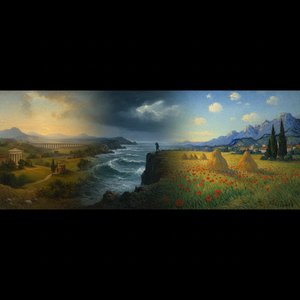 10 Breathtaking Masterpieces That Redefine the Landscape Genre
 Joachim Patinir
 Landscape with Christ Appearing to the Apostles at the Sea of Tiberias
 Beyond Reality: A Sophisticated Exploration of the Dreamlike Architecture in Surrealist Landscapes


