The Smithsonian American Art Museum is home to a stunning watercolor painting titled Sedona Storm Clouds II by the talented artist Donald Holden . Created in 1992, this piece measures 18 x 27 cm and showcases the artist's exceptional skill in capturi...
The landscape is rarely defined solely by the earth beneath our feet; rather, it finds its scale and sentiment within the heavens. To look upward during the heavy hour before a storm breaks is to witness a world in constant flux, where the horizon begins to dissolve into moisture and shadow. This atmospheric weight provides the essential context for every terrestrial detail, acting as the primary narrator of the scene's emotional temperature. When an artist captures a sky, they are not merely documenting weather; they are establishing the very boundaries of the viewer's experience.
In works such as Sedona Storm Clouds II by Donald Holden, we see this foundational role in action. The mountains and water serve as anchors, yet it is the dramatic tension within the clouds that dictates the energy of the American Southwest landscape. Without the sky’s movement, the earth remains static. The heavens provide the vertical dimension, a sense of infinite depth that pulls the eye away from the immediate foreground and into a larger, more profound dialogue with nature.
The Romantic Eye: Documenting Meteorological Truth
The Transient Sky: Seeking the Soul within the Ephemeral Cloud Study, Hampstead, Tree at Right Cloud Study, Hampstead, Tree at Right John Constable’s Cloud Study, Hampstead, Tree at Right , painted in 1821, is a cornerstone of Romantic landscape pain...
Before the radical shifts of the late nineteenth century, the approach to the sky was often one of meticulous observation and a devotion to the meteorological truth of the land. The Romantic movement brought an intense focus to how weather dictates the mood of the earth. Artists began to treat the sky as a living, material part of their composition, recognizing that no two shadows are ever truly identical in a changing climate.
John Constable’s 1821 work, Cloud Study, Hampstead, Tree at Right, serves as a cornerstone of this era. He did not merely observe; he documented the way the English countryside responded to the atmosphere. This period saw a growing understanding of aerial perspective—the phenomenon where distance softens contrast and shifts colors toward cooler, bluish hues. By mastering this, painters could create an illusion of depth that felt physically real, making the viewer feel the actual presence of the air between themselves and the distant hills.
Anatomy of Tension: Decoding Cumulonimbus and Arcus Formations
Cumulonimbus (from Latin cumulus 'heap' and nimbus 'rain cloud') is a dense, towering, vertical cloud, typically forming from water vapor condensing in the lower troposphere that builds upward carried by powerful buoyant air currents. Above the lower...
There is a specific science to the drama found in storm-heavy canvases. The most imposing of these are the Cumulonimbus clouds—dense, towering vertical structures that can reach altitudes of up to 21,000 meters. These are not merely shapes; they are massive, energetic systems, with an average weight of 500,000 kilograms. When a painter captures the anvil-shaped top of a well-developed cumulonimbus, they are depicting the result of intense wind shear and atmospheric inversion.
Beyond these giants, we find the more specialized Arcus clouds, which introduce a horizontal tension to the composition. The shelf cloud, a wedge-shaped formation attached to the parent storm, signals an approaching gust front, while the rarer roll cloud—a solitary, tube-shaped wave known as a soliton—moves with a haunting, detached grace. These formations, whether seen in the coastal regions of California or the North Sea, provide artists with a vocabulary of movement and threat, allowing them to paint the very edge of a storm's arrival.
The Impressionist Shift: Capturing the Ephemeral Moment
A Symphony of Blue and White: Exploring John Singer Sargent’s “Clouds” John Singer Sargent's "Clouds" – sometimes referred to as "A Sky" – is more than just a depiction of atmospheric conditions; it’s a masterful distillation of light, color, and emo...
As we move into the Impressionist era, the focus shifted from documenting meteorological structure to capturing the fleeting flicker of light that exists only for a heartbeat. For painters like Monet and Renoir, the instability of the sky was not a challenge to be overcome with rigid detail, but the very essence of their subject. They sought the breath of the atmosphere—the way sunlight filters through a cloud or how a sunset dissolves the horizon into a violet haze.
John Singer Sargent’s 1896 watercolor, Clouds (also known as A Sky), exemplifies this mastery of the transient. Through the transparency of the watercolor medium, he achieved a luminous quality that mimics the way light penetrates real cloud formations. His use of layered blues and whites creates a dreamlike, ethereal texture. Similarly, Sir Alfred James Munnings’ Sky Study utilizes a vigorous impasto technique, where thick ridges of paint catch the light to create a physical depth that mirrors the layered complexity of real clouds. In these works, the sky is no longer just a backdrop; it is a symphony of color and motion.
The Sublime Intersection: Where Beauty Meets Terror
The Threshold of the Sublime: Where Beauty Meets Terror Capturing the Sublime: A Visual Journey Through Art History's Most Dramatic Skies The Sublime Intersection: Where Beauty Meets Terror in the Romantic Sky 10 Iconic Masterpieces That Defined Roma...
At its most profound, landscape painting explores the threshold of the sublime—that precise point where beauty meets terror. This is found in the heavy, encroaching clouds that evoke existential dread or the haunting mist clinging to a mountain peak. The tension within a storm cloud is a mirror for the human spirit confronting the infinite majesty of nature.
This emotional resonance is achieved through the orchestration of atmosphere. An artist might use the mamma or mammatus features—those bubble-like protrusions on the underside of a cloud—to suggest an unsettling, turbulent energy. Or they may look to the works of Hans Theodor Woldsen Storm, whose landscapes capture the essence of a more somber, intimate atmosphere. Whether through the textured, heavy skies of Thomas Pollock Anshutz or the swirling blues of Hubert Damelincourt, the goal remains the same: to tap into a universal language of emotion that resides in the unpredictable power of the elements.
Atmospheric Curation: Bringing the Infinite into Contemporary Spaces
The Sky as a Window: Evoking Emotion Through Atmospheric Landscapes Landscape Study An Impressionistic Whisper of the English Countryside In this evocative Landscape Study , Sir Alfred James Munnings invites the viewer into a world where the boundari...
Integrating these atmospheric works into a modern interior is an exercise in expanding the boundaries of a room. A well-chosen landscape acts as a window to the infinite, pulling the viewer inward and providing a sense of depth that can transform even a compact study into an expansive sanctuary. The choice of artwork allows for a spectrum of moods; one might opt for the sun-drenched, energetic light of a Renoir to uplift a bright living area, or seek the sophisticated, dramatic edge of a dark, textured storm cloud to ground a formal lounge.
For the collector, these works offer more than decoration; they provide a sense of permanence in a world of fleeting moments. Whether through the high-impact, bold energy of contemporary reproductions or the delicate, light-drenched textures of historical masters, bringing the sky indoors allows us to maintain a connection to the rhythmic dialogue between the earth and the heavens.
Discover more explorations of art history and technique at OriginalUniqueArt.com.
Discover the sublime beauty of cloudscape masterpieces. From Impressionist light to atmospheric depth, explore a curated journey through fine art skies and learn how to acquire museum-quality oil reproductions for your collection.

 Sedona Storm Clouds II
 Whispers of the Sky: How Impressionist Masters Rendered the Transient Beauty of Clouds
 Cumulonimbus cloud
 Clouds (also known as A Sky)
 Tempest and Transcendence: A Study of Stormy Skies and the Sublime in Landscape Painting
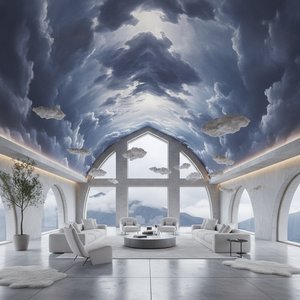 Capturing the Clouds: How Dramatic Sky Art Transforms Interior Spaces into Ethereal Sanctuaries


