The Allegorical Bloom: Myth and Flora in the Renaissance
 Primavera - Detail Of Flowers
Primavera - Detail Of Flowers, Sandro Botticelli
In the intellectual fervor of the Florentine Renaissance, the depiction of plants often transcended mere decoration to become a language of divine and mythological symbolism. Sandro Botticelli’s Primavera – Detail Of Flowers offers a profound example of this era, where the boundaries between the natural world and the celestial realm appear to dissolve. Within this lush, verdant landscape, the goddess Flora wanders through a meadow where every bloom carries a weight of meaning. The work is not a simple catalog of species but a poetic arrangement of lilies, violets, and roses, rendered with a precision that suggests both scientific observation and spiritual inspiration.
This Renaissance approach to botany finds its echo in the works of the early herbalists, such as Leonhart Fuchs and John Gerard. While their focus moved toward understanding botanical morphology, they shared with Botticelli the belief that to capture the precise curvature of a stem or the delicate serration of a leaf was to honor a higher order. The artist’s brush became an instrument of truth, transforming the botanical subject from a mere symbol into a subject of rigorous, observational study. In this period, the pursuit of accuracy was inseparable from the pursuit of beauty.
The technical execution of such works relied heavily on the properties of the medium. Botticelli utilized tempera on poplar wood, employing remarkably fine brushstrokes to create subtle gradations of color. These pastel hues—soft pinks and pale yellows—appear to glow from within, lending the scene an ethereal, almost translucent quality. It is this marriage of meticulous line work and luminous atmosphere that defines the high standard of Renaissance floral allegory.
The Apothecary’s Eye: The Dawn of Taxonomic Precision
As the focus shifted from the allegorical to the empirical, the role of the artist became increasingly intertwined with the needs of medicine and science. The distinction between a life-saving herb and a lethal poison necessitated a level of visual clarity that previous centuries had not demanded. This era saw the rise of the apothecary-artist, individuals who required absolute accuracy to ensure the safety of their practitioners. The transition from stylized forms in ancient manuscripts to the detailed morphological studies of the 16th and 17th centuries marked a pivotal moment in the history of naturalism.
This drive for clarity finds a historical parallel in the foundational herbals of the 4th and 5th centuries, such as the Vienna Dioscurides. While those early works prioritized essential identification over photorealistic detail, they established the fundamental principle that true botanical art must serve as a reliable guide. The evolution from these early, functional sketches to the sophisticated studies of the Enlightenment represents a continuous refinement of the human eye's ability to document the natural world.
The precision required for such work demanded a mastery of specific techniques. Artists utilized pencil and ink for the most basic outlines, but it was the application of watercolor that allowed for the representation of texture and life. By wetting the paper with a sponge and stretching it to prevent distortion, illustrators could achieve a depth of color that mirrored the vitality of the living specimen. This discipline ensured that the botanical record was both a scientific tool and a work of art.
The Engraver’s Legacy: Mastering Tonal Nuance
 Jan Van Kessel The Elder
Explore Jan van Kessel the Elder’s exquisite floral still lifes & insect studies! A Brueghel descendant, he captured 17th-century nature with scientific precision.
The 18th century brought a revolution in how botanical detail was disseminated, moving from unique manuscripts to widely circulated prints. This shift was driven by advancements in engraving techniques that allowed for a level of tonal gradation previously unattainable. The collaboration between scientists and master engravers allowed for the creation of works that could capture the subtle play of light and shadow on a petal, making the botanical subject feel tangible and three-dimensional.
This pursuit of tonal depth echoes the earlier traditions of Flemish masters like Jan van Kessel the Elder. While Kessel’s floral still lifes often functioned as coded messages of love or purity, his technical ability to render the texture of a bloom set a standard for the engravers who followed. The transition from the painterly application of color to the precise, hatched lines of the engraver allowed for a democratization of botanical knowledge, bringing the intricacies of rare flora into the hands of collectors across Europe.
A significant figure in this evolution was Johann Wilhelm Weinmann, whose Phytanthoza iconographia redefined the genre. Working alongside the engraver Georg Dionysius Ehret, Weinmann utilized the mezzotint technique to achieve unprecedented realism. This method allowed for a richness of tone that mimicked the soft transitions found in nature, bridging the gap between the scientific specimen and the aesthetic object.
The Immersive Landscape: Capturing the Spirit of the Flora
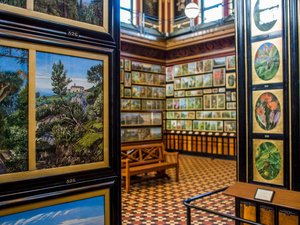 Marianne North Gallery
Discover the captivating world of Victorian botanical artist Marianne North at Kew Gardens! Explore over 800 vibrant paintings from her global travels, showcasing exotic plants and challenging artistic conventions.
By the 19th century, botanical art expanded beyond the isolated specimen to encompass the entire environment in which a plant thrives. Artists began to seek not just the shape of the leaf, but the atmosphere of the habitat. This period saw a move toward a more holistic representation, where light, moisture, and surrounding vegetation worked together to convey the essence of a species. The goal was no longer just to show what a plant looked like, but how it lived.
This immersive approach finds its roots in the early botanical gardens founded by naturalists like Ulisse Aldrovandi. By studying plants in their cultivated settings, artists began to understand the relationship between a specimen and its context. This shift from the white background of the laboratory to the textured reality of the landscape allowed for a more profound connection between the viewer and the subject.
Marianne North stands as a singular figure in this movement. Painting over 800 exotic plants from life, her work is characterized by a dedication to capturing the texture and light of diverse global landscapes. Her collection, now housed in the Marianne North Gallery, serves as a vital record of 19th-century flora. Unlike the clinical isolation of many scientific illustrations, North’s paintings offer a sense of being surrounded by the very landscapes she depicted, blending scientific accuracy with a deep aesthetic sensibility.
The Microscopic Lens: The Evolution of Morphological Detail
 Maud H. Purdy
Discover botanical illustrations by Maud H. Purdy (1873-1965). A renowned American artist, she created detailed plant studies for the Brooklyn Botanic Garden & beyond.
The advent of more powerful magnification tools allowed artists to move into the realm of the minute, focusing on the structures that define a species: the fine hairs on a stem, the intricate vein patterns of a leaf, or the microscopic texture of a petal. This era of botanical art is defined by an almost obsessive attention to the smallest details, where the artist functions as both a scientist and a virtuoso of the brush.
This focus on the minute finds a historical echo in the work of early naturalists who used magnifying glasses to study the morphology of plants. The ability to see what was previously invisible to the naked eye transformed the artist's task, requiring new levels of precision and a different approach to composition. The focus shifted from the whole plant to the essential, microscopic truths that dictate its biological identity.
Artists like Maud H. Purdy and Karl Blossfeldt pushed these boundaries, using magnification to reveal the hidden architecture of plant life. Their work often utilized techniques like stippling—the creation of tiny dots to build up tone—or advanced layering and hatching to achieve a sense of depth and luminosity. This level of detail ensures that the artwork serves as a permanent, high-resolution record of the natural world.
The Collector’s Curation: Provenance and the Botanical Aesthetic
 Johann Wilhelm Weinmann
Explore the botanical art of Johann Wilhelm Weinmann (1683-1741). Discover his detailed illustrations from 'Phytanthoza iconographia' and his significant contributions to plant science.
The acquisition of botanical art requires a discerning eye for both technical execution and historical weight.
In the 18th century, Johann Wilhelm Weinmann’s *Phytanthoza iconographia* represented a significant achievement in botanical curation, a monumental florilegium that sought to document the natural world with tonal nuance through the use of mezzotint. This was a systematic assembly of scientific truth and artistic skill, intended to provide a visual record that functioned as both an apothecary's tool and an object of beauty. This drive to curate the essential—to move from simple identification to a profound visual record—remains the cornerstone of serious collecting. Just as Weinmann’s work bridged the gap between the apothecary’s practical needs and the artist’s aesthetic pursuit, the modern collector seeks works that possess a similar dual nature: the rigor of morphological accuracy and the grace of fine art. Today, the value of a piece is found in the specifics of its construction. A collector evaluates the precision of the line, the depth of the glazing, or the subtle stippling used to build tone. Whether examining the delicate serration of a leaf, the fine hairs on a stem, or the translucency of a petal, the focus remains on the integrity of the representation. The collector looks for the mastery of fundamental elements: line, tone, color, texture, shape, and size.
Provenance and the rarity of the technique—be it the layered complexity of watercolor or the tactile presence of oil on canvas—determine the work's place within a private collection. The pursuit focuses on the precision with which a subject is captured, ensuring the work holds its significance through decades of observation.