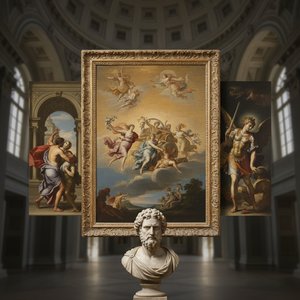
The Renaissance (UK: rin-AY-sənss, US: REN-ə-sahnss) was a European period of history and cultural movement taking place at the end of the Late Middle Ages and the beginning of the early modern era. It is variously defined as covering the 15th and 16...
The history of light is rarely a simple matter of illumination; it is often an act of revelation. In the transition from the balanced, even lighting of the Renaissance to the profound depths of the Baroque, artists discovered that what remains hidden is just as vital as what is revealed. This period saw the mastery of chiaroscuro—the deliberate, dramatic interplay between light and dark—not merely as a technical feat, and certainly not as a decorative flourish. Instead, it became a tool for psychological depth, a way to sculpt figures out of the void and force the viewer to confront the weight of the subject matter.
One finds an early echo of this tension in the works of the Renaissance masters, who used light to define form and clarity. Yet, as the seventeenth century approached, the shadows began to thicken. The darkness ceased to be a mere absence of light and became a palpable presence, a heavy shroud that could swallow entire landscapes or isolate a single, trembling hand. This shift changed how stories were told on canvas; the narrative was no longer found in a clear, panoramic view, but in the sudden, sharp strike of brilliance against an encroaching gloom.
The Visceral Martyr: Rubens and the Weight of Sacrifice
A Dramatic Tableau of Faith and Mortality The Beheading of St. John the Baptist stands as a monumental achievement in Baroque art—a visceral depiction of martyrdom that encapsulates the fervor and theatricality characteristic of the era. Painted by P...
When Peter Paul Rubens approached the subject of martyrdom, he did not shy away from the physical reality of mortality. In his 1610 work, Beheading of St. John the Baptist, the artist presents a scene that is as much about the heaviness of flesh as it is about spiritual triumph. The composition is crowded with movement—soldiers, witnesses, and the figure of Salome—yet the eye is inevitably drawn to the center, where the lifeless body of the Saint lies beneath a starkly illuminated, severed head. Rubens uses a palette of rich reds and yellows to convey both the grandeur of the moment and the visceral nature of the execution.
This intensity finds its historical antecedent in the more structured, often more cerebral approach to history painting seen in the works of Nicolas Poussin. While Poussin sought an intellectual clarity through geometry and disegno, Rubens embraced the theatricality of the flesh. Where Plausible order might prevail in a Poussin landscape, Rubens allows the blood and the bone to demand attention. The Baroque era, particularly in the hands of the Flemish master, transformed the biblical account into an immersive experience, making the sacrifice feel immediate, even inescapable.
The Meeting of Abraham and Melchizedek Peter Paul Rubens’s “Meeting of Abraham and Melchizedek” stands as an emblem of Baroque grandeur—a monumental tapestry commissioned by the Infanta Isabel Clara Eugenia, Governess of the Southern Netherlands, to ...
Beyond the singular moment of violence, the Baroque period excelled at depicting the grandeur of divine covenant through ceremonial splendor. Rubens’s The Meeting of Abraham and Melchizedek serves as a profound example of this capability. Commissioned to commemorate the Feast of Corpus Christi, this work utilizes a complex, pyramidal composition to direct the viewer toward the priestly dignity of Melchizedek. The scene is not merely a historical encounter; it is a symbolic representation of the relationship between the human and the divine, rendered with an anatomical precision that honors the physical world even as it celebrates the spiritual.
This sense of ceremonial importance echoes the earlier traditions of Flemish painting, where artists like Jan Brueghel the Elder specialized in intricate details that contributed to a larger, often more delicate, narrative. Rubens took this tradition of meticulousness and expanded its scale, using tenebrism to sculpt figures with a dramatic intensity that transformed a religious meeting into a monumental event. The use of gold, blue, and deep red pigments ensures that the theological weight of the encounter is felt through the very texture of the paint.
Captivating Subject and Rich Symbolism This remarkable Baroque masterpiece vividly depicts the biblical theme of charity and compassion through the depiction of the Seven Acts of Mercy. The scene captures a moment of divine intervention and human kin...
If Rubens provided the grandeur, Caravaggio provided the grit. In The Seven Acts of Mercy, the artist strips away the distance between the biblical past and the viewer's present. Through his revolutionary use of light, he brings the acts of charity—feeding the hungry, clothing the naked—into a sharp, uncompromising focus. There is no idealized grace here; there is only the raw, human effort of compassion. The figures are caught in fleeting moments of action, their gestures heavy with the reality of their struggle and the necessity of their virtue.
The roots of this approach can be traced back to the foundational principles of Christian art, which have long sought to make the sacred accessible through recognizable human emotion. Caravaggio simply removed the veil of sanctity, using deep shadows to isolate the act of mercy from any distracting background. By focusing on the realistic, often weathered features of his subjects, he forced a confrontation with the moral imperatives of the text, proving that the most profound divine interventions are often found in the simplest human kindnesses.
The Weight of Word and Spirit: Reni’s Apostolic Tension
Guido Reni’s *Sts Peter and Paul*: A Baroque Masterpiece of Dramatic Emotion Guido Reni's *Sts Peter and Paul*, painted around the early 17th century, is a profoundly moving work that exemplifies the height of Baroque art. Measuring 197 x 140 cm, thi...
In the hands of Guido Reni, the Baroque drama takes on a more contemplative, almost elegiac tone. His depiction of Sts Peter and Paul explores the tension between authority and discourse through the postures of the two apostles. St. Peter is presented with a sense of earthly weariness, leaning heavily upon his hand in a moment of profound reflection, while St. Paul stands upright, his gestures suggesting an impassioned sermon or debate. The dark background does not merely provide contrast; it serves to intensify the focus on the spiritual dialogue occurring between these two pillars of the Church.
This exploration of character and movement finds its way back to the classical ideals that informed much of the Italian tradition. Reni’s ability to balance the emotional intensity of the Baroque with a certain classical restraint allows the viewer to contemplate the saints not just as historical figures, but as embodiments of spiritual struggle. The use of red robes—a traditional symbol of martyrdom—adds a layer of symbolic gravity, reminding the observer that the weight of their mission was paid for in sacrifice.
Preserving the Sacred: The Continuity of Narrative Tradition
A Sanctuary of Faith and Artistic Legacy In the heart of Eger, Hungary, where the shadows of history dance upon ancient stone, lies the Keresztény Múzeum—a profound sanctuary that transcends the boundaries of a traditional gallery. To enter this muse...
The brilliance of the Baroque era lies not in its departure from tradition, but in its profound engagement with it. Whether through the intricate religious iconography of the Middle Ages or the structured narratives of the Renaissance, the artists of this period were part of a long, unbroken lineage of storytellers. They took the established symbols—the halo, the cross, the specific gestures of saints—and recontextualized them within a world of shadow and light, making the ancient stories feel as though they were unfolding in real-time.
Today, we see this legacy preserved in institutions like the Keresztény Múzeum in Eger, where the evolution from Gothicrealism to Baroque grandeur is palpable. The preservation of these narratives allows us to understand that art has never been a mere imitation of life, but a way to interpret the eternal through the temporal. At OriginalUniqueArt.com, we honor this tradition by providing hand-painted reproductions that maintain the integrity of the original brushstroke and the depth of the artist's vision, ensuring that these profound dramas continue to find their place in the modern home.
Explore the life & work of Guido Reni, a master of Baroque classicism. Discover his iconic religious & mythological paintings, and understand his enduring influence on art history. Expert analysis for collectors.

 Renaissance
 Beheading of St. John the Baptist
 The Meeting of Abraham and Melchizedek
 The Seven Acts Of Mercy
 Sts Peter and Paul
 Keresztény Múzeum