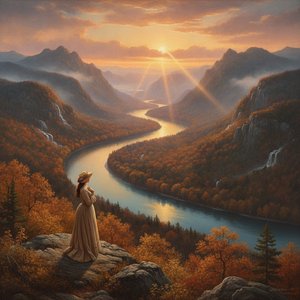
The Sublime Frontier: Defining the American Romantic Landscape
To gaze upon the landscape paintings of the nineteenth century is to witness a nation discovering its own soul. Before the sprawling industrialization of the modern era, the American wilderness stood as a vast, unwritten epic—a realm of terrifying grandeur and profound serenity. This was the era of American Romanticism, a movement that sought to move beyond mere topographical accuracy to capture the emotional resonance of the land. The concept of the Sublime became the heartbeat of this movement; it was an aesthetic experience that combined awe with a touch of fear, reminding the viewer of the overwhelming power of nature compared to the fragility of human existence.
These artists did not merely paint trees and mountains; they painted the divine presence felt within the untamed. The frontier was viewed as a cathedral of light and shadow, where every mist-covered valley and jagged peak whispered of an infinite, untouched majesty. Through their brushes, the rugged topography of the New World was transformed into a spiritual journey, inviting the observer to contemplate their place within a much larger, more mysterious cosmos. This period of art established a visual language for American identity, one rooted in the reverence for a landscape that felt both primordial and promising.
Luminosity and Light: The Hudson River School’s Atmospheric Mastery
At the pinnacle of this movement stood the Hudson River School, a group of painters whose mastery of light redefined the boundaries of landscape art. For these masters, light was not merely a tool for visibility but a primary subject in itself. They utilized a technique often referred to as luminosity, where layers of translucent oil glazes were applied to create a sense of depth and an inner glow that seemed to emanable from within the canvas. This meticulous process allowed them to capture the fleeting moments of the day—the golden warmth of a setting sun, the ethereal silver of moonlight on a lake, or the dramatic, heavy atmosphere of an approaching storm.
The technical brilliance of these artists lay in their ability to manipulate atmospheric perspective. By subtly altering colors and clarity as they receded into the distance, they created an illusion of immense space, drawing the viewer’s eye through dense forests toward distant, hazy horizons. This interplay of light and shadow—the chiaroscuro of the wild—created a sense of drama that was both visceral and contemplative. When we observe these works today, we are not just looking at scenery; we are experiencing the very breath of the atmosphere, captured through layers of pigment and passion.
Echoes of the Wild: Exploring the Works of Cole, Martin, and Boutelle
The lineage of this American tradition is best understood through the profound contributions of its most evocative practitioners. Thomas Cole, often regarded as the father of the Hudson River School, utilized his canvases to weave complex allegories of nature’s cycles and the rise and fall of civilizations. His works, such as the breathtakingly detailed Valley of the Vaucluse, serve as windows into a world where every element of the landscape carries symbolic weight, inviting a deep, philosophical reflection on the passage of time.
Following in this tradition of evocative naturalism, artists like Homer Dodge Martin brought a different, more intimate perspective to the movement. In works such as Landscape with Fisherman, Martin moved away from the epic scale toward a sense of profound tranquility and atmospheric stillness. His ability to capture the quietude of a lakeside morning offers a counterpoint to the grander, more turbulent scenes of his contemporaries. Similarly, the works of DeWitt Clinton Boutelle remind us of the enduring allure of the American highlands. His serene depictions of the Catskills, Adirondacks, and White Mountains exemplify a romantic naturalism that finds beauty in the quiet, enduring strength of the mountains. Together, these artists form a tapestry of vision, ranging from the monumental to the meditative.
Nature as Narrative: Capturing Tranquility and Tension in the Wilderness
Within the American wilderness landscape, there exists a fascinating duality between peace and peril. The art of this era excels at navigating this tension, presenting nature as both a sanctuary and a formidable force. In many compositions, we find scenes of extreme tranquility—a calm river reflecting a cloudless sky, or a sun-drenched meadow where the world seems at rest. These images offer a sense of pastoral ideal, a longing for a harmonious existence within the natural order.
Yet, beneath this surface of peace, there is often an underlying current of tension. The presence of a lightning strike, the looming shadow of a mountain, or the churning waters of a heavy sea serves as a reminder of the wild’s untamable spirit. This narrative tension keeps the viewer engaged, preventing the landscape from becoming merely decorative. It forces an encounter with the unpredictable. By capturing both the stillness of the forest and the fury of the storm, these artists created a complete portrait of the American wilderness—a place that is as much about the quiet moments of grace as it is about the overwhelming power of the elements.
Preserving the Legacy: Bringing the Spirit of Classical Landscapes into Modern Interiors
In our contemporary, fast-paced world, the enduring appeal of these classical landscapes lies in their ability to provide a sense of permanence and profound connection to the earth. Integrating such works into a modern home is more than an act of decoration; it is an invitation to slow down and engage with a timeless aesthetic. Whether through a large-scale oil reproduction that serves as a focal point in a grand hall or a delicate print that adds depth to a quiet study, these pieces bring the restorative power of the wilderness indoors.
At OriginalUniqueArt.com, we believe that the beauty of the Old Masters and the great American landscape painters should be accessible to all. Our mission is to preserve the soul of these historical masterpieces through meticulous, hand-painted reproductions. Each piece we create is a labor of devotion, where our artists use traditional techniques—applying multiple layers of oil paint on heavy-duty cotton canvas—to ensure that the tactile texture and luminous light of the original are preserved. By bringing these works into your space, you are not just displaying art; you are curating a legacy of wonder, ensuring that the untamed spirit of the American wilderness continues to inspire generations to come.