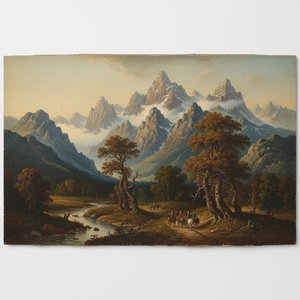
The Philosophy of the Sublime: Mountains as Mirrors of the Human Soul Peak Inspiration: 10 Breathtaking Artworks That Capture the Majesty of Mountains Introduction There is a profound, almost spiritual silence that resides within the peaks of our wor...
To look upon a mountain is to confront the eternal. There is a profound gravity residing within these colossal geological formations, acting as silent witnesses to the relentless passage of time. Throughout the annals of art history, mountains have functioned as far more than mere geographical landmarks; they have served as powerful cultural metaphors and mirrors for the human psyche. When we gaze at a jagged summit piercing the clouds, we are witnessing the earth’s most ambitious reach toward the heavens.
In the Western tradition, this encounter is often defined by the concept of the sublime—that unsettling intersection where immense beauty meets a sense of overwhelming grandeur. It is the moment when the human spirit meets the infinite scale of nature and recognizes its own fragility. These peaks represent the immovable and the absolute, providing a canvas upon which artists have projected their deepest reflections on solitude, strength, and the tension between the terrestrial and the celestial.
Imaginary Horizons: The Weltlandschaft Tradition and Verhaecht’s Vision
Alpine Landscape is an oil-on-canvas painting by Flemish painter Tobias Verhaecht. The painting was completed between 1600 and 1615, and is now in the Museum of Prado in Madrid. == Painting == The painting was painted in Antwerp between 1600 and 1615...
Before the era of topographical photography, the landscape was often a product of the artist's imagination rather than a literal record of terrain. This is evident in the work of Tobias Verhaecht, particularly his Alpine Landscape, completed between 1600 and 1615. Following his time in Italy, where he worked on frescoes in Florence and Rome, Verhaecht returned to Antwerp to practice the Weltlandschaft style. This approach favored an imaginary, expansive view over realistic accuracy, a method designed to satisfy the sophisticated tastes of contemporary commissioners.
Verhaecht’s composition is structured through three distinct color bands—yellow, green, and blue—running parallel toward the background. The space is populated with meticulous details: a hunter on a white horse with a falcon, riders on mountain trails, and even small birds and flowers in the foreground. This hybrid product of naturalistic detail and imagined topography creates a sense of a world that is both tangible and mythic. His work, now held in the Museo del Prado, demonstrates how the 16th-century landscape tradition could blend human activity with an elevated, almost infinite horizon.
Romanticism and the Heroic Peak: Rottmann’s Bavarian Majesty
A Vision of Myth and Majesty – Carl Rottmann’s Corinth with Akrocorinth Carl Anton Joseph Rottmann's “Corinth with Akrocorinth,” completed in 1847, stands as a cornerstone of Bavarian Romanticism. More than just a depiction of a mountainous landscape...
As the movement of Romanticism took hold, the mountain transitioned from a stage for myth to a symbol of heroic struggle. Carl Anton Joseph Rottmann’s 1847 work, Corinth with Akrocorinth, exemplifies this shift within Bavarian Romanticism. Commissioned by King Ludwig I, the painting reflects the monarch's fascination with classical ideals blended with untamed wilderness. The title itself carries profound weight; while Corinth evokes the divine inspiration of Apollo, the peak of Akrocorinth symbolizes resilience and the triumph of the human spirit.
Rottmann utilized a revolutionary technique known as encaustic, fusing heated beeswax mixed with pigments onto primed wood panels. This method allowed for an incredibly durable and luminous surface, capturing subtle tonal variations that traditional oils often struggle to sustain. Through his use of atmospheric perspective—the gradual blurring of details as distance increases—Rottmann conveys the immense scale of the Bavarian Alps. The result is a landscape that does not merely depict rock and sky but sculpts them with light, inviting contemplation of the sublime.
Atmospheric Tension: Turner, Koch, and the Dissolution of Form
The Architect of the Heroic Landscape Joseph Anton Koch stands as a singular figure in Austrian art history—a painter who deftly navigated the shifting currents of Neoclassicism into the burgeoning fervor of German Romanticism. Born in 1768 in Elbige...
The evolution of mountain painting eventually led to a period where the boundaries between solid matter and ephemeral light began to dissolve. J.M.W. Turner was a master of this atmospheric tension. In his 1842 watercolor, The Foot of Mount St. Gotthard, he rejects topographical accuracy in favor of capturing the very essence of the air and mist. Here, the mountain is not a static object but a participant in a swirling, light-drenched drama where form becomes secondary to feeling.
This pursuit of a heroic aesthetic was shared by Joseph Anton Koch. Having been shaped by his youth tending cattle in Austria, Koch possessed an intimate connection to the natural world. His transition from Neoclassical rigor to the sweeping grandeur of Romanticism allowed him to reimagine classical ideals through the lens of the Austrian Alps. Influenced by the monumental compositions of Poussin and Claude Lorrain, Koch organized space using dramatic lighting and rugged terrains to create landscapes that felt both visceral and legendary.
The Intimate Mountain: Victorian Precision from Crossland to Woodford
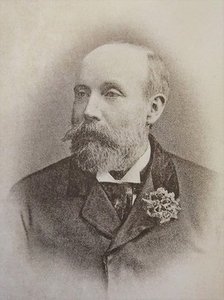
James Henry Crossland: A Yorkshire Painter of Mountain Majesty James Henry Crossland (1852-1939) emerges from the heart of Victorian England as a quietly significant landscape artist, a master of capturing the rugged beauty and atmospheric drama of t...
Not all mountain art seeks the overwhelming; some find power in the quiet, detailed observation of the earth's texture. James Henry Crossland, a Yorkshire painter active in the late 19th century, offered intimate glimpses into the rugged beauty of the Peak District and the Welsh mountains. His work is characterized by a deep sensitivity to the changing weather—the way mists cling to valleys or how sunset light bathes a limestone edge.
This tradition of precision continues through the works of David James Woodford. Approaching the landscape with an almost architectural care, Woodford treats every ridge and peak of Snowdonia as a monumental project. His oil paintings capture the palpable energy of Welsh weather, where heavy clouds and shafts of sunlight coalesce to create a sense of living drama. Unlike more abstract approaches, Woodford’s work maintains a structural integrity that honors the geological permanence of the mountains he depicts.
Modern Echoes: Expressionist Peaks and Contemporary Reinterpretations
A Sanctuary of Expressionism Amidst the Alpine Peaks Nestled within the serene landscape of Davos, Switzerland, the Kirchner Museum Davos serves as a profound sanctuary for the soul of German Expressionism. It is not merely a repository of art but a ...
In the twentieth century, the mountain became a site for psychological exploration. At the Kirchner Museum Davos, the legacy of Ernst Ludwig Kirchner is preserved within the very landscape that inspired his metamorphosis. His work in the Swiss Alps moved away from the jaggedness of his Berlin years toward a more nuanced, contemplative style. The museum itself, with its modernist architecture and expansive windows, creates a rhythmic connection between the painted vistas on the walls and the real mountains visible beyond the glass.
Today, this dialogue continues through contemporary voices like Arnold Chang. In works such as Mapping the Universe, Chang reinvents traditional Chinese landscape painting for a modern era. His large-scale ink and brush works eschew traditional perspective, presenting craggy, branching forms that resemble alpine peaks viewed from an orbital distance. It is a profound reminder that while our techniques change—from Rottmann’s encaustic to digital-age abstractions—the human impulse to find meaning in the heights remains unchanged.
For those looking to bring these powerful atmospheres into their own spaces, OriginalUniqueArt.com offers a curated selection of high-impact reproductions and custom commissions. Whether you seek the textured impasto of a classical oil or a modern reimagining of a historical master, our artists specialize in transforming the sublime into a permanent fixture of your collection.
Explore the history of mountain painting! Discover Romantic masterpieces & key artists like Dahl & Calame. Learn about the Sublime & Picturesque aesthetics and find your perfect artwork at OriginalUniqueArt.
Immerse yourself in the raw emotion of German Expressionism. Explore 25 iconic masterpieces by Ernst Ludwig Kirchner, from bold street scenes to vibrant landscapes. Find inspiration for museum-quality art reproductions and decor. Discover all masterpieces on OriginalUniqueArt.com.

 Majestic Peaks: A Definitive Guide to the Sublime Alpine Landscapes of Art History
 Alpine Landscape
 Corinth with Akrocorinth
 Joseph Anton Koch
 James Henry Crossland
 Kirchner Museum Davos