Mastering Form: A Curated Guide to Captivating Abstract Shape Artworks for the Discerning Collector
Discover the profound beauty of geometric abstraction. Our expert guide explores the mastery of form, from Mondrian to Kandinsky, offering sophisticated insights for collectors seeking museum-quality abstract reproductions and bespoke commissions.
Abstract art uses visual language of shape, form, color, and line to create a composition which may exist with a degree of independence from visual references in the world. Abstract art, non-figurative art, non-objective art, and non-representational...
To gaze upon a masterpiece of geometric abstraction is to witness a world stripped of the superfluous, reduced to its most fundamental and resonant truths. Unlike representational art, which seeks to mirror the visible world through the lens of perspective and imitation, this movement dares to exist independently of any external reference. It is a visual language composed of lines, colors, and shapes that vibrate with an almost mathematical purity. When we encounter these works, we are not looking at a landscape or a portrait; we and instead engaging with a structural dialogue where every angle and curve serves a purpose. This pursuit of non-objective composition allows the viewer to transcend the literal and enter a realm of pure aesthetic experience, where the tension between a sharp edge and a soft hue creates a profound sense of order and clarity.
The beauty of this movement lies in its ability to communicate through the elemental. A single vibrant square can act as a visual anchor, drawing the eye into a contemplative state, while a grid-like pattern provides a sense of stability and architectural rhythm. This is not merely an exercise in minimalism; it is an exploration of how basic forms can evoke complex psychological responses. By removing the distraction of recognizable figures, the artist invites us to appreciate the inherent power of color and form as they interact within a non-illusionistic space. It is a sophisticated dance of balance and weight, where the simplicity of the subject matter belies the profound intellectual depth required to master such restraint.
Architectural Precision: The Legacy of Geometric Abstraction Masters
Friedrich Vordemberge-Gildewart: Architect of Geometric Abstraction Born in Osnabrück, Germany, in 1899, Friedrich Vordemberge-Gildewart’s artistic journey was a radical departure from traditional representation, charting instead a course toward pure...
The history of geometric abstraction is inextricably linked to the architects of modernism, individuals who viewed the canvas as a site for structural innovation. Figures such as Friedrich Vordemberge-Gildewart approached the medium with the meticulous eye of an architect, translating his studies in sculpture and structure into compositions that emphasize weight, volume, and spatial relationships. His work, deeply influenced by the De Stijl movement, reflects a quest for a universal visual language—one that utilizes the precision of the line to create a sense of cosmic order. Similarly, the influence of the Bauhaus and Constructivist principles can be seen in works that treat the canvas as a construction site, where shapes are layered and interlocked to build a new reality.
This era of artistic revolution was characterized by a departure from the romanticized chaos of previous centuries toward a more disciplined, cerebral approach. Artists like Auguste Herbin navigated this transition with grace, moving from the expressive textures of Fauvism into the structured elegance of geometric abstraction. His journey exemplifies the broader cultural shift of the early 20th century, where the rapid advancements in science and technology inspired a fascination with logic and mathematical harmony. In these works, we see the legacy of a period that sought to find truth within structure, using the clean, sharp edges of modernism to reflect an increasingly organized and industrial world.
The Emotional Resonance of Shape: From Suprematism to Lyrical Abstraction
Introduction To embark on a journey through the top 25 artworks of Kazimir Malevich is to enter a realm where color and form transcend representation, becoming pure feeling made visible. It’s an encounter with radical simplicity, a challenge to every...
While geometry may suggest rigidity, the true mastery of abstract art lies in its ability to evoke deep, often spiritual, emotional responses. The movement known as Suprematism, pioneered by the visionary Kazimir Malevich, pushed this boundary to its absolute limit. For Malevich, the reduction of art to pure geometric forms was a way to achieve a state of "pure feeling," where color and shape could transcend the physical world entirely. His compositions are not mere arrangements of shapes; they are windows into an inner landscape of emotion and transcendence, challenging the viewer to find meaning in the absence of recognizable imagery.
In contrast to the starker, more rigid forms of Suprematism, other branches of abstraction embraced a more fluid and lyrical approach. Wassily Kandinsky, a titan of the movement, utilized color as if it were music, creating compositions where shapes dance and colors sing. His work often embodies an "inner necessity," using vibrant, energetic brushstrokes to capture the spiritual vibrations of the soul. Even within the realm of geometric forms, there is room for lyrical abstraction—a style that allows for a more organic, emotive interaction between shape and pigment. Whether through the intense, focused tension of a single red square or the sweeping, rhythmic movement of overlapping circles, these artworks serve as conduits for human emotion, proving that even the most abstract forms can touch the very core of our being.
Curating the Modern Interior: Integrating Abstract Works into Luxury Spaces
Abstract Composition [Triptych] by Vaclav Vytlacil (1937). Explore this dynamic black & white triptych featuring bold lines, textures & geometric shapes. A key example of American modernism.
For the discerning collector and interior designer, integrating abstract art into a luxury environment requires a sophisticated understanding of balance and focal points. A large-scale geometric abstraction piece can serve as the definitive architectural anchor for a contemporary room, providing a sense of structural integrity to a wide wall or a grand staircase. When selecting works for a professional space—such as a high-end hotel lobby or a private estate—one must consider how the rhythm of the lines interacts with the existing architecture. A multi-panel triptych, for instance, can extend the visual horizon of a room, creating a sense of continuity and movement that guides the eye through the space.
The key to successful curation lies in the interplay between the artwork and the surrounding textures and tones. An abstract work featuring bold, primary colors can provide a striking contrast to neutral, minimalist interiors, while more muted, monochromatic compositions can enhance the serenity of a tranquil study. Designers often utilize group set paintings to create a cohesive narrative across multiple walls, ensuring that the brushstrokes and color palettes flow seamlessly from one area to another. By treating art not merely as decoration but as an essential architectural element, one can transform a physical space into a curated experience of profound aesthetic depth.
Investment and Longevity: Preserving the Integrity of Abstract Masterpieces
--- title: Geometric Abstraction - The Metropolitan Museum of Art author: Magdalena Dabrowski url: https://www.metmuseum.org/essays/geometric-abstraction hostname: metmuseum.org description: Geometric abstraction, through the Cubist process of purify...
Acquiring fine art is an act of stewardship, a commitment to preserving beauty for future generations. When investing in high-quality reproductions or original works, the longevity of the materials is paramount. True mastery is found in the hand-painted oil reproduction, where the physical texture of the impasto and the depth of the pigment layers offer a tactile richness that digital prints simply cannot replicate. To ensure these investments endure, it is essential to consider the chemistry of the medium; the use of high-quality oils, flexible gesso, and protective damar varnishes protects the surface from the atmospheric pollutants and moisture that can degrade lesser works.
Preservation also extends to the environment in which the art resides. To protect a collection, collectors should avoid direct sunlight and utilize acid-free matting to prevent chemical interactions between the artwork and its frame. For those managing large-scale collections or B2B projects for hospitality, maintaining a consistent standard of care is vital. Whether it is a bespoke commission or a carefully selected piece from a global gallery, the integrity of the artwork relies on a foundation of academic excellence and meticulous craftsmanship. By honoring the traditions of the masters through careful curation and preservation, we ensure that the profound dialogue between form and emotion continues to inspire long after the initial encounter.
Discover the world of fine art at OriginalUniqueArt.com, where we specialize in bringing museum-quality hand-painted reproductions and bespoke commissions to collectors worldwide. From transforming personal memories into oil masterpieces to providing expert art consultations for luxury interiors, our mission is to preserve human creativity through unparalleled craftsmanship.
By the OriginalUniqueArt.com Editorial Team
Exclusive ArtistDavid Moreau
b. 1967 · Lyon, France
Discover the exquisite textured works of Moreau. WahooArt offers exclusive access to his master-style plaster and texture art reproductions.
Experience the visionary "revisited translations" of Duvallier. Masterfully bridging Old World techniques with modern clarity, his exclusive WahooArt collection offers rare, sophisticated interpretations of legendary masterpieces. Shop premium …
Discover the profound connection between abstract geometry and human emotion. Explore how shapes like circles and squares reflect your true personality through an expert psychological lens, perfect for the discerning art collector seeking deeper meaning in their curated collection.
Discover expert guidance on curating abstract art for a harmonious home. Learn to balance geometric precision and chromatic energy with insights from museum-grade collectors and professional art historians.
Journey through the radical world of Kazimir Malevich. Explore 25 iconic Suprematist masterpieces, from Black Square to White on White. Discover the stories behind these geometric legends and find museum-quality art reproductions for your space. Explore the full collection on OriginalUniqueArt.com.
Discover the sophisticated art of blending bold abstract masterpieces with classic interiors. Our expert guide offers timeless design inspiration for curators seeking to harmonize modern energy with traditional elegance through museum-quality fine art.


 Abstract art
 friedrich vordemberge gildewart
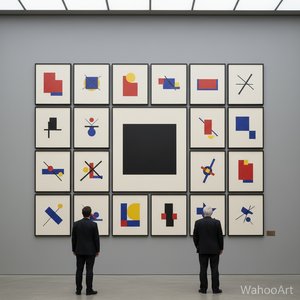 Kazimir Malevich: 25 Masterpieces of Suprematism & Abstract Art | OriginalUniqueArt
![Abstract Composition [triptych]](/media/artworks/images/thumbnails/e5/3d/e53db42ea02644b9a8e722f9d4dd3742.jpg) Abstract Composition [triptych]
Abstract Composition [triptych]