The Genesis of Gesture: Defining the Abstract Expressionist Movement
To understand the profound impact of Abstract Expressionism, one must look beyond the canvas to the turbulent era from which it emerged. Following the global upheaval of the mid-20th century, a new vanguard of artists sought to transcend representational boundaries, turning inward to capture the unutterable complexities of the human psyche. This movement was not merely a stylistic shift but an ontological revolution. It abandoned the safety of recognizable figures and landscapes in favor of a raw, unfiltered language of form and energy. For the discerning collector, this era represents the moment when art ceased to be a window into another world and instead became a direct conduit to the artist's very soul.
The movement found its epicenter in New York, giving rise to the legendary New York School, where the boundaries between creator and medium began to dissolve. These artists were not interested in depicting the external reality of a subject; rather, they sought to manifest the internal reality of emotion. By stripping away the anecdotal and the figurative, they arrived at a universal vocabulary of line, color, and texture. This pursuit of the sublime allowed for a visceral connection that resonates across generations, making these works timeless anchors for any sophisticated collection.
- Spontaneity: The rejection of premeditated composition in favor of intuitive creation.
- Scale: The use of monumental canvases to envelop the viewer within the artistic experience.
- Subjectivity: A focus on the personal, psychological landscape of the individual artist.
The Language of Action: Exploring the Technique of Action Painting
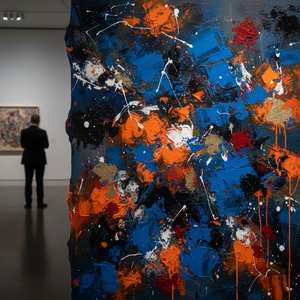
At the heart of this movement lies the concept of Action Painting, a term that fundamentally redefines the act of creation. In this paradigm, the canvas is no longer a passive surface for a finished image but an arena in which to act. The artist’s physical movements—the sweep of an arm, the forceful drip of pigment, the rhythmic application of heavy impasto—become the very subject of the work itself. This technique imbues the painting with a kinetic energy that is palpable to the observer, as if one can still trace the trajectory of the brush through the dried layers of oil.
Consider the works of masters like Franz Kline, where bold, black strokes collide with vibrant color blocks in a dance of structural tension. His Zinc Yellow serves as a testament to this power, showcasing how a single, decisive gesture can command an entire space. Similarly, the work of Michael Goldberg exemplifies the second generation of the New York School, utilizing gestural abstraction to create compositions that feel both spontaneous and deeply structured. For the collector, these pieces offer more than visual interest; they offer a physical encounter with the history of human movement and intention.
This technique demands a high level of technical mastery, often involving multiple layers of paint to build a three-dimensional texture. When observing an authentic action painting, one does not merely see color; one witnesses the residue of a performance, a frozen moment of intense creative struggle that continues to vibrate long after the artist has laid down their tools.
Chromatic Intensity: The Emotional Resonance of Color and Form
While some artists focused on the muscularity of line, others explored the profound psychological depths of color. This facet of Abstract Expressionism utilizes chromatic intensity to evoke specific emotional states, ranging from serene contemplation to existential dread. The interplay between light and pigment becomes a tool for spiritual resonance, where color is used not as a descriptive element, but as an emotive force.
The works of Cy Twombly offer a masterclass in this delicate balance. In pieces such as Nine Discourses on Commodus – Part IX, we see a dynamic explosion of color and raw emotion, where gestural techniques and symbolic depth merge to create a sense of ancient, almost mythological, weight. The way colors bleed into one another or stand in stark, jarring contrast can trigger deep-seated emotional responses within the viewer, making the artwork a mirror for their own internal landscape.
This emotional resonance is further explored through the use of swirling, organic forms. In Norman Bluhm’s Erythea, the movement of color creates a captivating sense of depth and motion, pulling the eye into a labyrinth of pigment. For those curating spaces intended for reflection or intellectual stimulation, these works provide a sophisticated layer of complexity, where the science of color meets the poetry of abstraction.
A Legacy of Sublimity: Key Figures and the New York School
The lineage of Abstract Expressionism is a rich tapestry woven by artists who dared to redefine the limits of expression. From the foundational figures of the first generation to the innovative voices of the second, each artist contributed a unique thread to this monumental legacy. The movement was never monolithic; it encompassed a spectrum of approaches, from the controlled, color-field explorations to the wild, uninhibited energy of the gesturalists.
The diversity within the New York School allowed for a broad range of aesthetic possibilities. We see the influence of feminist perspectives in the vibrant, romantic abstractions of Susana Sierra, whose use of oils and acrylics brought a unique vitality to the movement's legacy. The strength of this era lies in its ability to support such varied voices while maintaining a cohesive commitment to the exploration of the subconscious.
To collect these works is to participate in a historical continuum. Each piece serves as a link to a period of unparalleled creative bravery, preserving the spirit of an era that fundamentally changed the trajectory of Western art history. The enduring value of these artists lies in their ability to communicate truths that are independent of time, culture, or language.
Curating Chaos: Integrating Abstract Masterpieces into Modern Interiors
Integrating the raw energy of Abstract Expressionism into a contemporary interior requires a sophisticated eye for balance and composition. Because these works often possess immense visual weight and emotional intensity, they function as powerful focal points within a room. The challenge—and the opportunity—for the collector is to curate an environment where the artwork does not merely decorate the space but actively engages with it.
In modern architectural settings, characterized by clean lines and minimalist palettes, an abstract masterpiece can provide a necessary "soul." A large-scale, multi-panel arrangement can transform a wide wall or a grand staircase into a dynamic gallery experience, creating a sense of movement that complements the structural flow of the home. The use of textures, such as the tactile impasto found in high-quality oil reproductions, adds a layer of sensory richness that flat prints cannot achieve.
When selecting pieces for a collection, consider the following:
- Color Harmony: Utilizing color analysis to ensure the artwork complements or intentionally contrasts with your existing palette.
- Scale and Proportion: Choosing works that command attention without overwhelming the architectural proportions of the room.
- Texture and Depth: Opting for reproductions that feature visible brushstrokes to provide a three-dimensional, "living" quality.
Ultimately, the goal of curation is to create a dialogue between the art and the inhabitant. Whether through a single, monumental canvas or a curated series of smaller works, Abstract Expressionism offers an unparalleled way to infuse a space with intellect, emotion, and timeless elegance.
At OriginalUniqueArt.com, we specialize in preserving this profound legacy. From meticulously handcrafted oil reproductions that capture the very texture of the masters to museum-quality Giclée prints, our mission is to make the sublime accessible to collectors worldwide. Whether you are seeking a bespoke commission that reimagines a personal memory in the style of the New York School or looking for expert consultation to complete your collection, OriginalUniqueArt provides the expertise and craftsmanship required to bring the power of Abstract Expressionism into your home.