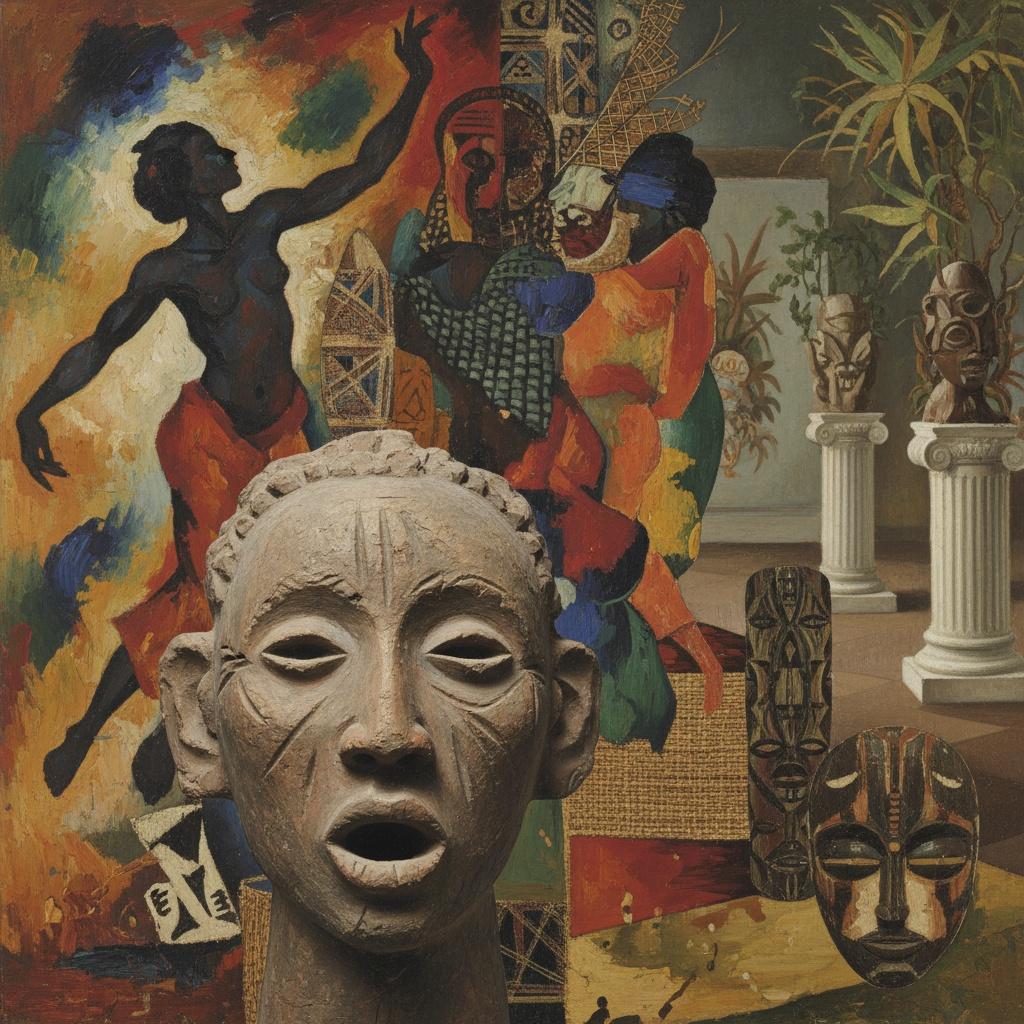
The Essence of Primitivism: Breaking from Academic Tradition
To understand the seismic shift that occurred at the dawn of the twentieth century, one must first envision the rigid, polished world of the European Academies. For generations, the pinnacle of artistic achievement was defined by mimesis—the meticulous, almost photographic imitation of reality through smooth brushwork, anatomical perfection, and a strict adherence to perspective. The masters of the Academy sought to hide the hand of the artist, presenting a window into a perfected world where every shadow and highlight served the illusion of depth.
However, a profound restlessness began to stir within the hearts of a new generation of creators. They felt that this polished veneer had become a cage, stifling the raw, visceral energy of human experience. This period saw the emergence of Primitivism, not as a mere stylistic choice, but as a rebellion against the suffocating constraints of Western rationalism. Artists began to look beyond the boundaries of their own refined culture, seeking a more primal, unadulterated form of expression that could communicate the depths of emotion without the interference of academic artifice.
This movement was characterized by a deliberate embrace of the "uncultivated." By stripping away the complexities of traditional shading and proportion, these artists sought to rediscover a fundamental truth. They found beauty in the distorted, the flat, and the exaggerated, believing that such elements could tap into a universal psychological language that the refined techniques of the past had long since forgotten.
The Encounter with the 'Other': Colonialism and the Discovery of Non-Western Aesthetics
The rise of Primitivism cannot be discussed without acknowledging the complex, often turbulent historical context of the era. As European empires expanded their reach across Africa, Oceania, and the Americas, a flood of ethnographic artifacts entered the museums and private collections of Europe. To the Western eye, these objects—masks, totems, and sculptures—appeared strikingly different from the classical traditions of Greece and Rome. They possessed a powerful, rhythmic geometry and a symbolic density that felt entirely alien yet undeniably magnetic.
This encounter with the "Other" provided the catalyst for a radical reimagining of form. The discovery of these non-Western aesthetics offered artists a way to bypass the exhausted tropes of realism. There was an intoxicating allure in the perceived "purity" of these objects, which many European intellectuals mistakenly believed were untouched by the corrupting influence of civilization. This romanticized view allowed for a fascination with the spiritual and the ritualistic, viewing these artifacts as conduits to a more authentic human state.
Yet, this period remains a subject of intense scholarly debate. The relationship between modern art and colonialism is fraught with the complexities of cultural appropriation. While artists were undoubtedly inspired by the formal qualities of these works, they often did so through a lens of colonial dominance, frequently stripping the objects of their original sacred contexts to serve a new, Western aesthetic agenda. Understanding this tension is essential for any discerning enthusiast seeking to grasp the full, nuanced history of modernism.
Gauguin and the Search for the Untouched: A Post-Impressionist Revolution
Among the pioneers of this movement, few figures loom as large or as enigmatic as Eugène Henri Paul Gauguin. A man who famously abandoned a stable career in finance to pursue the life of an artist, Gauguin sought more than just new techniques; he sought a new way of being. His journey led him away from the urban centers of France toward the tropical landscapes of Tahiti, where he believed he could find a world still vibrating with primordial energy.
Gauguin’s work represents a pivotal bridge between Impressionism and the more radical movements that followed. He moved away from the fleeting light effects of his predecessors, opting instead for bold, saturated colors and large, flat areas of pigment. His compositions often utilized heavy outlines and a simplified, almost decorative approach to form, reminiscent of stained glass or ancient friezes. In his Tahitian paintings, the subject matter is inseparable from the technique; the exotic landscapes and figures are rendered with a symbolic intensity that transcends mere representation.
Through his use of Symbolist themes, Gauguin infused his canvases with a sense of mystery and spiritual longing. He did not merely paint what he saw; he painted the essence of the mythic and the eternal. By integrating the vibrant hues of the Pacific with a flattened, non-naturalistic perspective, he provided a blueprint for how art could move away from the literal and toward the emotional and the symbolic.
Picasso and the Sculptural Shift: How African Masks Reimagined Form
If Gauguin provided the color and the spirit, Pablo Picasso provided the structural revolution. The arrival of African and Oceanic art in Paris acted as a profound shock to Picasso’s system. During his formative years leading up to the birth of Cubism, he became deeply enamored with the sculptural qualities of African masks—objects that utilized abstraction to convey powerful, often terrifying, psychological truths.
In works such as those seen in his early explorations of the human figure, one can observe a radical departure from anatomical accuracy. Picasso began to deconstruct the face and body, replacing soft curves with sharp angles, intersecting planes, and fragmented features. The influence of the mask is evident in the way he treated the human countenance: eyes became mere slits or geometric voids, and noses were rendered as stark, protruding shapes. This was not a destruction of the subject, but a reconstruction of it.
This sculptural approach to painting allowed Picasso to represent multiple viewpoints simultaneously, breaking the single-point perspective that had dominated art since the Renaissance. By treating the canvas as a space for geometric experimentation rather than a window into reality, he paved the way for the Cubist movement, forever altering the way we perceive depth, volume, and the very nature of visual representation.
The Enduring Legacy: Primitivism's Influence on 20th-Century Expressionism
The ripples of the Primitivist movement extended far beyond the initial shock of its arrival. The liberation of color and form paved the way for a multitude of movements that would define the twentieth century. The raw, emotive power found in the works of Gauguin and Picasso became the foundational language for Expressionism, where the artist’s internal psyche was projected onto the canvas through distortion and intense pigment.
Later movements, from Fauvism to Surrealism, owe a profound debt to this era of experimentation. The Fauves, led by Matisse, took Gauguin's use of color to its logical extreme, using hues that were entirely arbitrary to the subject but perfectly aligned with the emotional temperature of the piece. Meanwhile, the Surrealists drew upon the dreamlike, symbolic qualities of Primitivist aesthetics to explore the subconscious realms of Freud and Jung.
Even in the contemporary era, the echoes of this revolution remain audible. The idea that art can be a vehicle for primal truth, unburdened by the need for literal accuracy, continues to inspire creators across all mediums. The movement taught us that the most profound truths are often found not in the perfection of the surface, but in the raw, unvarnished depths of human emotion.
Revisiting the Narrative: Modern Perspectives on Cultural Appropriation and Artistic Inspiration
As we reflect on this transformative era from a modern vantage point, it is impossible to ignore the ethical complexities that shadow the legacy of Primitivism. The term "Primitivism" itself is now viewed with scrutiny, as it carries the weight of colonialist assumptions—the idea that non-Western cultures were "primitive" or "lesser" than the West. Modern art historians work tirelessly to decenter this narrative, acknowledging the agency and sophisticated artistry of the African, Oceanic, and Indigenous creators whose works inspired the European avant-garde.
The conversation has shifted from a simple celebration of "influence" to a much more rigorous examination of cultural appropriation. We now ask: where does inspiration end and exploitation begin? How can we appreciate the formal brilliance of these ancestral traditions without erasing their historical context or disrespecting their sacred origins? This critical dialogue does not diminish the greatness of artists like Picasso or Gauguin, but it enriches our understanding by providing a more complete, honest history of how art evolves through global encounter.
Ultimately, studying Primitivism allows us to appreciate the incredible, often turbulent, interconnectedness of human creativity. It reminds us that art is never created in a vacuum; it is a continuous, complex dialogue between cultures, eras, and perspectives—a dialogue that continues to shape our visual world today.
At OriginalUniqueArt.com, we are dedicated to preserving the profound beauty of art history for a modern audience. Whether you are drawn to the bold, symbolic colors of Gauguin or the revolutionary structures of Picasso, our mission is to make these masterpieces accessible through exquisite hand-painted reproductions and museum-quality prints. From custom oil paintings that capture every tactile brushstroke to personalized art consultations for your home, we invite you to bring the transformative power of history into your personal space.