The Industrial Aesthetic: Defining the Precisionist Vision
To understand the soul of American Modernism, one must look beyond the frantic energy of European Expressionism and toward the disciplined, crystalline clarity of Precisionism. Emerging in the early twentieth century, this movement did not seek to distort reality through emotion, but rather to refine it through a lens of absolute clarity. It was an aesthetic born from the rhythmic pulse of a nation transforming itself into an industrial titan. Where other movements found chaos in the modern world, the Precisionists found a profound, almost spiritual order within the steel, the concrete, and the glass.
This was not merely a stylistic choice; it was a philosophical stance. The movement sought to strip away the superfluous, leaving behind only the essential geometries of the machine age. By emphasizing clean lines, smooth surfaces, and a controlled palette, artists were able to elevate the mundane structures of industry—silos, factories, and bridges—into objects of high art. There is a certain quietude in this vision, a stillness that invites the collector to contemplate the monumental strength of human ingenuity. It is an art of focus, where every edge is deliberate and every shadow is mathematically placed.
Geometry of the Machine Age: Steel, Skyscrapers, and Order
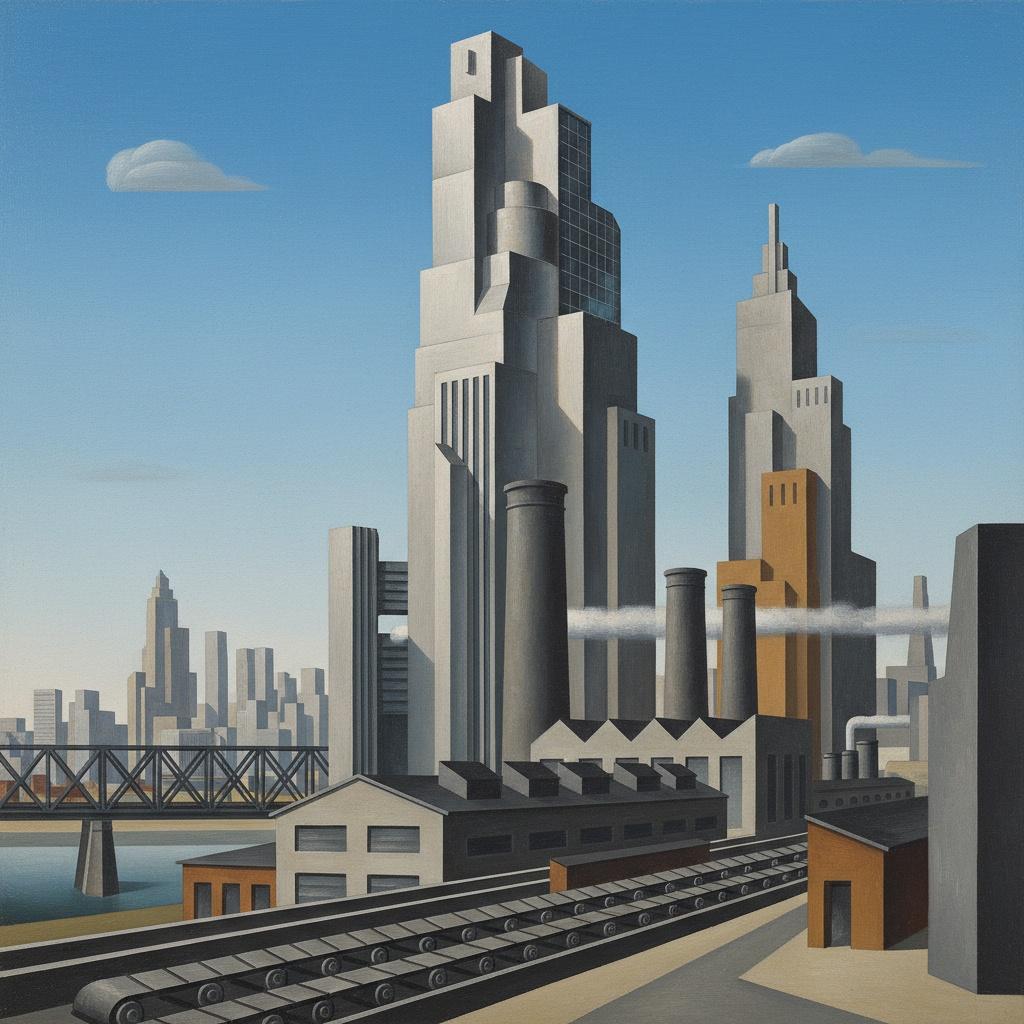
The landscape of the early twentieth-century United States was undergoing a radical metamorphosis, and Precisionism served as its most faithful chronicler. As skyscrapers began to pierce the clouds and sprawling industrial complexes redefined the horizon, artists found themselves captivated by the interplay of light and structural form. The subject matter was unapologetically modern: the soaring verticality of urban architecture and the rhythmic repetition of factory windows provided a perfect canvas for exploring geometric composition.
In these works, the machine is not a source of dread, but a symbol of progress and structured beauty. The heavy, unyielding nature of steel and the starkness of concrete are rendered with such meticulous care that they appear almost weightless, suspended in a state of permanent perfection. This fascination with order allowed for a unique dialogue between the organic world and the man-made environment. Through the use of sharp contours and a reduction of detail, the artists achieved a sense of monumental permanence, capturing a moment in history when the architecture of industry felt like the very foundation of a new civilization.
Beyond Abstraction: The Intersection of Realism and Modernity
While Precisionism shares a lineage with the more radical abstractions of the era, it occupies a sophisticated middle ground that remains deeply accessible to the discerning eye. It is an art form that exists at the intersection of representational realism and geometric abstraction. Unlike the total abandonment of form found in pure abstraction, Precisionism retains a recognizable connection to the physical world, yet it subjects that world to a rigorous process of simplification.
This tension between what is seen and what is distilled creates a captivating visual experience. An observer might recognize a grain elevator or a water tower, but they are seeing it through a transformative filter—one that emphasizes the mathematical harmony of its construction. This approach allows for a profound level of detail in texture and light without the distraction of narrative clutter. For the collector, this provides a unique opportunity to possess works that are both intellectually stimulating in their formal complexity and emotionally resonant in their depiction of tangible, powerful subjects.
Architectural Linearity: The Influence of Cubism and Constructivism
The intellectual scaffolding of Precisionism was undoubtedly supported by the avant-garde movements of Europe. The fragmented perspectives of Cubism and the structural rigor of Constructivism provided the essential vocabulary for American artists to articulate their vision. From Cubism, they learned the power of breaking down a subject into its constituent geometric planes; from Constructivism, they adopted the reverence for industrial materials and the beauty of engineered forms.
However, the Precisionists applied these influences with a distinctly American temperament—one characterized by a preference for clarity over fragmentation and stability over movement. They utilized the sharp edges and overlapping planes of their predecessors to create compositions that felt grounded and resolute. This synthesis of European technique and American subject matter resulted in a style that was both globally informed and locally rooted. It was an architectural approach to painting, where the canvas was treated not just as a surface for pigment, but as a blueprint for exploring the structural integrity of the modern world.
The Legacy of the Sharp Edge: Precisionism in Contemporary Collecting
Today, the legacy of Precisionism continues to resonate within the halls of contemporary art collections and modern architectural spaces. Its influence can be seen in the clean lines of mid-century modern design and the minimalist movements that followed. For the modern collector, acquiring works that embody this era is an investment in a period of unparalleled optimism and structural clarity. These pieces serve as timeless anchors in a collection, offering a sense of permanence and sophisticated restraint.
As we navigate our own era of rapid technological change, the Precisionist focus on finding order within progress remains strikingly relevant. The movement reminds us that even amidst the complexity of a changing world, there is beauty to be found in the precise, the structured, and the enduring. Whether through the study of original masterpieces or the appreciation of high-quality reproductions that capture the tactile essence of the era, the sharp edge of American Modernism continues to define the standard for aesthetic excellence.
At OriginalUniqueArt.com, we celebrate this enduring legacy by offering exquisite hand-painted reproductions and museum-quality prints that bring the precision of this movement into the modern home. From the meticulous layering of oil on canvas to the archival permanence of our Giclée prints, our mission is to preserve the spirit of the masters for a new generation of collectors.