The Sun's Eternal Bloom: An Introduction to the Sunflower in Art History
To gaze upon a sunflower is to witness a silent dialogue between the earth and the heavens. Throughout the annals of art history, few botanical subjects have commanded such profound reverence, serving as much more than mere floral ornamentation. The sunflower, with its heliotropic nature—the instinctual movement to follow the sun across the sky—has long been embraced by painters as a potent metaphor for devotion, vitality, and the cyclical rhythm of life itself. In the quietude of a studio or the grandeur of a gallery, these golden blooms act as vessels of light, capturing the fleeting warmth of a summer afternoon and preserving it within the permanence of pigment and canvas.
Historically, the sunflower has transitioned from a symbol of simple rustic charm to a complex emblem of emotional depth. While early botanical illustrations focused on the scientific precision of the seed head and petal, the evolution of fine art allowed for a more subjective interpretation. Artists began to see not just a plant, and certainly not just a subject, but a way to explore color theory and the very essence of luminosity. This journey from the periphery of still-life tradition to the heart of the Post-Impressionist revolution marks one of the most significant shifts in how we perceive the natural world through the lens of human emotion.
Van Gogh’s Yellow Symphony: Decoding the Post-Impressionist Masterpiece
No discussion of golden radiance is complete without a pilgrimage to the works of Vincent van Gogh. For the Dutch master, the sunflower was not merely a subject; it was a language of intense, often turbulent, emotion. His series of Sunflowers, particularly the iconic Twelve Sunflowers in a Vase, represents a pinnacle of Post-Impressionist expression. In these works, we see a departure from the muted palettes of the past, replaced by a daring, monochromatic exploration of yellow. By utilizing varying shades of ochre, amber, and lemon, Van Gogh achieved a sense of internal light that seems to radiate from within the canvas itself.
To study these masterpieces is to enter a world where color carries the weight of the soul. The brilliance of his work lies in its ability to convey both life and decay; some blooms are in full, exuberant glory, while others bow their heavy heads, surrendered to the passage of time. This duality creates a profound tension that resonates with any viewer who has experienced the bittersweet nature of existence. Through his eyes, the sunflower becomes a symbol of the artist's own struggle and his unyielding passion for the light, making these paintings some of the most recognizable and emotionally charged works in the global art canon.
Light and Texture: The Impasto Technique and the Soul of the Petal
The true magic of the sunflower masterpieces lies not just in their hue, but in their tactile reality. One cannot truly appreciate these works without acknowledging the impasto technique—a method where paint is applied in thick, heavy layers, creating a three-dimensional topography on the canvas. When observing a high-quality reproduction or an original masterpiece, the eye does not merely glide over a flat surface; it wanders through a landscape of ridges and valleys. These visible brushstrokes catch the light at different angles, mimicking the organic complexity of a real petal and giving the artwork a "living" quality.
This sculptural approach to painting allows the artist to imbue the sunflower with physical weight. The texture provides a sense of movement, as if the petals are still swaying in a gentle breeze. This interplay between light and shadow within the paint itself adds a layer of depth that a flat print can never replicate. It is this very physicality—the way the pigment stands proud from the heavy-duty cotton canvas—that allows the viewer to feel the energy of the artist's hand, bridging the gap between the historical moment of creation and the modern observer.
Beyond the Canvas: The Cultural Symbolism of Radiance and Vitality
Beyond the technical mastery of light and texture, the sunflower carries a heavy mantle of cultural symbolism. In many traditions, the flower represents longevity and the sun's unceasing energy. Its bright, outward-facing petals suggest an openness to the world, while its sturdy stalk speaks to resilience in the face of adversity. For the art enthusiast, collecting such imagery is an act of inviting this positive energy into one's personal sanctuary. The sunflower serves as a perennial reminder of the beauty found in growth and the necessity of seeking the light, even during the darkest seasons of life.
This symbolism transcends borders and eras, making the sunflower a universal icon of hope. Whether depicted in a quiet Dutch interior or a sweeping Impressionist landscape, the flower remains a steadfast companion to the human spirit. It challenges us to find brilliance in the mundane and to recognize the extraordinary potential within the natural world. As we curate our lives and our homes, these golden icons serve as anchors of warmth, grounding us in the timeless beauty of the earth's most radiant offerings.
Curating a Golden Gallery: Bringing Timeless Masterpieces into the Modern Home
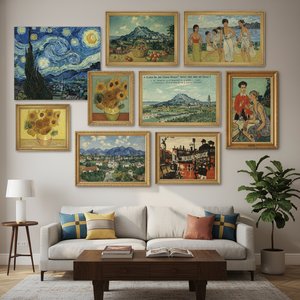
Integrating such powerful imagery into a contemporary interior requires a sophisticated touch. A well-placed sunflower masterpiece can serve as a breathtaking focal point, injecting warmth into a minimalist room or adding a layer of historical depth to a modern architectural space. For those looking to honor this legacy, the choice between different mediums is essential. While Giclée prints offer incredible color accuracy and longevity through 12-color pigment inks, a Handmade Oil Reproduction offers something far more profound: the soul of the original.
A bespoke oil painting, meticulously crafted with multiple layers of pigment and finished with protective Damar varnish, brings the tactile essence of the masters into your home. These reproductions feature the same heavy brushstrokes and impasto textures that define the works found in the Rijksmuseum or the Van Gogh Museum. By choosing a piece that emphasizes texture and depth, you are not merely decorating a wall; you are curating an experience—a permanent window into a golden era of human creativity that continues to inspire, much like the eternal bloom of the sunflower itself.