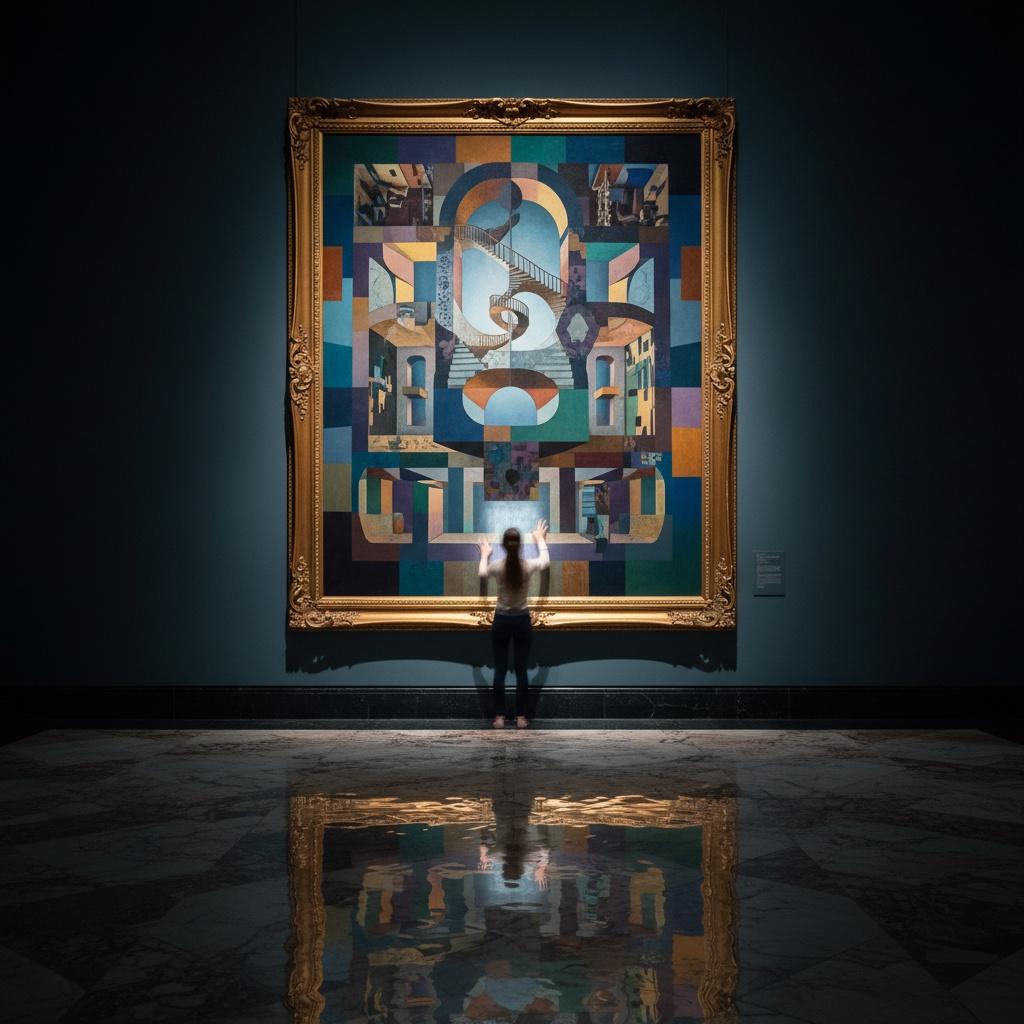
The Architecture of Illusion: How Op Art Challenges the Retinal Experience
To gaze upon a true masterpiece of optical art is to enter into a silent dialogue with one's own biology. Unlike traditional representational art, which seeks to mirror the external world through light and shadow, Op Art functions as a sophisticated interrogation of the human retina. It does not merely present an image; it orchestrative a physiological event. When we encounter these works, the eye is no longer a passive observer but an active participant in a dance of flickering light and shifting boundaries. This movement is not found within the pigment itself, but in the neurological struggle to resolve conflicting visual signals.
The brilliance of this genre lies in its ability to exploit the very mechanics of sight. Through the strategic use of high-contrast patterns and precise geometric arrangements, artists create a sense of vibration, where static lines appear to pulse or swell. This phenomenon, often referred to as retinal afterimages or motion aftereffects, forces the viewer to confront the fallibility of their own perception. It is an art form that exists in the liminal space between the canvas and the consciousness, turning the act of looking into a profound exploration of how we construct reality from mere light and color.
Geometric Rhythms: The Mathematical Precision of Victor Vasarely
At the heart of this perceptual revolution stands Victor Vasarely, the undisputed pioneer whose work serves as the foundational grammar of Op Art. His approach was never merely about trickery; it was a rigorous pursuit of a new visual language rooted in mathematical harmony and geometric abstraction. In works such as Abstract 7, we witness the power of monochrome precision, where black and white interplay to create a rhythmic, hypnotic cadence that seems to expand infinitely beyond the frame. Vasarely understood that by stripping away the anecdotal elements of subject matter, he could tap into a universal aesthetic frequency.
His mastery extended into the creation of complex, multi-dimensional illusions through works like Lang and Calcis-C. In Lang, the stark, monochromatic patterns evoke a sense of disorientation, pulling the viewer into a swirling vortex of geometric depth. Conversely, Calcis-C utilizes a vibrant palette of blues and greens to simulate a three-dimensional topography, where flat shapes appear to rise and fall like undulating waves. Through this meticulous application of shape and color, Vasarely transformed the canvas into a dynamic environment, proving that mathematical order could produce the most profound sense of organic wonder.
Sensory Disorientation: Exploring Depth and Movement in Abstract Abstractions
The true allure of abstract illusionism is found in the moment when the viewer loses their sense of spatial orientation. This sensory disorientation is a deliberate aesthetic tool, used to break down the boundaries between the foreground and the background. In many high-level abstractions, the concept of a "flat" surface is utterly obliterated. Through the use of overlapping shapes and carefully calculated gradients, artists create an illusion of depth that feels almost architectural, inviting the eye to wander through corridors of light and shadow that do not physically exist.
This movement is often characterized by a sense of kinetic energy. As the viewer moves around a piece or shifts their focus, the artwork appears to breathe. This "living" quality is achieved through the careful manipulation of luminance and edge definition. When lines are placed in such close proximity that they trigger simultaneous contrast, the brain struggles to find a resting point, resulting in a shimmering effect that mimics the natural movement of light on water or the flickering of shadows in a forest. It is a masterful orchestration of tension and release, where the stillness of the paint belies a frantic internal motion.
The Modern Frontier: Walter Farndon and the Evolution of Perceptual Reality
As the lineage of perceptual art evolved, new voices emerged to push the boundaries of what constitutes "reality" on canvas. Walter Farndon stands as a significant figure in this progression, moving beyond the purely geometric to explore more nuanced, sensory illusions. His work represents a bridge between the rigid structures of mid-century Op Art and a more contemporary, atmospheric exploration of perception. In paintings such as Safe Harbor and Pot Cove, Farndon utilizes a more painterly approach to evoke sensations of depth and environmental presence.
Farndon’s innovation lies in his ability to blend the abstract with the evocative, creating works that feel less like mathematical puzzles and more like sensory memories. He explores how light interacts with perceived surfaces to create a sense of "presence," challenging the viewer to distinguish between what is seen and what is felt. By focusing on the subtle textures of light and the soft edges of form, Farndon expands the vocabulary of illusion art, proving that the disruption of perception can be achieved through subtlety and atmosphere just as effectively as through high-contrast geometry.
Beyond Sight: The Psychological Impact of Optical Masterpieces on the Viewer
Ultimately, the study of masterpieces that redefine visual perception leads us to a deeper psychological truth: our vision is inextricably linked to our emotions. The disorientation, wonder, and even the slight vertigo induced by these works can trigger profound psychological responses. There is a certain vulnerability in realizing that our senses can be so easily deceived; it humbles the observer and opens the mind to the idea that reality itself may be more fluid than we dare to imagine.
To engage with such art is to undergo a transformative experience. It demands presence, focus, and an openness to the unknown. Whether through the hypnotic rhythms of Vasarely or the atmospheric depths of Farndon, these works remind us that the eye is merely the gateway to a much deeper, more complex internal landscape. In the end, these masterpieces do not just change how we see the world; they change how we understand our place within it, turning every glance into an act of discovery.
At OriginalUniqueArt.com, we celebrate this enduring legacy of human creativity. Our mission is to bring the profound depth of these historical and contemporary movements into your personal space through museum-quality reproductions and bespoke commissions. Whether you seek a meticulously hand-painted oil reproduction that captures the tactile impasto of a master or a high-fidelity Giclée print that preserves every geometric nuance, our studio is dedicated to preserving the soul of the artwork for generations to come.