The Fractured Lens: Deconstructing the Cubist Revolution
To understand the seismic shift brought about by Cubism, one must first envision the world as it was perceived for centuries: a singular, fixed vantage point, governed by the rigid laws of linear perspective. Before the dawn of the twentieth century, the canvas served as a window, a transparent medium through which a stable reality was presented to the viewer. However, at the turn of the century, a radical rupture occurred. Artists began to reject the illusion of depth in favor of a more profound, intellectualized truth. This was not merely a change in style, but a fundamental deconstruction of the visual language itself.
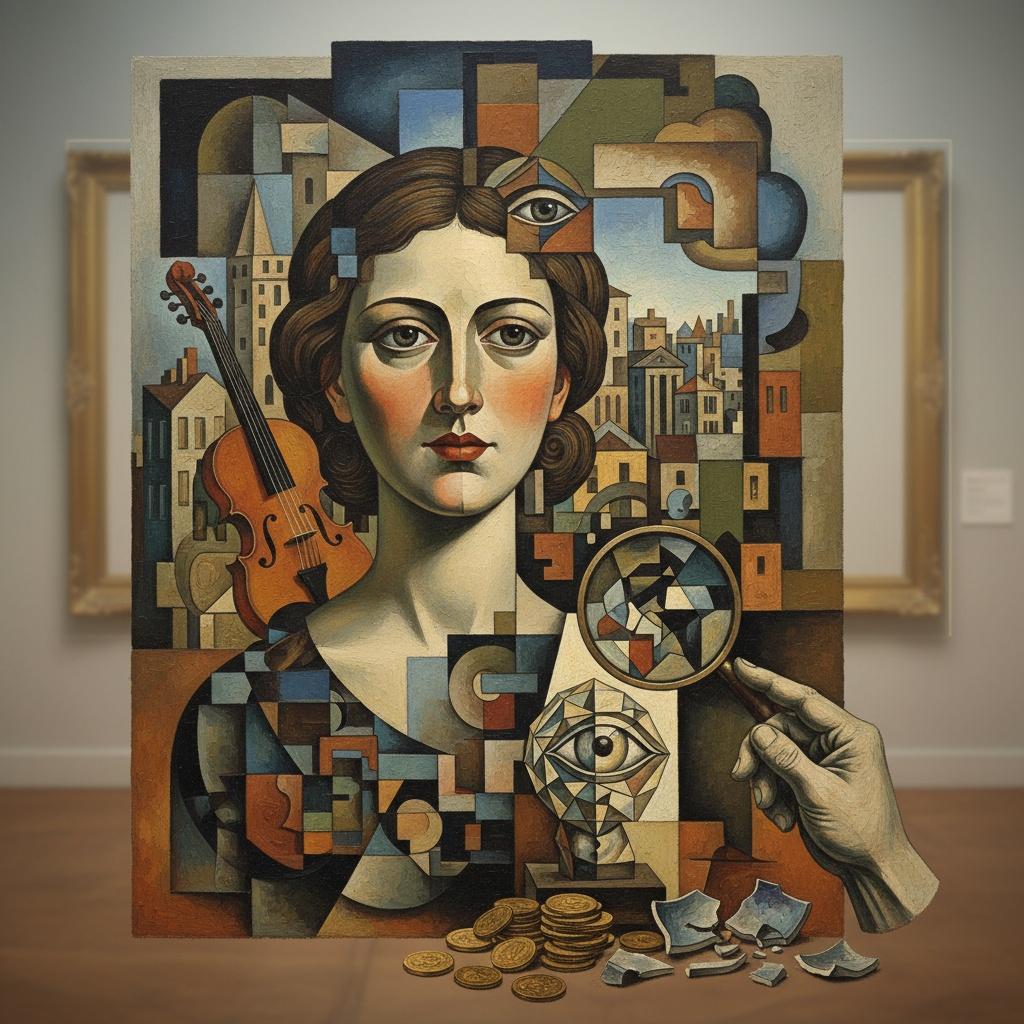
The revolution was characterized by the fragmentation of objects into geometric components, stripping away the superficiality of light and shadow to reveal the underlying structure of form. By breaking the subject into facets, Cubism challenged the very notion of what it means to "see." It invited the observer to participate in a reconstruction of reality, where the boundaries between object and space became increasingly blurred. This period marked the end of art as mere mimicry and the beginning of art as an autonomous, conceptual exploration of the essence of existence.
Geometric Truths: The Shift from Mimry to Abstraction
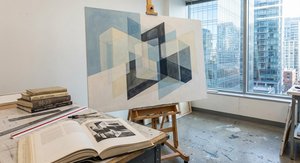
As the movement matured, the pursuit of geometric truth became the guiding light for a new generation of visionaries. The transition from the representational to the abstract was not an abandonment of reality, but a deeper dive into its fundamental architecture. Where traditional painters sought to capture the ephemeral glow of sunlight on silk, the Cubists sought the permanence of the cube, the sphere, and the cone. This pursuit is beautifully echoed in works like Abstraction 6 by Frantisek Kupka, where geometric compositions embody modernist principles through a layered, symbolic depth that transcends simple depiction.
This era of abstraction demanded a new kind of literacy from the collector. One had to learn to read the language of lines and planes. The influence of this movement can be traced through the evolution of American modernism, seen in the dynamic, textured triptychs of Vaclav Vytlacil, where bold lines and geometric shapes create a rhythmic tension. This shift moved the focus from the what of the subject to the how of its construction, establishing a precedent for the entire trajectory of twentieth-century abstraction and paving the way for movements like the concrete art movement, exemplified by groups such as equipo 57.
Multiplicity of Vision: Redefining Depth and Temporal Perspective
Perhaps the most profound achievement of Cubism was its ability to introduce the dimension of time into a static medium. By presenting multiple viewpoints simultaneously—the profile, the frontal view, and the oblique angle all occupying the same plane—the artist achieved a multiplicity of vision. This technique effectively collapsed the distance between the viewer and the subject, creating a sense of temporal movement. The eye no longer rests on a single point; instead, it wanders across the facets of the canvas, experiencing the subject as a series of interconnected moments.
This concept of perspectives extends far beyond the boundaries of the Cubist era. We see its echoes in the modernist works of Néjib Belkhodja, where geometric abstraction and tunnel-like scenes create a unique sense of depth that feels both immersive and intellectually stimulating. This ability to manipulate space—to create a sense of looking through or into a structure—redefined the psychological impact of art. It transformed the canvas from a passive surface into an active, multidimensional environment that mirrors the complexity of human perception and memory.
The Legacy of Form: From Analytical Cubism to Modern Geometric Abstraction
The lineage of Cubism is a continuous thread that weaves through the fabric of modern art history. The analytical phase, with its muted palettes and intense fragmentation, eventually gave way to more synthetic approaches, where color and texture played a more prominent role in defining form. This evolution was championed by pioneers like Auguste Herbin, whose work revolutionized painting through vibrant color theories and complex geometric compositions. His ability to balance the structural rigor of Cubism with the emotive power of color became a cornerstone for future abstract movements.
Today, the legacy of this movement is visible in every corner of contemporary abstraction. The principles of structure, rhythm, and the interplay of light and geometry continue to inspire artists who seek to communicate complex ideas through simplified forms. From the stark, monochromatic precision of early modernist prints to the lush, layered textures of modern oil reproductions, the DNA of Cubism remains present. It taught us that art does not need to mirror the world to be true; it only needs to capture the underlying logic and beauty of the universe's construction.
Curating the Fragmented Aesthetic: Integrating Cubist Principles into Modern Collections
For the discerning collector, integrating works influenced by Cubist principles requires an appreciation for both form and intellectual depth. A collection that celebrates geometric abstraction offers a sophisticated dialogue between historical reverence and modern architectural aesthetics. Whether it is a large-scale multi-panel installation that spans a grand staircase or a singular, textured oil painting that serves as a focal point in a minimalist study, the impact of these works lies in their ability to command space through structural integrity.
Modern curation allows for a beautiful "remixing" of art history. One might pair a contemporary geometric print with a classical landscape, creating a tension between tradition and innovation. The key is to look for the tactile depth—the visible brushstrokes and the three-dimensional texture that give an artwork its soul. As we continue to explore new ways to interact with art, from AI-driven stylistic transformations to bespoke hand-painted commissions, the fundamental lessons of Cubism—to see beyond the surface and find the structure within—remain as vital and captivating as ever.
At OriginalUniqueArt.com, we celebrate this enduring legacy by providing access to museum-quality reproductions and custom commissions that honor the masters. From meticulously layered oil paintings to high-fidelity Giclée prints, our mission is to bring the profound beauty of art history into the modern home, ensuring that the revolutionary spirit of the avant-garde continues to inspire generations of collectors worldwide.