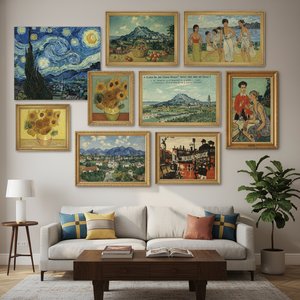
The Impressionist Legacy: The Foundation of a Revolution
To understand the profound shift that occurred at the end of the nineteenth century, one must first look back at the shimmering light of the Impressionists. Before the Post-Impressionists sought to redefine the canvas, masters like Claude Monet and Pierre-Auguste Renoir had already shattered the rigid constraints of the Académie des Beaux-Arts. They turned their gaze away from historical allegories and toward the ephemeral beauty of a sun-drenched garden or the fleeting movement of water. Their revolution was one of perception, capturing the impression of a moment through broken brushstrokes and an unprecedented focus on natural light.
This era introduced a radical new way of seeing, where the atmosphere itself became a subject worthy of study. However, while the Impressionists succeeded in capturing the transient nature of reality, they often left behind a sense of incompleterness. The works were beautiful and luminous, yet they lacked the structural permanence and emotional weight that many artists felt were necessary to truly convey the depth of human experience. This tension between the fleeting moment and the desire for lasting form would become the catalyst for the next great movement in art history.
As these painters moved beyond mere observation, they began to realize that light alone could not tell the whole story. The foundation laid by Impressionism was essential, providing the technical freedom and color palette necessary for what was to come, yet it served primarily as a springboard for a much more structured and expressive era.
Breaking the Surface: Defining the Post-Impressionist Movement
Post-Impressionism was not a single, unified school of thought, but rather a diverse collection of artists who shared a common desire to move beyond the superficiality of light. While they retained the vibrant, unblended colors of their predecessors, these artists sought to inject more order, symbolism, and personal emotion into their compositions. They were no longer content with simply recording what the eye saw; they wanted to express what the soul felt and what the mind understood about the underlying structure of the world.
This movement emerged as a reaction against the perceived lack of form in Impressionism. Artists began to experiment with more deliberate, heavy outlines and much more saturated palettes. Some sought to restore a sense of geometric permanence to the landscape, while others used color as a psychological tool to evoke specific moods or spiritual states. It was an era of profound experimentation where the canvas became a site for intellectual and emotional exploration.
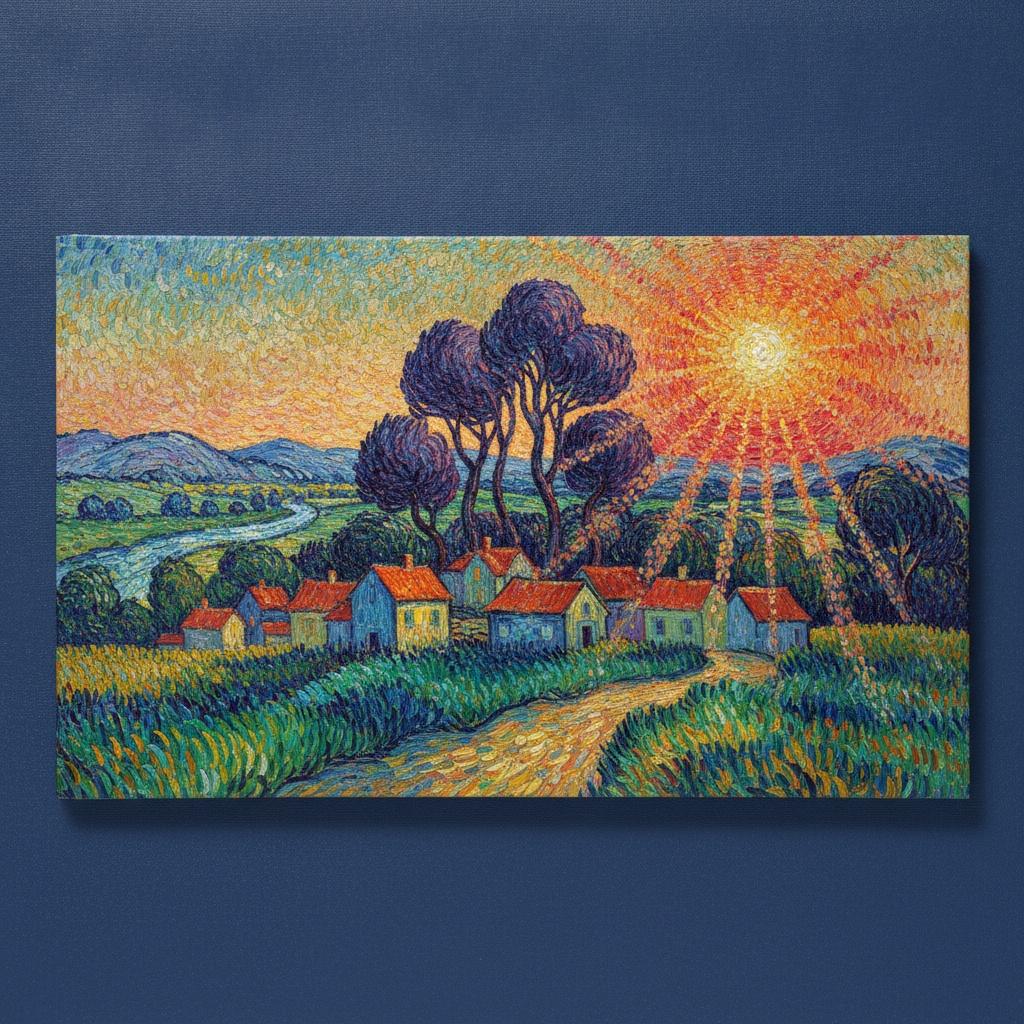
The beauty of Post-Impressionism lies in its incredible variety. One might encounter the rhythmic, swirling energy of a landscape that feels alive with movement, or a portrait so heavy with symbolic meaning that every shadow tells a story. By breaking away from the purely optical experience, these artists paved the way for the abstraction and expressionism that would dominate the twentieth century, forever changing our relationship with the painted image.
The Science of Color: Seurat and the Mastery of Pointillism
Among the most revolutionary figures of this era was Georges Seurat, a man who approached the canvas with the precision of a scientist. While his contemporaries were often driven by spontaneous emotion, Seurat sought to bring a mathematical rigor to the application of color. He developed a technique known as Pointillism, or Divisionism, which involved applying tiny, distinct dots of pure color in close proximity to one another.
The magic of this method lies in the phenomenon of optical mixing. Rather than blending pigments on a palette—which can often lead to muddy, dull tones—Seurat placed dots of complementary colors side-by-side, allowing the viewer's eye to perform the blending at a distance. When viewing his monumental masterpiece, La Grande Jatte - Landscape with Figures, one does not see mere dots, but a luminous, vibrating surface where light seems to emanate from within the painting itself. This technique required immense patience and an advanced understanding of color theory.
Beyond the grand landscapes, Seurat’s ability to capture profound introspection can be seen in works like The Artist's Mother, where the Pointillist method lends a certain melancholic stillness to the portrait. Through the meticulous application of light and dot, Seurat proved that art could be both highly structured and deeply moving, bridging the gap between scientific observation and poetic expression.
Emotional Depth and Structure: Beyond the Fleeting Moment
While Seurat focused on the science of sight, other Post-Impressionists turned their attention to the weight of structure and the intensity of emotion. This period saw a departure from the "snapshot" quality of Impressionism toward a more permanent, almost architectural approach to composition. Artists like Paul Cézanne, often regarded as the father of modern art, began to treat nature in terms of its fundamental shapes—the sphere, the cone, and the cylinder.
Cézanne’s work was a masterclass in balance; he sought to capture the enduring essence of a mountain or an orchard, using deliberate brushstrokes to build a sense of volume and mass. This structural integrity provided a much-needed anchor to the vibrant colors of the age. Simultaneously, other artists used the canvas as a vessel for intense, often turbulent, psychological expression. The use of color became less about mimicking sunlight and more about conveying internal landscapes of joy, fear, or solitude.
This duality—the search for structural permanence on one hand and the exploration of raw emotion on the other—is what gives Post-Impressionism its enduring power. Whether through the rhythmic patterns of a landscape or the heavy, expressive textures of a portrait, these artists ensured that art would no longer be just a reflection of the external world, but a profound dialogue with the internal one.
The Lasting Impact: How Post-Impressionism Shaped Modern Art
The legacy of the Post-Impressionists is woven into the very fabric of modern creativity. By liberating color from its descriptive role and emphasizing the artist's subjective vision, they dismantled the traditional boundaries of representation. The movement’s emphasis on structure directly informed the development of Cubism, while its emotional intensity became the cornerstone of Fauvism and German Expressionism.
Today, we see their influence in everything from the bold, graphic nature of modern design to the textured, emotive qualities of contemporary painting. They taught us that a painting does not need to be a window into a literal reality; instead, it can be a window into a reimagined world, constructed through the deliberate use of line, color, and form.
For the modern collector and art enthusiast, appreciating Post-Impressionism is an invitation to look deeper. It is a reminder that beneath the surface of what we see lies a complex web of technique, emotion, and intellect. As we continue to explore these vibrant works, we are not just looking at history; we are experiencing the very moment when the modern eye was born.
At OriginalUniqueArt.com, we celebrate this enduring legacy by bringing the masters back to life. Our studio specializes in creating exquisite, hand-painted oil reproductions that capture the tactile soul of Post-Impressionist masterpieces. From the meticulous Pointillism of Seurat to the textured impasto of the great expressionists, our artists use premium pigments and heavy-duty canvas to ensure every brushstroke retains its historical depth. Whether you are looking for a museum-quality Giclée print or a bespoke, custom oil painting transformed from your own photograph, OriginalUniqueArt is dedicated to preserving the magic of art history for your home.