The Venetian Context: A Republic Forged in Art
The Venetian Renaissance had a distinct character compared to the general Italian Renaissance elsewhere. The Republic of Venice was topographically distinct from the rest of the city-states of Renaissance Italy as a result of their geographic locatio...
To understand Vittore Carpaccio, one must first grasp the unique spirit of Venice itself. Unlike Florence, Rome, or Milan—cities defined by powerful families and centralized authority—Venice was a republic, a maritime empire built on trade, diplomacy, and a remarkable degree of collective governance. This distinct political landscape profoundly shaped its art. The city’s wealth, derived from its control of Eastern Mediterranean routes, fostered a cosmopolitan atmosphere where diverse influences converged. Art wasn't primarily commissioned by popes or princes seeking to assert dominance; instead, it flourished through the patronage of guilds, confraternities, and wealthy merchants who valued beauty, narrative detail, and the celebration of civic life. This environment allowed for a more eclectic artistic expression, less bound by rigid classical ideals and open to the exotic allure of the East—a characteristic that would become deeply ingrained in Carpaccio’s work.
The lagoon city's very topography contributed to its artistic identity. Isolated from mainland Italy, Venice developed a unique aesthetic sensibility, prioritizing color, light, and atmosphere over linear perspective and anatomical precision – though Carpaccio demonstrates a mastery of perspective when he chooses to employ it. The shimmering reflections on the canals, the opulent fabrics traded from distant lands, and the constant interplay of water and sky all found their way into Venetian paintings, creating a world of ethereal beauty and sensual richness.
Gentile Bellini’s Legacy & Carpaccio’s Early Influences
 Wikipedia: Vittore Carpaccio
Vittore Carpaccio (UK: kar-PATCH-ee-oh, US: -PAHTCH-, Italian: [vitˈtoːre karˈpattʃo]; c. 1460/65 – c. 1525) was an Italian painter of the Venetian school who studied under Gentile Bellini. Carpaccio was largely influenced by the style of the earl...
Vittore Carpaccio (c. 1460/65 – c. 1525) entered this vibrant artistic milieu as a student of Gentile Bellini, one of the leading painters in Venice at the time. Bellini's influence is readily apparent in Carpaccio’s early works—a meticulous attention to detail, a refined sense of composition, and a penchant for historical narrative. However, Carpaccio wasn’t merely an imitator. While he absorbed his mentor’s technical skills, he developed a distinctive voice characterized by a more lyrical quality, a greater emphasis on decorative elements, and a fascination with the everyday world.
Beyond Bellini, Carpaccio's artistic formation was shaped by exposure to Antonello da Messina, whose pioneering use of oil paint brought new levels of realism and luminosity to Italian art. The influence of Early Netherlandish painting is also discernible in his precise rendering of textures, intricate details, and symbolic motifs. This synthesis of diverse influences—Venetian tradition, Flemish realism, and the innovations of Antonello—created a unique artistic blend that set Carpaccio apart from his contemporaries.
Narrative Cycles: The Legend of St. Ursula and Beyond
 Vittore Carpaccio
Explore the captivating Venetian Renaissance paintings of Vittore Carpaccio (1465-1526). Known for narrative cycles like 'The Legend of St. Ursula,' his work blends early Netherlandish & Italian styles with a unique orientalist flair. Discover his le
Carpaccio is best known for his large-scale narrative cycles, particularly The Legend of St. Ursula, commissioned by the Scuola di San Giorgio degli Schiavoni in 1490. This ambitious project comprises nine panels depicting the life and martyrdom of St. Ursula, a British princess who led a pilgrimage to Cologne with eleven thousand virgins. What distinguishes Carpaccio’s treatment of this subject is not simply his technical skill—though it is remarkable—but his ability to transform a religious narrative into a captivating visual spectacle.
Each panel is a miniature world unto itself, filled with meticulously rendered figures, elaborate architectural settings, and exotic details. Carpaccio doesn't focus solely on the dramatic climax of Ursula’s martyrdom; he devotes equal attention to the journey itself, depicting scenes of everyday life along the Rhine River, encounters with various cultures, and moments of quiet contemplation. This emphasis on the mundane elevates the narrative beyond a simple recounting of religious events, imbuing it with a sense of human drama and emotional resonance.
Other notable narrative cycles include The Life of Moses and The Passion of St. Jerome, each demonstrating Carpaccio’s mastery of storytelling and his ability to create visually compelling compositions that draw the viewer into the heart of the scene.
Detail as Devotion: Examining Carpaccio's Technique & Symbolism
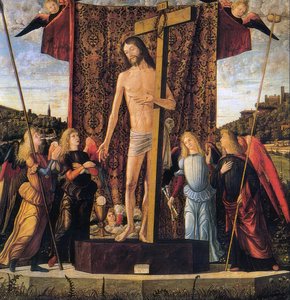 Christ with the Symbols of the Passion Surrounded by Angels
Witness Vittore Carpaccio’s 1510 ‘Christ with the Passion.’ A poignant Renaissance masterpiece blending sorrow & symbolism. Explore Venetian artistry, detailed figures & divine beauty.
Carpaccio’s paintings are renowned for their extraordinary level of detail. He meticulously renders fabrics, architectural elements, and natural objects with a precision that borders on hyperrealism. This isn’t merely an exercise in technical virtuosity; it’s an integral part of his artistic vision. For Carpaccio, detail wasn't simply decorative—it was devotional.
Every object, every gesture, every architectural feature is imbued with symbolic meaning. The rich costumes worn by the figures reflect their social status and religious beliefs. The elaborate architecture evokes the grandeur of Venice and its connection to the classical world. Even seemingly insignificant details—the types of flowers depicted in a garden, the patterns on a carpet—carry hidden layers of symbolism. Christ with the Symbols of the Passion Surrounded by Angels (1510) exemplifies this approach, where each element contributes to a deeper understanding of Christ’s suffering and sacrifice.
His use of color is equally significant. Carpaccio favored rich, luminous hues—deep reds, blues, and golds—that create a sense of opulence and spiritual intensity. He often employed contrasting colors to highlight key figures or objects, drawing the viewer's attention to specific details within the composition.
Carpaccio’s Portraits: Capturing Venetian Nobility & Individuality
 Portrait of a lady
Admire Vittore Carpaccio's Renaissance masterpiece, 'Portrait of a Lady.' This captivating painting showcases exquisite detail and a serene expression, offering a glimpse into Venetian nobility of the 1490s.
While best known for his narrative cycles, Carpaccio also produced a number of exquisite portraits that offer fascinating glimpses into Venetian society. Portrait of a Lady (c. 1490s) is a particularly striking example, showcasing his ability to capture not only the physical likeness of his sitter but also her inner character.
The lady’s serene expression, elegant attire, and refined posture convey a sense of dignity and intelligence. Carpaccio pays meticulous attention to the details of her clothing—the intricate embroidery on her sleeves, the delicate folds of her gown—revealing her social status and wealth. However, it is in her eyes that we find the true essence of the portrait—a quiet intensity and subtle self-awareness that transcends mere representation.
Carpaccio’s portraits are not simply likenesses; they are psychological studies, offering insights into the lives and personalities of the Venetian elite. They reveal a society that valued beauty, refinement, and intellectual pursuits.
A Lasting Impression: Rediscovering the Master Storyteller
Despite being celebrated during his lifetime, Carpaccio’s reputation waned in the centuries following his death. He was often overshadowed by more flamboyant contemporaries like Titian and Tintoretto. However, in recent decades, there has been a renewed appreciation for his unique artistic vision.
Scholars have come to recognize Carpaccio as a master storyteller, whose paintings offer not only technical brilliance but also profound insights into Venetian culture and society. His meticulous attention to detail, lyrical compositions, and captivating narratives continue to resonate with audiences today. Whether exploring the epic journey of St. Ursula or capturing the quiet dignity of a Venetian noblewoman, Carpaccio’s work invites us to immerse ourselves in a world of beauty, wonder, and spiritual contemplation.
Discover the timeless masterpieces of Vittore Carpaccio at OriginalUniqueArt.com, where you can explore museum-quality reproductions and bring his captivating art into your home.