Early Life and Apprenticeship: Foundations of a Ukiyo-e Master
Utagawa Kuniyoshi, born Yanagiya Yoshisaburō on January 1st, 1798, emerged from the bustling world of Edo-period Japan—a society steeped in tradition yet increasingly open to new forms of expression. His father was a silk dyer, and it’s believed that early exposure to the intricate patterns and vibrant colors inherent in textile design subtly shaped Kuniyoshi's artistic sensibility. However, his true calling resonated with the dramatic imagery he encountered as a young boy: the bold woodblock prints depicting legendary samurai and scenes of everyday life. These weren’t merely pictures; they were windows into a world of heroism, adventure, and fleeting beauty—a “floating world” (ukiyo) that would become his lifelong obsession.
At the age of twelve, Yoshisaburō demonstrated sufficient talent to attract the attention of Utagawa Toyokuni, a prominent master within the renowned Utagawa school. Admission into Toyokuni’s studio in 1811 marked a formal commitment to the rigorous discipline of ukiyo-e production. For three years, he immersed himself in the techniques of woodblock printing—sketching preliminary designs, understanding the nuances of carving and color application, and absorbing the stylistic conventions of his teacher. This apprenticeship wasn’t simply about mastering a craft; it was about inheriting a legacy, learning to navigate the complex world of publishers and patrons, and finding one's own voice within an established artistic tradition.
His early works, published around 1814 after receiving the name “Kuniyoshi,” were modest—illustrations for popular chapbooks (kusazōshi) often parodying well-known tales like the *Chūshingura*. These initial efforts, while not groundbreaking, revealed a burgeoning talent and a willingness to experiment with narrative storytelling. However, the following years proved challenging; a lack of consistent commissions and fierce competition within the Utagawa school threatened to stifle his artistic development.
The Suikoden Series and Rise to Prominence: A Turning Point in Kuniyoshi’s Career
The turning point arrived in 1827 with the commission for *One Hundred and Eight Heroes of the Popular Suikoden* (Tsūzoku Suikoden gōketsu hyakuhachinin no hitori). Based on the immensely popular Chinese novel *Shuihu Zhuan*, this series catapulted Kuniyoshi to fame. The tale, brimming with outlaws, rebels, and acts of extraordinary courage, resonated deeply with Edo-period audiences—a population increasingly drawn to stories that challenged conventional authority. Kuniyoshi didn’t simply illustrate the characters; he *embodied* them.
What set Kuniyoshi's Suikoden prints apart was his innovative approach to character depiction. He adorned each hero with elaborate, often fantastical tattoos—a novelty that quickly became a fashion statement in Edo society. These weren’t merely decorative elements; they were visual narratives themselves, hinting at the characters’ backstories and personalities. The series wasn't just about depicting warriors; it was about capturing their spirit, their flaws, and their unwavering loyalty to one another. The demand for Kuniyoshi’s prints surged, establishing him as a leading figure in the ukiyo-e world and opening doors to collaborations with prominent literary circles.
This success wasn't accidental. Kuniyoshi possessed an uncanny ability to tap into the collective imagination of his audience, understanding their desires for dramatic storytelling, heroic figures, and visually arresting imagery. The Suikoden series proved that he was not merely a skilled craftsman but a master storyteller capable of captivating the hearts and minds of Edo-period Japan.
Warrior Prints and the Blending of Myth, History, and Spectacle
Following the triumph of *Suikoden*, Kuniyoshi dedicated himself to exploring the rich tapestry of Japanese war tales. He drew inspiration from classics like the *Tale of the Heike* (Heike monogatari) and *The Rise and Fall of the Minamoto and Taira* (Genpei Seisuiki), transforming historical events and legendary battles into breathtaking woodblock prints. However, Kuniyoshi’s depictions weren't simply faithful recreations; they were infused with a unique blend of myth, imagination, and dramatic spectacle.
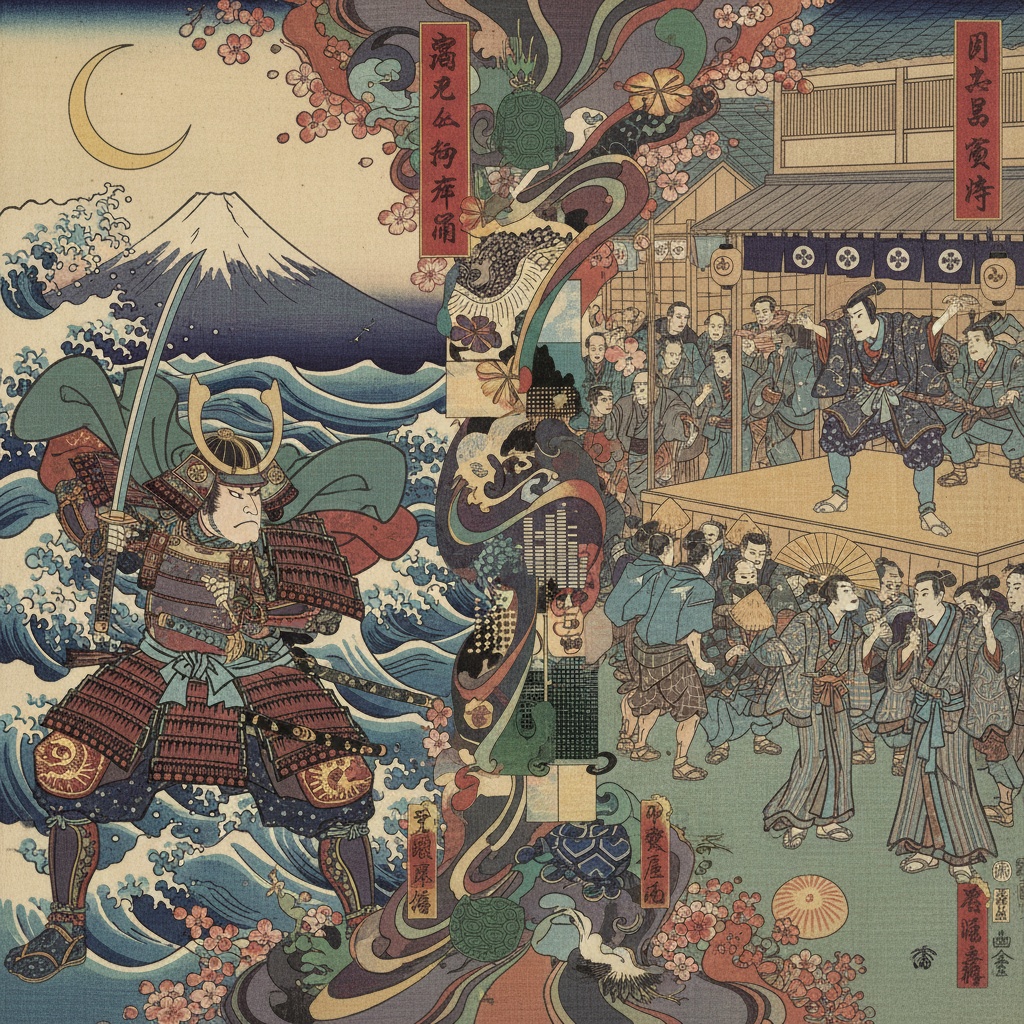
He introduced elements of the supernatural—ghostly apparitions, ominous omens, and superhuman feats—adding layers of intrigue and emotional resonance to his compositions. His prints often depicted warriors in moments of intense action, their faces contorted with determination or anguish, surrounded by swirling clouds, crashing waves, and vibrant bursts of color. *The Ghost of Taira no Tomomori at Daimotsu Bay* (Taira Tomomori borei no zu) exemplifies this approach—a haunting depiction of a vengeful spirit rising from the sea, embodying the tragic fate of a fallen warrior. Similarly, his 1839 triptych *The Gōjō Bridge* (Gōjō no bashi no zu) masterfully conveys the chaos and intensity of combat between Yoshitsune and Benkei, showcasing Kuniyoshi’s ability to evoke a powerful sense of movement and emotion.
This fascination with the ghastly, exciting, and bizarre reflected a growing public appetite for sensationalism during the Edo period. Kuniyoshi skillfully catered to this demand, creating prints that were not only visually stunning but also emotionally captivating—works that tapped into the collective anxieties and aspirations of his audience.
Kuniyoshi's Innovative Use of Color, Composition, and Western Influences
Beyond his compelling subject matter, Kuniyoshi distinguished himself through his mastery of color, composition, and a subtle yet significant incorporation of Western artistic techniques. While deeply rooted in traditional ukiyo-e aesthetics, he wasn’t afraid to experiment with new approaches, pushing the boundaries of the medium.
His use of color was particularly striking—often employing bold contrasts, rich textures, and intricate patterns inspired by his father's silk dyeing business. He understood how color could evoke specific emotions, create a sense of depth, and draw the viewer’s eye to key elements within the composition. Furthermore, Kuniyoshi demonstrated an exceptional talent for dynamic composition, often utilizing unconventional angles, dramatic perspectives, and overlapping forms to create a sense of movement and energy.
Perhaps most subtly, his work reveals traces of Western influence—particularly in his exploration of landscape painting and caricature. While not directly copying Western styles, he incorporated elements such as atmospheric perspective, realistic shading, and exaggerated facial expressions into his prints. This wasn’t a wholesale adoption of Western techniques but rather a selective integration that enhanced the emotional impact and visual complexity of his work.
Beyond Warriors: Exploring the Breadth of Kuniyoshi’s Subject Matter – Landscapes, Women, and Kabuki
While best known for his warrior prints, to define Kuniyoshi solely by this genre would be a disservice to the breadth of his artistic vision. He was a remarkably versatile artist who explored a diverse range of subjects throughout his career—landscapes, women (bijin-ga), Kabuki actors, cats, and even mythical creatures.
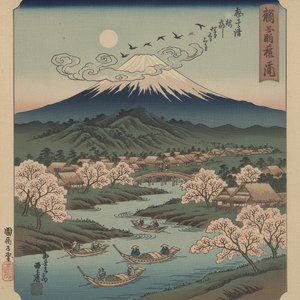
His landscape prints, though less numerous than his warrior scenes, demonstrate a keen eye for detail and a sensitivity to the natural world. He captured the beauty of Japan’s diverse landscapes—from serene mountain vistas to bustling coastal towns—with a delicate balance of realism and artistic interpretation. His depictions of women, while often adhering to traditional aesthetic conventions, reveal a subtle psychological depth and an appreciation for their inner lives.
Kabuki actors were another frequent subject, capturing the drama and spectacle of Japan’s iconic theatrical tradition. He skillfully portrayed their elaborate costumes, expressive gestures, and captivating performances—offering glimpses into the vibrant world of Edo-period entertainment. Even his seemingly whimsical prints of cats reveal a playful sense of humor and an attention to detail that is characteristic of his broader artistic style.
Legacy and Influence: Kuniyoshi’s Enduring Impact on Japanese Art and Beyond
Utagawa Kuniyoshi passed away in 1861, leaving behind a vast body of work that continues to captivate audiences today. As one of the last great masters of ukiyo-e, he played a pivotal role in shaping the evolution of Japanese woodblock printing—pushing the boundaries of narrative storytelling, color application, and compositional innovation.
His influence extended far beyond his own lifetime. Kuniyoshi’s dynamic warrior prints inspired generations of artists, both within Japan and abroad. His bold compositions, vibrant colors, and dramatic subject matter resonated with a growing public appetite for sensationalism and spectacle. He left an indelible mark on the art world.
Today, Kuniyoshi's works are celebrated in museums and private collections around the globe—testaments to his enduring artistic legacy. At OriginalUniqueArt.com, we are proud to offer high-quality reproductions of his masterpieces, allowing you to experience the captivating beauty and narrative power of this extraordinary artist firsthand. Explore our collection and discover the world of Utag