From Snapshot to Canvas: The Historical Evolution of Portraiture & AI's Role
Neural style transfer (NST) software algorithms are able to manipulate digital images, or videos, in order to adopt the appearance or visual style of another image. NST algorithms are characterized by their use of deep neural networks for the sake of...
For centuries, the human desire to capture likenesses has driven artistic innovation. From the solemn grandeur of Egyptian funerary masks to the opulent oils depicting Renaissance nobility, portraiture wasn’t merely about visual representation; it was a declaration of status, an assertion of lineage, and ultimately, a striving for immortality. These early commissions were inherently exclusive – reserved for those who could afford the patronage of skilled masters. The advent of photography in the 19th century democratized image-making to a degree, yet often lacked the nuanced artistry sought by individuals yearning for something beyond simple replication. Digital manipulation offered fleeting control, but frequently resulted in images that felt sterile or lacking in genuine emotional resonance. Today, we stand at the cusp of another revolution: artificial intelligence (AI) is not simply mimicking art; it’s reimagining its very foundations, offering unprecedented opportunities to transform cherished photographs into unique artistic expressions accessible to all.
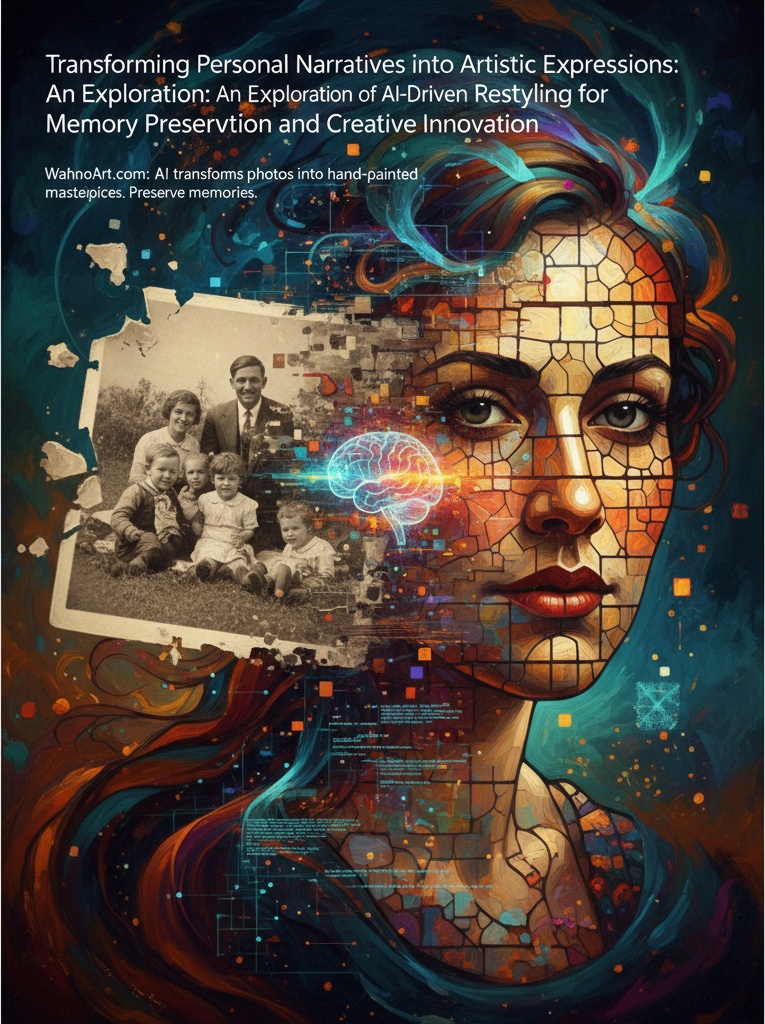
The core principle driving this transformation lies within neural style transfer (NST). Algorithms analyze the stylistic elements – the brushstrokes of Van Gogh, the color palettes of Monet, the textural complexities of Rembrandt – and apply them to user-supplied photographs. This isn’t a mere filter; it's a complex process involving deep learning networks that dissect and reconstruct artistic techniques. The technology has evolved from its initial experimental phase in 2015, popularized by apps like DeepArt and Prisma, into sophisticated tools capable of producing museum-quality reproductions. The separation of ‘content’ – the objects and composition within an image – from ‘style’ is key. AI algorithms then recombine these elements, resulting in a photograph imbued with the aesthetic qualities of a chosen masterpiece, effectively bridging the gap between personal memory and artistic legacy.
The Science Behind the Style: Understanding Neural Networks, GANs & Diffusion Models
Delving deeper into the mechanics reveals a fascinating interplay of computer vision and deep learning. NST forms the bedrock of many photo restyling applications. Research on image stylization over the past two decades demonstrates that these algorithms utilize convolutional neural networks (CNNs) to deconstruct images, extracting content from deeper layers – capturing structural elements – while discerning style from shallower layers, focusing on textures and patterns. However, NST is just one piece of the puzzle. Generative Adversarial Networks (GANs) represent a more advanced approach. These networks consist of two competing components: a generator that creates new images and a discriminator that attempts to distinguish between real artworks and AI-generated reproductions. Through iterative training – a constant push and pull – the generator learns to produce increasingly realistic and stylistically accurate results, pushing the boundaries of visual fidelity.
More recently, diffusion models have emerged as a dominant force in the field. Unlike GANs which directly generate images, diffusion models operate by gradually adding noise to an image until it becomes pure randomness, then learning to reverse this process – effectively ‘denoising’ the image to create new content. This approach allows for greater control over detail and realism, resulting in outputs that are often indistinguishable from hand-painted artworks. The advancements highlighted in recent research papers demonstrate a clear progression: from early optimization-based methods requiring significant processing time, to millisecond feed-forward generators capable of 4K resolution – a testament to the rapid evolution of AI technology.
Beyond Replication: Achieving Artistic Depth with AI-Driven Photo Restyling
While AI excels at replicating stylistic elements, achieving truly artistic results demands more than technical prowess. It requires careful consideration of aesthetic principles and, crucially, human oversight. The ability to transform a photograph into the style of Van Gogh is impressive, but it doesn’t automatically equate to compelling art. A successful transformation considers factors beyond mere visual replication – composition, color harmony, emotional impact, and narrative coherence. The article ‘AI: An Active and Innovative Tool for Artistic Creation’ emphasizes the need for human-centered approaches in AI art, advocating for collaboration rather than complete automation.
Artists can leverage AI as a powerful tool to explore new creative avenues but must retain control over the artistic vision. This involves carefully selecting source images – choosing photographs that possess inherent compositional strength and emotional resonance – adjusting parameters to fine-tune the stylistic transfer, and refining the output to achieve a desired aesthetic effect. The ethical implications of authorship also come into play: is an AI-generated artwork truly ‘original,’ or simply a derivative work based on existing styles? Transparency in the process – acknowledging the role of AI – is crucial for maintaining artistic integrity. Furthermore, understanding the limitations of AI is essential; algorithms can struggle with complex compositions, subtle details, and nuanced emotions.
Transforming Memories into Tangible Art: Practical Applications for Home & Business
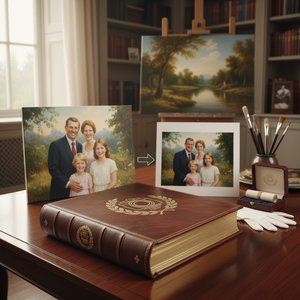
The practical application of AI-driven photo restyling extends far beyond personal enjoyment, encompassing a diverse range of professional fields. One prominent example is the transformation of travel photography into timeless oil paintings, allowing individuals to preserve cherished memories in a classic medium. This service caters to those seeking museum-quality reproductions that capture not just *what* they saw, but *how* they felt. Custom portrait commissions represent another significant market. AI enables the creation of unique portraits styled after renowned artists – imagine a family portrait rendered in the vibrant brushstrokes of Monet or a beloved pet immortalized in the Pop Art style of Warhol – offering personalized gifts for weddings, anniversaries, and other special occasions.
Interior designers can leverage this technology to create bespoke artwork that complements specific spaces and aesthetic themes. Marketing professionals can utilize AI-generated images for advertising campaigns, creating visually compelling content that resonates with target audiences. The ability to rapidly generate variations of an image – exploring different styles, colors, and compositions – streamlines the creative process and reduces production costs. Furthermore, businesses can commission custom artwork for offices, hotels, and other commercial spaces, enhancing their brand identity and creating a unique atmosphere.
Ensuring Museum Quality: Materials, Artists & The Reproduction Process
The pursuit of museum-quality results hinges on a commitment to excellence in every stage of the process. Hand-painted reproductions are created by skilled artists with close attention to detail and historical accuracy. The expertise of the artist is paramount – their ability to capture the nuances of brushstrokes, color palettes, and textures distinguishes a mere copy from a genuine work of art. The choice of materials also plays an indispensable role. Premium-grade oil paints, renowned for their vibrancy and longevity, are applied to 100% cotton canvas, ensuring archival quality that will endure for generations.
Framing options should not be an afterthought; they must complement the artwork and protect it from damage. Digital reproductions require high-resolution scans and printing techniques that accurately reproduce colors and details. Giclée prints, utilizing archival inks, offer exceptional durability and vibrancy. The process often involves a multi-step review system, with artists providing detailed photographs of the work in progress for client approval. Adjustments can be made at any stage to ensure complete satisfaction – a testament to our dedication to exceeding expectations.
Navigating the Landscape: Choosing a Service and Maximizing Your Results
Selecting the right service is crucial for realizing your artistic vision. Consider your aesthetic goals: what style do you want to emulate? Do you have a specific artist in mind? Look for companies that employ skilled artists, utilize premium materials, and offer a satisfaction guarantee – a commitment to quality speaks volumes. Provide high-quality source images; clear, well-lit photographs with good resolution will yield the best results. Be prepared to provide feedback throughout the process; artists may require clarification on specific details or adjustments to achieve your desired aesthetic effect.
Understand the limitations of AI – algorithms can struggle with complex compositions and subtle nuances. Don’t expect a perfect replica; embrace the unique qualities of the AI-generated artwork, recognizing it as an interpretation rather than a carbon copy. Ask about the artist’s experience and qualifications; a skilled artist will be able to translate your vision into a compelling piece of art. At OriginalUniqueArt.com, we believe in democratizing access to art and empowering individuals to transform their cherished memories into lasting masterpieces. We offer a comprehensive suite of services, from hand-painted reproductions to custom portrait commissions, all executed with the highest standards of artistry and care. Let us help you bring your vision to life.