Introduction: The Enduring Appeal of Moral Allegory
 Wikipedia: Allegory
As a literary device or artistic form, an allegory is a narrative or visual representation in which a character, place, or event can be interpreted to represent a meaning with moral or political significance. Authors have used allegory throughout his...
From the earliest cave paintings to the grand frescoes of the Renaissance, art has served as a mirror reflecting humanity’s deepest concerns – and its most persistent struggles. Among these, the concepts of virtue and vice hold a particularly enduring fascination. These aren't simply abstract ideas; they are embodied forces, dramatic characters in a timeless play enacted across canvas and stone. The appeal lies not merely in didactic storytelling, but in the potent visual language used to explore the complexities of human nature, offering both warning and aspiration. The very act of representing these qualities—of giving form to concepts like greed, temperance, or envy—demands a level of artistic skill and psychological insight that continues to captivate audiences centuries later.
The Renaissance Stage for Virtue & Vice: A Flourishing of Symbolic Representation
Renaissance art (1350 – 1620) is the painting, sculpture, and decorative arts of the period of European history known as the Renaissance, which emerged as a distinct style in Italy in about AD 1400, in parallel with developments which occurred in phi...
The Italian Renaissance witnessed an extraordinary resurgence of interest in classical learning, philosophy, and aesthetics. This wasn’t simply a nostalgic revival; it was a dynamic re-engagement with the past that profoundly shaped artistic expression. Humanism, with its emphasis on individual potential and earthly experience, provided fertile ground for exploring moral themes. Artists began to move beyond purely religious iconography, delving into allegorical narratives that examined the choices individuals faced and their consequences. This period saw a deliberate attempt to visually codify virtues and vices, often employing recognizable symbols – scales for justice, overflowing cornucopias for gluttony, or mirrors for vanity. The rediscovery of ancient texts also fueled this trend; artists drew inspiration from classical myths and philosophical treatises, adapting them to contemporary contexts. The patronage system played a crucial role, with wealthy families like the Medici commissioning works that not only showcased their wealth but also reflected their values—or at least, the image they wished to project.
Bosch's 'Allegory of Gluttony and Lust': A Descent into Excess and Decay
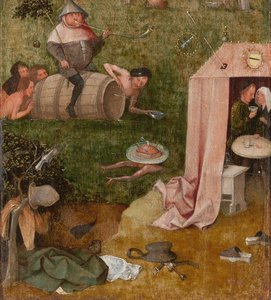 Allegory of Gluttony and Lust
Explore Hieronymus Bosch's 'Allegory of Gluttony and Lust,' a haunting triptych fragment depicting sin & excess. Witness a vivid scene of moral decay, rich in symbolism & detail – available as a stunning hand-painted reproduction.
Hieronymus Bosch’s fragmented triptych panel, ‘Allegory of Gluttony and Lust,’ offers a particularly unsettling vision of moral decay. Unlike the more balanced representations common in Renaissance art, Bosch plunges us directly into the chaotic consequences of unchecked desire. The scene is teeming with grotesque figures indulging in unrestrained excess – feasting, drinking, and engaging in illicit pleasures. What’s striking isn't just the depiction of sin itself, but the *manner* in which it’s portrayed: a swirling vortex of bodies, distorted forms, and unsettling symbolism. The artist masterfully employs color to heighten the sense of unease; lurid reds and deep blacks dominate the composition, creating an atmosphere of claustrophobia and impending doom. Bosch wasn't simply illustrating vices; he was dissecting them, revealing their inherent ugliness and spiritual emptiness. The detail is astonishing – every object, every gesture contributes to a larger narrative of moral corruption. The work serves as a stark reminder of the fragility of human virtue and the seductive power of temptation.
Botticelli’s ‘Calumny of Apelles’: The Power of False Accusation and Reputation
 Calumny of Apelles
Sandro Botticelli's 'Calumny of Apelles,' based on an ancient story by Pliny the Elder, presents a more subtle but equally powerful exploration of moral themes. The painting depicts the moment when Apelles, a renowned Greek painter, is falsely accused of wrongdoing. The scene unfolds with dramatic intensity: a deceitful figure whispers lies into the ear of a king, while innocent individuals are unjustly condemned. Botticelli’s genius lies in his ability to capture the psychological nuances of this situation – the malice of the accuser, the bewilderment of the victim, and the gullibility of those swayed by false narratives. The composition is carefully constructed; figures are arranged in a dynamic interplay of gestures and expressions, drawing the viewer's eye to the central act of deception. The use of light and shadow further enhances the dramatic effect, highlighting the vulnerability of truth in the face of slander. ‘Calumny’ isn’t merely a historical anecdote; it’s a timeless commentary on the destructive power of rumor and the importance of defending one's reputation.
Lotto's 'Allegory of Virtue and Vice': Navigating Choice and Consequence
Lorenzo Lotto’s ‘Allegory of Virtue and Vice,’ currently housed in the National Gallery of Art, offers a particularly intriguing meditation on moral decision-making. The painting is divided into two distinct realms: one representing virtue, embodied by a youthful figure surrounded by symbols of learning and contemplation; the other depicting vice, personified by a reclining satyr indulging in earthly pleasures. A broken tree trunk serves as a visual dividing line, with a golden urn—a symbol of abundance but also potential excess—placed prominently between them. The composition is rich in symbolism: books represent wisdom, while red liquid spilling from an overturned vessel suggests the dangers of unchecked desire. The satyr’s exaggerated smile and relaxed posture convey a sense of complacency, contrasting sharply with the child's focused gaze. Lotto doesn’t offer a simple moral judgment; instead, he presents us with a complex tableau that invites contemplation. The stormy sea in the background further emphasizes the precariousness of life and the challenges of navigating between opposing forces. The painting is a testament to Lotto’s masterful use of allegory and his profound understanding of human psychology.
Beyond the Canvas: The Lasting Legacy of Moral Themes in Art
The exploration of virtue and vice didn't end with the Renaissance. Throughout art history, artists have continued to grapple with these fundamental concepts, adapting them to their own cultural contexts and personal visions. From the Baroque dramas of Caravaggio to the Romantic landscapes of Caspar David Friedrich, moral themes remain a powerful source of inspiration. The enduring appeal lies in their universality – the struggles between good and evil, temptation and restraint, are timeless aspects of the human experience. Today, we can still find echoes of these ancient allegories in contemporary art, reminding us that the questions raised by Bosch, Botticelli, and Lotto remain as relevant as ever. At OriginalUniqueArt, we strive to make these masterpieces accessible, offering high-quality reproductions that allow you to bring the power and beauty of art into your own home. Explore our collection and discover the captivating stories behind these iconic works – and perhaps reflect on the virtues and vices within yourself.