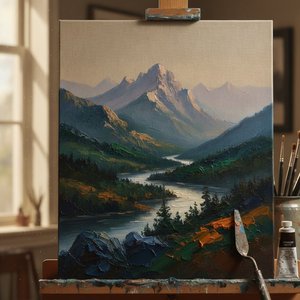
The Alchemy of Pigment: The Technical Brilliance of Oil on Canvas
To understand the profound impact of a masterpiece, one must first look beneath the surface at the very chemistry that sustains it. Unlike the rapid drying of tempera or the ephemeral nature of watercolor, oil paint offers an unparalleled window of manipulation. This slow-drying characteristic allows the artist to engage in a true dialogue with the medium, blending colors directly on the canvas to achieve transitions so seamless they appear as mere whispers of light. The alchemy lies in the suspension of pigment within drying oils, such as linseed or saffromer, creating a viscous, luscious substance that holds its form yet remains infinitely malleable.
This technical flexibility enables a level of precision and nuance that is simply unattainable in other mediums. An artist can meticulously blend a sunset's gradient or capture the subtle translucency of human skin through controlled application. The brilliance of this medium is not merely in its color, but in its ability to hold light within its very structure. When pigments are suspended in oil, they possess a unique refractive index, allowing light to penetrate multiple layers of paint before reflecting back to the viewer’s eye. This creates an internal luminosity, a glow that seems to emanate from within the canvas itself, breathing life into every stroke.
Ultimately, the technical mastery of oil painting is a pursuit of perfection through patience. It is a medium that rewards the deliberate hand and the observant eye, transforming raw minerals and botanical oils into a window onto another reality.
Layers of Emotion: How Glazing and Impasto Create Depth and Soul
The true soul of an oil painting resides in its dimensionality, achieved through the sophisticated interplay of two opposing techniques: glazing and impasto. Glazing is the art of subtlety, involving the application of thin, transparent layers of oil paint over dried underpaintings. Each translucent veil adds a new dimension of color and depth, much like looking through colored glass. This process allows for the creation of complex shadows and luminous highlights that possess a spectral quality, capturing the atmospheric perspective and the soft, diffused light characteristic of the great Impressionist masters.
In stark contrast to the ethereal nature of glazing stands the visceral power of impasto. Here, the artist abandons subtlety in favor of texture, applying thick, heavy layers of paint that rise prominently from the canvas surface. In works such as those by the Dutch Golden Age masters or the expressive movements of Romanticism, impasto serves to sculpt the light. The ridges and valleys created by the brush or palette knife catch actual physical light, casting microscopic shadows that change as the viewer moves around the piece. This tactile quality provides a sense of movement and energy, making the turbulent seas of a maritime scene or the rugged terrain of a landscape feel palpable and alive.
When these two techniques are harmonized, the result is a painting with profound emotional resonance. The depth provided by glazing offers a sense of mystery and introspection, while the physical presence of impasto provides an immediate, sensory connection to the artist's hand. It is within this tension between the transparent and the opaque that the most evocative narratives are told.
A Legacy of Light: The Historical Significance of the Oil Medium
The history of Western art is, in many ways, a history of the evolution of oil painting. While early artists relied on more temperamental mediums, the refinement of oil techniques during the Renaissance marked a pivotal shift in human expression. This era saw the emergence of masters who utilized the medium to achieve a new level of naturalism, moving away from the stylized icons of the medieval period toward a profound observation of the physical world. The ability to render texture, light, and shadow with unprecedented accuracy allowed for the birth of portraiture that captured not just likeness, but character.
As centuries progressed, the medium became the vehicle for various artistic revolutions. From the dramatic chiaroscuro of the Baroque period—where intense contrasts between light and dark created theatrical tension—to the light-drenched canvases of the Impressionists, oil remained the foundational language of prestige. The medium’s capacity to adapt to changing philosophies allowed it to remain relevant through the rise of Romanticism, the structured precision of Neoclassicism, and the emotive distortions of Modernism. It has served as the primary vessel for documenting the human condition, from the grand scale of historical epics to the intimate beauty of still lifes.
This enduring legacy is why oil on canvas remains the gold standard for collectors and enthusiasts alike. To hold an oil painting is to hold a piece of history, a continuous thread of human creativity that has been woven through the ages by hands that mastered the very essence of light.
The Tactile Experience: Why Texture Defines the Masterpiece
There is a profound difference between seeing an image and experiencing an artwork. In the realm of fine art, this distinction is often found in the tactile dimension of the canvas. A true masterpiece is not merely a flat arrangement of colors; it is a three-dimensional object that commands the space it inhabits. The presence of visible brushstrokes and the physical topography of the paint create a sensory engagement that transcends the visual. This texture invites the viewer to contemplate the physical labor and the rhythmic movement of the artist during the creative process.
The tactile nature of oil painting provides a sense of authenticity and "presence" that digital or flat reproductions often lack. When one observes the heavy, sculptural application of paint in an abstract textured work, the eyes follow the direction of the stroke, feeling the energy and the impulse behind each movement. This physical depth creates a dynamic relationship with the surrounding environment; as ambient light shifts within a room, the shadows cast by the raised paint change, ensuring that the artwork is never static. It is a living entity, responding to its architectural context.
For the discerning collector, this texture is what imbues a piece with its "aura." The ability to perceive the artist's touch—the subtle ridges of a dried brush or the thick, buttery peaks of a palette knife—connects the viewer directly to the moment of creation. It transforms the act of viewing into an intimate encounter with the physical reality of art.
Preserving the Eternal: The Science of Longevity in Oil Artworks
The enduring fascination with oil paintings is matched only by the scientific rigor required to preserve them. The longevity of these works is no accident; it is the result of a sophisticated understanding of chemistry and material science. To ensure that a masterpiece survives for centuries, artists and conservators must manage the complex drying process of oils. Using specific mediums, such as safflower oil for lighter pigments to prevent yellowing, or flexible gessoes to prevent the cracking of heavy impasto, is essential to maintaining the structural integrity of the paint film.
The final, critical step in this preservation process is the application of varnish. A high-quality coat of Damar or synthetic resin serves as a protective shield, guarding the delicate pigments from the ravages of dust, moisture, and atmospheric pollutants. This layer not only protects the surface but also saturates the colors, restoring the depth and clarity that may have been dulled by time. Furthermore, the use of heavy-duty cotton canvases and acid-free supports ensures that the foundation of the work remains stable, resisting the warping or degradation that can plague lesser materials.
When art is created with such meticulous attention to the science of permanence, it ceases to be a mere object and becomes an heirloom. It becomes a vessel of memory and culture, capable of passing through generations with its vibrancy and soul intact, standing as a testament to the enduring power of human creativity.
At OriginalUniqueArt.com, we celebrate this timeless tradition by bringing the grandeur of the Old Masters into the modern home. From hand-painted oil reproductions that capture every meticulous brushstroke to museum-quality Giclée prints, our mission is to make the profound beauty of art accessible to all. Whether you seek a custom portrait that transforms a personal memory into a Renaissance masterpiece or a large-scale mural to redefine your architectural space, our academy-trained artists are dedicated to preserving the magic of oil on canvas for a new era of collectors.