Early Life & Artistic Foundations: The Influence of Philip Reinagle
Ramsay Richard Reinagle (19 March 1775 – 17 November 1862) was an English portrait, landscape, and animal painter, and son of Philip Reinagle. == Biography == Ramsay Richard Reinagle was a pupil of his father Philip Reinagle, whose style he follo...
Ramsay Richard Reinagle’s artistic journey began not as a solitary pursuit, but as an inheritance – a continuation of the legacy established by his father, Philip Reinagle (1747-1828). Philip, a respected animal painter himself, instilled in his son a deep appreciation for the natural world and the meticulous observation required to capture its essence. Born in 1775, Ramsay Richard was immersed in an artistic environment from infancy, absorbing not only technical skills but also a burgeoning interest in the scientific study of animals that would become a hallmark of his own work. This early tutelage wasn’t merely about replicating form; it was about understanding anatomy, behavior, and the subtle nuances of light and shadow as they played across fur, feather, and scale. While Philip's style leaned towards more formal portraiture, often depicting hunting scenes with aristocratic patrons, Ramsay Richard would eventually forge his own path, blending scientific accuracy with a distinctly Romantic sensibility.
From Panoramas to Portraits: Reinagle’s Diverse Early Career
The late 18th and early 19th centuries were periods of rapid artistic innovation, and Reinagle's career reflects this dynamism. He exhibited at the Royal Academy remarkably young, in 1788, demonstrating an early aptitude for painting. However, his path wasn’t immediately linear. A significant period saw him involved with Robert Barker’s panorama in Leicester Square – a groundbreaking form of entertainment that captivated London audiences. This experience, while perhaps not traditionally ‘high art,’ proved invaluable. It honed Reinagle's skills in creating expansive scenes, managing perspective, and capturing atmospheric effects—qualities that would later distinguish his landscape work. Following this, he entered into partnership with Thomas Edward Barker to establish a rival panorama house in the Strand, producing impressive views of Rome, Naples, Florence, and other European cities. This entrepreneurial venture showcased his versatility but ultimately led him back towards more personal artistic endeavors: portraiture and, crucially, landscapes.
The Rise of Animal Portraiture: Capturing Nature with Scientific Precision
Reinagle’s true talent blossomed in the realm of animal portraiture. Unlike many artists of the time who focused solely on aesthetic appeal, Reinagle brought a level of scientific rigor to his depictions of creatures great and small. This wasn't simply about painting a beautiful lion; it was about accurately representing its anatomy, musculature, and natural habitat. His work coincided with a growing public fascination with zoology and exploration, fueled by expeditions around the globe. He skillfully captured the power and grace of lions, the delicate beauty of birds, and the subtle expressions of domestic animals. This dedication to realism wasn’t merely technical; it reflected a genuine respect for the natural world and a desire to document its wonders. His paintings weren't just decorative objects; they were visual records of a rapidly changing environment.
Landscapes and the Romantic Aesthetic: Derbyshire, Italy, and Beyond
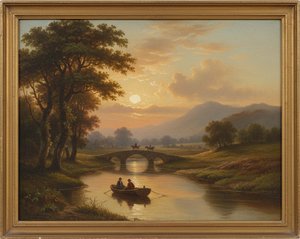
 Matlock Bath, High Tor, Derbyshire
Ramsay Richard Reinagle’s "Matlock Bath" captures a serene Derbyshire landscape in Romantic style. Explore this oil on canvas masterpiece of mountains, river & tranquility.
While celebrated for his animal studies, Reinagle’s landscapes reveal a profound connection to the burgeoning Romantic movement. His travels to Italy in 1796 proved formative, exposing him to classical traditions and inspiring a series of evocative scenes that captured the beauty of the Italian countryside. However, it was his depictions of Derbyshire – particularly around Matlock Bath and High Tor – that truly showcase his mastery of atmospheric perspective and emotional resonance. Paintings like “Matlock Bath” are not simply topographical representations; they evoke a sense of tranquility, awe, and the sublime power of nature. The mountains rise majestically in the background, while the river flows serenely through the valley, creating a harmonious composition that speaks to the Romantic ideal of finding spiritual connection within the natural world. He also painted “The Western Isles”, capturing serene coastal scenes & maritime life.
Reinagle & The Society of Painters in Watercolours: A Period of Leadership
Reinagle’s artistic recognition extended beyond his individual practice; he became a prominent figure within the art establishment, particularly through his involvement with the Society of Painters in Watercolours. Elected an associate in 1805 and a full member in 1806, he quickly rose through the ranks, becoming treasurer in 1807 and president from 1808 to 1812. During this period, he exhibited over sixty drawings, primarily Italian landscapes and scenes of the English lakes, further solidifying his reputation as a skilled watercolorist. His leadership role within the Society demonstrates not only his artistic talent but also his commitment to fostering a vibrant community of artists. He actively promoted the medium of watercolour, elevating its status alongside oil painting.
Legacy and Rediscovery: Reinagle’s Place in British Art History
Despite achieving considerable success during his lifetime – including election as an associate (1814) and academician (1823) of the Royal Academy – Ramsay Richard Reinagle's reputation waned somewhat after his death in 1862. A late-life controversy involving a deceptive submission to the Royal Academy, where he presented a work altered from another artist’s original as his own, tarnished his standing. However, recent scholarship has begun to reassess his contributions, recognizing him as a significant figure in British sporting art and landscape painting. His meticulous attention to detail, combined with a distinctly Romantic sensibility, sets him apart from many of his contemporaries. Today, his paintings are held in numerous public collections, including Sheffield, Rotherham, Doncaster, Derby Art Gallery, and the Government Art Collection, offering a glimpse into a world where scientific observation met artistic expression. OriginalUniqueArt is proud to offer high-quality reproductions of Reinagle’s captivating works, allowing art enthusiasts to experience the beauty and tranquility of his landscapes and animal portraits firsthand. Explore our collection today and discover the enduring legacy of Ramsay Richard Reinagle.