Early Life & Artistic Foundations: Montevideo Roots
 Wikipedia: Rafael Barradas
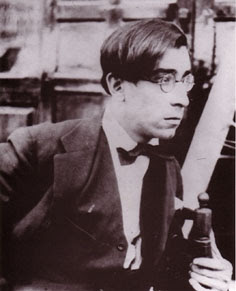
Rafael Pérez Giménez Barradas (4 January 1890 in Montevideo – 12 February 1929 in Montevideo), was an Uruguayan modernist painter and graphic artist who worked in Spain. == Biography == His parents were immigrants from Spain. His older sister, Carm...
Rafael Pérez Giménez Barradas, born in Montevideo, Uruguay, in 1890, emerged from a family steeped in artistic sensibility. Though his parents were Spanish immigrants—a detail that would profoundly shape his later aesthetic explorations—his early exposure to art wasn’t through formal training but rather an intuitive absorption of creative energy within the domestic sphere. His father's own painting endeavors sparked a nascent interest, while the musical talents of his sister, Carmen, a gifted pianist and composer, and the poetic inclinations of his brother, Antonio (writing under the pseudonym Antonio de Ignacios), fostered an environment where artistic expression flourished. These formative years weren’t marked by rigorous academic study; instead, Barradas honed his skills through self-directed exploration, initially finding outlets in magazine illustrations—a practical grounding that would later inform his dynamic compositions. Montevideo itself, a bustling port city brimming with cultural currents, served as the initial canvas for his observations and inspirations. It was a world of vibrant street life, diverse populations, and a palpable sense of change, all elements that would subtly weave their way into the fabric of his artistic vision.
European Influences & The Birth of 'Vibrationism'
Art Deco, short for the French Arts décoratifs (lit. 'Decorative Arts'), is a style of visual arts, architecture, and product design that first appeared in Paris in the 1910s just before World War I and flourished internationally during the 1920s to ...
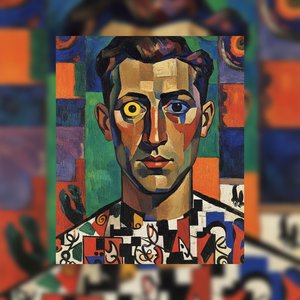
The year 1913 proved pivotal. Invited to accompany a friend studying singing at La Scala in Milan, Barradas embarked on a journey that irrevocably altered the course of his artistic development. Italy introduced him to the burgeoning Futurist movement—a radical aesthetic embracing speed, technology, and dynamism. This encounter ignited within him a desire to capture the energy of modern life, but it was Paris that truly unlocked his unique style. Immersed in the latest Cubist experiments, Barradas began to synthesize these European avant-garde principles with his own sensibilities. However, he wasn’t content merely to replicate; instead, he embarked on a path of innovation, developing what he termed ‘Vibrationism.’ This distinctive approach sought to convey not just the visual appearance of objects but also their inherent energy and movement—a shimmering, almost palpable sense of life captured through fragmented forms and bold chromatic choices. It was an attempt to represent the very essence of existence, a world constantly in flux.
Barradas in Madrid: A Hub of Artistic Exchange
Following his time in Europe, Barradas’s journey led him to Madrid in 1919, a city that quickly became central to his artistic life. He established a studio near the bustling Atocha train station—a location symbolic of movement and connection—and immersed himself in the vibrant intellectual and artistic circles of the Spanish capital. This period marked a flourishing of collaboration and exchange. Barradas frequented local cafés, becoming a familiar figure among writers, poets, and fellow artists. A particularly significant relationship blossomed with Gregorio Martínez Sierra, a prominent playwright and publisher who commissioned Barradas to design costumes and scenery for the Teatro Eslava. Beyond theatrical work, Martínez Sierra also provided Barradas with opportunities to illustrate books, including those by Ramón Gómez de la Serna, further expanding his reach and influence. His involvement in avant-garde publications like *Alfar*, spearheaded by fellow Uruguayan poet Julio J. Casal, solidified his position as a leading voice within the Spanish modernist landscape.
Thematic Explorations: Social Commentary and Mysticism
Barradas’s artistic output wasn't confined to purely formal experimentation; it was deeply imbued with thematic concerns reflecting his social consciousness and spiritual inclinations. While initially captivated by the dynamism of urban life, he gradually shifted towards exploring more introspective subjects. The 1920s witnessed a move away from pure abstraction toward a renewed focus on figuration, characterized by a darker palette and a profound sense of empathy for the working class. His series *Los Místicos* (The Magnificent Ones) stands as a testament to this shift—a poignant portrayal of ordinary people at rest, imbued with a quiet dignity and spiritual resonance. Later works, such as *Estampones Montevideanos* (Montevideo Stamps), revisited his hometown, capturing the essence of its port life and the character of the Barrio Sur neighborhood. These weren’t merely depictions; they were attempts to capture the soul of a place and its people—a testament to Barradas's deep connection to his roots.
Legacy and Influence: Pioneering Uruguayan Modernism
Despite a tragically short life – he passed away in Montevideo in 1929 at the age of 39 – Rafael Barradas left an indelible mark on Uruguayan art. His innovative ‘Vibrationism’ served as a crucial bridge between European avant-garde movements and a distinctly Latin American aesthetic sensibility. He wasn't simply importing ideas; he was transforming them, infusing them with local color, energy, and social consciousness. His influence extended beyond his own paintings, notably impacting the work of Joaquín Torres García, who incorporated elements of Vibrationism into his “Constructive Universalism.” For years after his death, Barradas’s works remained largely within the confines of his family home, a testament to their personal significance. However, in 1969, they were generously donated to the Ministerio de Educación y Cultura de Uruguay, leading to the establishment of a dedicated Museo Barradas—a fitting tribute to a pioneer who dared to forge a new path for Uruguayan modernism.
Collecting Barradas Today: Investment & Appreciation
Today, Rafael Barradas’s works are increasingly recognized as significant contributions to Latin American art history. His paintings and graphic pieces represent not only aesthetic beauty but also a crucial moment in the development of modernist expression. The scarcity of his output—a consequence of his short career—contributes to their value, making them sought-after acquisitions for both private collectors and institutions. Investing in Barradas is more than acquiring an artwork; it’s owning a piece of Uruguayan cultural heritage. His dynamic compositions, bold colors, and evocative themes continue to resonate with contemporary audiences. For those seeking unique pieces that blend European sophistication with Latin American vibrancy, Barradas offers a compelling opportunity. OriginalUniqueArt.com provides access to high-quality reproductions of his iconic works, allowing art enthusiasts worldwide to experience the brilliance of this often-overlooked modernist master and appreciate his lasting legacy. Explore our collection today and discover the captivating world of Rafael Barradas.