Early Life & Parisian Beginnings: From Ministry to Master Painter
Philip James de Loutherbourg’s journey from the intended path of a Lutheran minister to becoming one of Britain's most celebrated Romantic painters is a testament to the power of artistic calling. Born Philippe Jacques de Loutherbourg in Strasbourg in 1740, his early education steered him towards theology, yet even then, an undeniable inclination toward visual expression simmered beneath the surface. This nascent talent led him to Paris in 1755, where he apprenticed under Charles-André van Loo and later Francesco Giuseppe Casanova – a lineage that instilled within him a foundation of classical technique blended with burgeoning Baroque sensibilities. His early successes at the Salon, beginning in 1763 with landscapes praised by Denis Diderot, signaled not merely competence but a distinctive voice emerging amidst the established artistic circles of France. These weren’t simply pretty pictures; they possessed an atmospheric quality, a sensitivity to light and shadow that hinted at the dramatic power to come. His election to the French Academy in 1767, despite being below the required age, further solidified his position as a rising star, painting landscapes, sea storms, and battles with a flair that quickly garnered attention.
Loutherbourg's Theatrical Innovations: Stage Design & the Eidophusikon
 Wikipedia: Philip James de Loutherbourg
Philip James de Loutherbourg, RA (born Philippe Jacques de Loutherbourg; 31 October 1740 – 11 March 1812) was a French-born British painter who became known for his large naval works, his elaborate set designs for London theatres, and his invention o...
While Loutherbourg’s brushstrokes were gaining recognition on canvas, it was his foray into the world of theatre that truly began to define his artistic vision. In 1771, he arrived in London and entered the employ of David Garrick, the renowned actor-manager of Drury Lane Theatre. For fifteen years, Loutherbourg revolutionized stage design, not merely creating backdrops but crafting immersive environments. He wasn’t content with static scenery; he sought to evoke genuine emotion through dynamic effects – trees shifting from verdant green to autumnal russet, moons rising and casting ethereal glows upon passing clouds. These illusions were achieved through ingenious lighting techniques, employing colored lantern slides and translucent materials, captivating audiences and earning the admiration of fellow artists like Joshua Reynolds. However, his most ambitious project was undoubtedly the Eidophusikon, a miniature mechanical theatre unveiled in 1781. This six-by-eight-foot marvel presented “Various Imitations of Natural Phenomena, represented by Moving Pictures,” illuminated by Argand lamps and stained glass to create breathtakingly realistic scenes. Though financially unsustainable due to the relentless demand for new productions, the Eidophusikon stands as a precursor to modern cinema, showcasing Loutherbourg’s fascination with illusion, spectacle, and the power of visual storytelling.
Naval Dramas & Historical Paintings: Capturing Conflict and Spectacle
 The Battle of the Nile
Own a hand-painted reproduction of Philip James de Loutherbourg’s dramatic 'The Battle of the Nile'! This 1800 naval masterpiece captures intense action & fiery spectacle. Perfect for history buffs and art collectors seeking powerful, large-scale pai
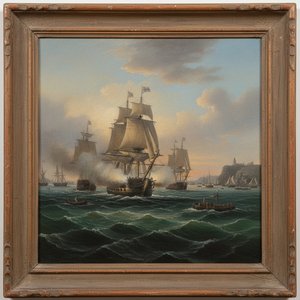
By 1800, Loutherbourg had firmly established himself as the painter of maritime conflict. Commissioned to commemorate British naval victories, he turned his attention to large-scale depictions of battles – scenes brimming with action, fire, and a palpable sense of national pride. Works like The Battle of the Nile, completed in 1800, are not simply historical records but dramatic interpretations that prioritize emotional impact over strict documentation. The intensity of the fighting, the fiery spectacle of exploding ships, and the sheer scale of the composition convey the chaos and heroism of war with breathtaking force. The Battle of Camperdown (1799) similarly captures a decisive moment in British naval history, focusing on the flagship Venerable unleashing its final broadside against the Dutch fleet. Loutherbourg’s approach wasn't about precise topographical accuracy; it was about conveying the “horror and devastation attendant upon a conflict disputed with such obstinate bravery.” His paintings weren’t merely representations of events; they were carefully constructed narratives designed to stir patriotic fervor and evoke awe in the viewer.
The Sublime in Maritime Art: Emotion, Power, and the Romantic Aesthetic
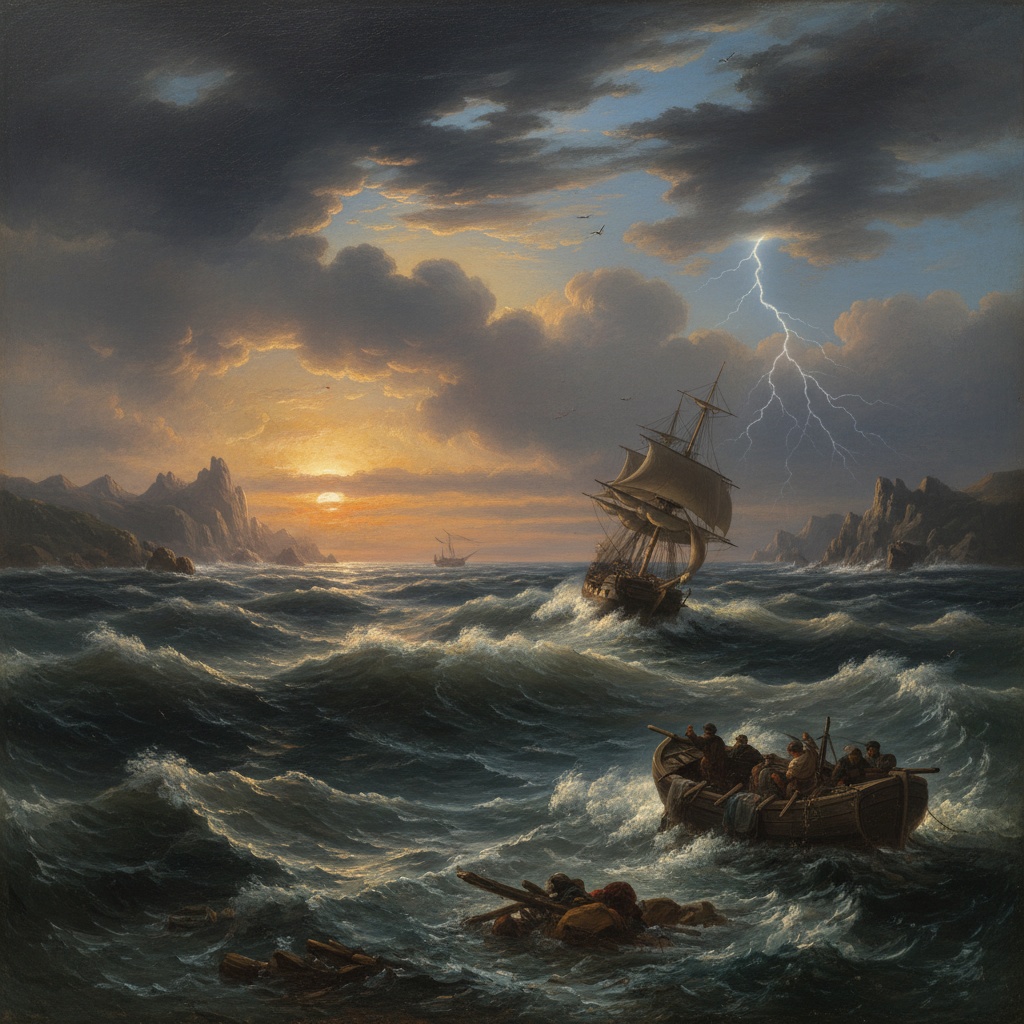
Loutherbourg's enduring appeal lies in his masterful depiction of the sublime – that potent combination of terror and beauty that captivated the Romantic imagination. His seascapes aren’t tranquil depictions of calm waters; they are often scenes of tempestuous storms, towering waves, and ships battling against overwhelming forces of nature. This fascination with the power of the natural world reflects a broader Romantic sensibility, rejecting the Enlightenment's emphasis on reason in favor of emotion, intuition, and an appreciation for the untamed wilderness. He understood that true beauty wasn’t found in perfect order but in the awe-inspiring grandeur of chaos. His paintings evoke a sense of humanity’s vulnerability in the face of immense power, prompting contemplation about our place within the vastness of the universe. This emotional resonance is further amplified by his use of dramatic lighting and composition, drawing the viewer into the heart of the storm and immersing them in the experience.
Legacy and Influence: De Loutherbourg’s Impact on 19th-Century Painting
Philip James de Loutherbourg's influence extended far beyond his own prolific output. His innovative stage designs paved the way for modern scenic techniques, while his dramatic naval paintings established a new standard for maritime art. He wasn’t merely documenting history; he was shaping it through visual narrative. His work inspired generations of artists to explore themes of conflict, spectacle, and the sublime, influencing painters who followed in his wake. Though often overshadowed by contemporaries like J.M.W. Turner, Loutherbourg's contribution to the Romantic movement is undeniable. His paintings continue to captivate audiences today, offering a glimpse into a world where art wasn’t simply about representation but about evoking emotion, celebrating heroism, and confronting the awe-inspiring power of nature. At OriginalUniqueArt.com, we are proud to offer high-quality reproductions of his iconic works, allowing you to experience the drama and beauty of Loutherbourg’s vision firsthand.