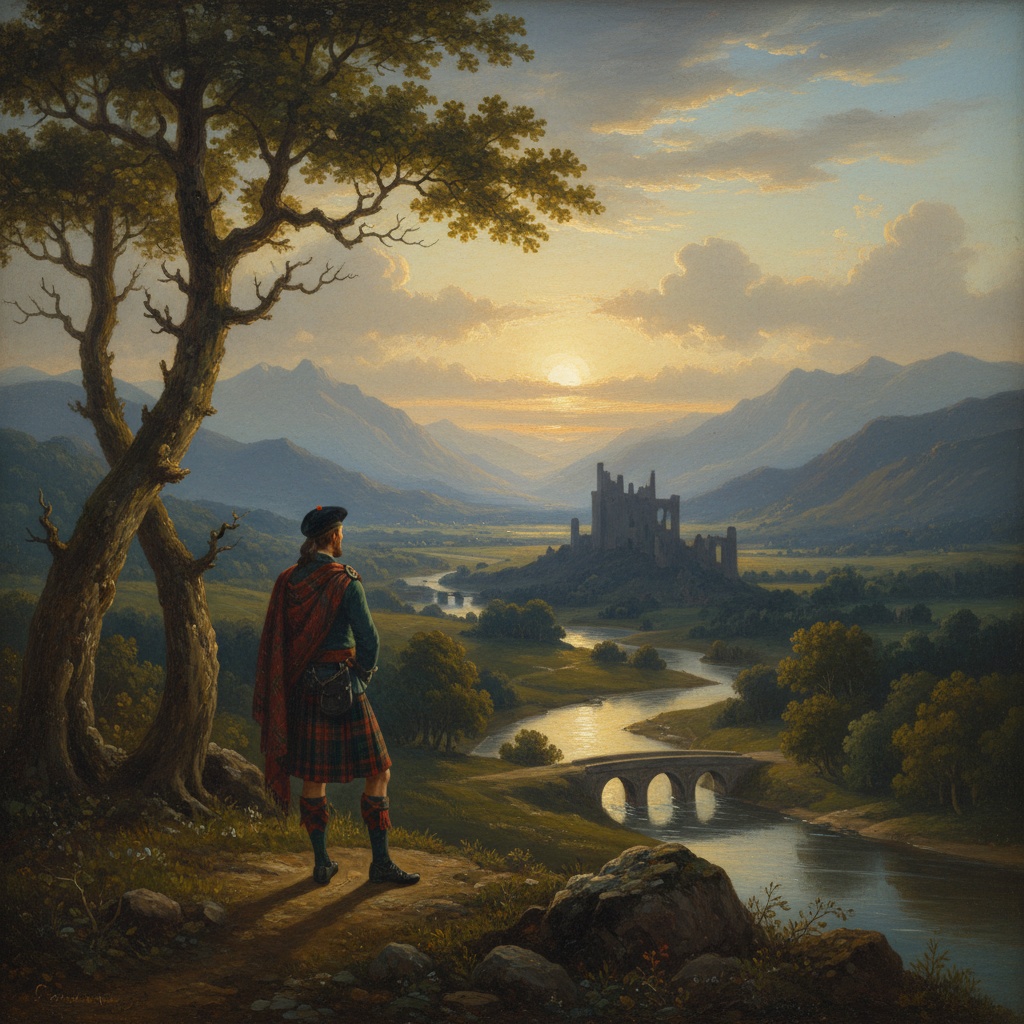
Early Life & Artistic Foundations: The Nasmyth Dynasty
Patrick Nasmyth, (7 January 1787 – 17 August 1831), was a Scottish landscape painter. He was the eldest son of the artist Alexander Nasmyth. == Life == Nasmyth was one of the eleven children of Barbara and Alexander Nasmyth of Edinburgh. His six si...
The name Nasmyth resonates with a particular vibrancy within the annals of Scottish art, inextricably linked to a family whose creative energies spanned generations. Patrick Nasmyth, born in Edinburgh on January 7th, 1787, was not merely an artist; he was the eldest son of Alexander Nasmyth, a figure often hailed as ‘the father of landscape painting in Scotland.’ This lineage proved formative, instilling within young Patrick a deep appreciation for the natural world and a burgeoning talent that would soon blossom. The Nasmyth household was a bustling hub of artistic endeavor, raising eleven children – six daughters who themselves achieved notable recognition as artists, and a younger brother, James, whose inventive genius led to the creation of the steam hammer, demonstrating a remarkable breadth of skill within the family.
Alexander Nasmyth’s commitment extended beyond simply nurturing his children's abilities; he actively fostered their independence. Early art lessons were commonplace, but more importantly, a spirit of self-reliance was cultivated. This emphasis on individual expression would become a defining characteristic of Patrick’s own work, even as it bore the clear imprint of his father’s influence. The early loss of function in his right hand—an accident that forced him to paint with his left—and subsequent hearing impairment further shaped his introspective nature and perhaps deepened his connection to the visual realm, compensating for diminished physical and auditory senses with heightened observation.
Navigating Romanticism: Scottish Identity & Landscape Painting
Romanticism in Scotland was an artistic, literary and intellectual movement that developed between the late eighteenth and the early nineteenth centuries. It was part of the wider European Romantic movement, which was partly a reaction against the Ag...
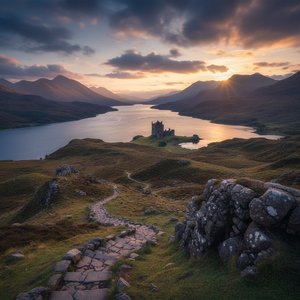
To understand Patrick Nasmyth’s art is to understand its place within the broader context of Romanticism, a movement that swept across Europe in the late eighteenth and early nineteenth centuries. Romanticism represented a reaction against the Enlightenment's emphasis on reason and order, instead prioritizing emotion, individuality, and a renewed fascination with the past—particularly the medieval period. In Scotland, this manifested as a powerful surge of national pride and a rediscovery of its unique cultural heritage. Artists began to turn their attention towards the dramatic landscapes of the Highlands, imbued with a sense of wild beauty and historical resonance.
Nasmyth’s work is deeply rooted in this Scottish Romantic sensibility. While he later resided in London, his artistic heart remained firmly anchored in the scenes of his native land. He wasn't simply depicting picturesque views; he was capturing an *essence* of Scotland—its ruggedness, its atmospheric depth, and a certain melancholic grandeur. This focus on national identity differentiated Scottish Romanticism from its counterparts elsewhere, creating a distinct aesthetic that celebrated the country’s unique character. The concept of a separate national public sphere, as articulated by scholars like Ian Duncan and Murray Pittock, is readily apparent in Nasmyth's dedication to portraying Scotland’s specific landscapes.
The Influence of Dutch Masters & the Pursuit of Realism
Despite his embrace of Romantic ideals, Patrick Nasmyth’s artistic technique was firmly grounded in a more classical tradition. He and his father were both profoundly influenced by the 17th-century Dutch masters, particularly Meindert Hobbema and Jacob van Ruysdael. These artists were renowned for their meticulous attention to detail, their masterful use of light and shadow, and their ability to capture the subtle nuances of nature. A wealth of works by Hobbema and Ruysdael were readily accessible in London galleries during Nasmyth’s lifetime, providing a constant source of inspiration.
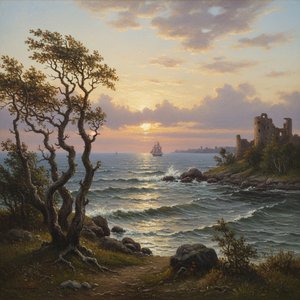
However, Nasmyth was not merely an imitator. He studied these artists intently, absorbing their techniques but ultimately forging his own distinct style. He preferred to sketch directly from nature, working tirelessly outdoors—often from a small mobile tent to shield himself from the frequent Scottish rain—rather than relying on studio-bound conventions. This dedication to observation resulted in paintings that possessed a remarkable degree of realism, capturing the textures of bark, the play of light on water, and the atmospheric effects of the Scottish climate with exceptional fidelity. He sought not just to *represent* nature but to convey its very feeling.
Embracing the Grand Manner: Idealization and Noble Qualities in Nasmyth’s Work
 Wikipedia: Grand manner
Grand manner refers to an idealized aesthetic style derived from classicism and the art of the High Renaissance. In the eighteenth century, British artists and connoisseurs used the term to describe paintings that incorporated visual metaphors in ord...
The term “Grand Manner,” popularized by Sir Joshua Reynolds, refers to an idealized aesthetic style derived from classicism and the art of the High Renaissance. Reynolds argued that true artistry lay not in mere imitation but in perceiving subjects through generalization and idealization, elevating them to a higher plane of nobility. While Nasmyth primarily painted landscapes, elements of the Grand Manner are subtly present in his work.
Although he focused on natural scenes, Nasmyth’s compositions often possess a sense of order and harmony that transcends simple representation. He wasn't simply recording what he saw; he was carefully arranging elements to create a visually compelling narrative—a landscape imbued with a certain dignity and emotional weight. The atmospheric perspective in his paintings, the careful rendering of light and shadow, and the subtle use of color all contribute to this effect. He sought to evoke a sense of awe and reverence for the natural world, imbuing even seemingly humble scenes with a quiet nobility. This wasn’t about depicting specific locations as much as it was about capturing the *spirit* of place.
A Life Cut Short: Legacy and Rediscovery of Patrick Nasmyth's Art
Tragically, Patrick Nasmyth’s life was cut short on August 17th, 1831, at the age of just forty-four. He succumbed to pneumonia-like symptoms contracted after spending too long exposed to the elements while sketching near London—a poignant testament to his unwavering dedication to his art. Despite his relatively brief career, Nasmyth left behind a substantial body of work that continues to captivate audiences today.
For many years, his paintings remained somewhat overshadowed by those of his father, Alexander. However, in recent decades, there has been a growing appreciation for Patrick’s unique artistic vision and technical skill. His works are now held in numerous public collections, including The Met in New York, the British Museum, and the V&A, demonstrating a wider recognition of his importance within the Scottish art landscape. OriginalUniqueArt is proud to offer high-quality reproductions of Nasmyth’s most celebrated paintings, allowing you to experience the beauty and emotional depth of his work firsthand. His legacy endures not only through these stunning canvases but also as a reminder of the power of artistic dedication and the enduring allure of the Scottish Romantic spirit. Explore our collection today and bring a piece of Scotland's artistic heritage into your home.