
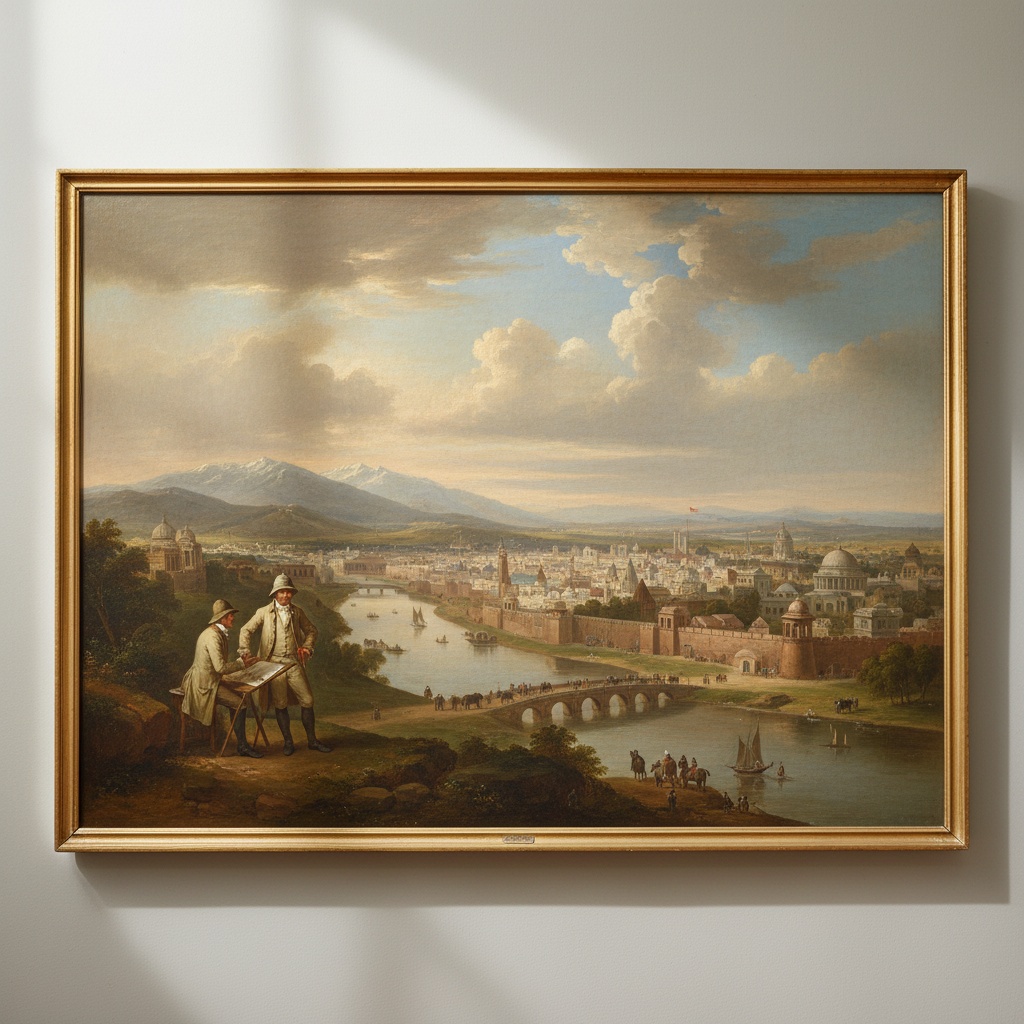
Introduction: Charting New Territories – The Daniells’ Pioneering Vision
The late 18th and early 19th centuries witnessed a burgeoning European fascination with the East, fueled by trade, exploration, and a romanticized curiosity about distant lands. While many accounts were filtered through colonial lenses or limited to textual descriptions, the work of Thomas and William Daniell offered something radically different: a visual immersion into the landscapes, architecture, and daily life of India. Their monumental project, Oriental Scenery, wasn’t merely a collection of picturesque views; it was an ambitious attempt to chart not just geographical territories but also cultural ones, bringing the subcontinent vividly to life for a British audience largely unfamiliar with its complexities. This undertaking, spanning eight years of travel and painstaking artistic labor, established the Daniells as pioneers in landscape painting and printmaking, forever altering perceptions of India within the Western imagination.
A Family Affair: Thomas & William Daniell – Collaboration and Artistic Roles
The story of Oriental Scenery is inextricably linked to the dynamic partnership between uncle and nephew, Thomas Daniell (1749-1840) and William Daniell (1769-1837). Thomas, a seasoned landscape painter already established in London, embarked on his first journey to India in 1785 seeking new subject matter and professional opportunities. He soon recognized the potential for a large-scale series of Indian views, but quickly realized he needed assistance. Enter William, a young and eager artist who joined his uncle in 1789. Their collaboration was remarkably symbiotic. Thomas possessed the experience and established reputation, while William brought youthful energy and a keen eye for detail. The division of labor wasn’t strictly defined; both artists sketched extensively on location, with Thomas often taking the lead in composition and overall artistic direction, and William focusing on precise rendering and technical execution. The success of their project hinged not only on individual talent but also on this harmonious blend of skills and perspectives.
The 'Oriental Scenery' Project: A Visual Record of 18th-Century India
 The Taje Mahel, Agra'. Aquatint
From 1795 to 1808, the Daniells published six volumes comprising a total of 144 hand-colored aquatints. These weren’t simply copies of existing images; they were based on original drawings created during three extensive tours across India – journeys that took them from bustling coastal cities like Calcutta and Madras to the ancient ruins of Ellora and the majestic palaces of Agra. The scope of their subject matter was breathtakingly diverse, encompassing architectural marvels such as the Qutb Minar and the Taj Mahal (as seen in works like “The Taje Mahel, Agra'”), vibrant street scenes teeming with life, and serene landscapes that captured the vastness and beauty of the Indian countryside. Each aquatint served as a window into a world previously accessible only through limited textual accounts or fleeting merchant reports. The project’s ambition lay not just in its sheer scale but also in its attempt to present a comprehensive visual narrative of India, encompassing both its grand monuments and its everyday realities.
Aquatint Technique and Aesthetic Qualities: Capturing Light, Tone, and Detail
Aquatint is an intaglio printmaking technique, a variant of etching that produces areas of tone rather than lines. For this reason it has mostly been used in conjunction with etching, to give both lines and shaded tone. It has also been used histori...
The Daniells' choice of aquatint as their primary medium was crucial to the success of Oriental Scenery. Unlike engraving, which relies on precise lines to create form and texture, aquatint allowed for a greater range of tonal values, mimicking the subtle gradations of light and shadow found in watercolor washes. The process involved applying powdered rosin to a copper plate, then etching it with acid to create areas that held ink. By carefully controlling the application of rosin and the duration of the etching process, the artists could achieve remarkable depth and atmospheric effects. The resulting prints possessed a unique softness and luminosity, perfectly suited for capturing the hazy light and vibrant colors of India. Works like “Coaduwar Gaut, From Oriental Scenery” demonstrate this mastery; the delicate rendering of foliage and architectural details is enhanced by the subtle tonal variations achieved through aquatint. The technique also allowed for relatively large print runs, making their images accessible to a wider audience than traditional hand-painted watercolors.
Beyond Representation: Orientalism, Imperial Contexts, and the Daniells’ Perspective
In art history, literature, and cultural studies, Orientalism is the imitation or depiction of aspects of the Eastern world (or "Orient") by writers, designers, and artists from the Western world. Orientalist painting, particularly of the Middle East...
It's impossible to discuss Oriental Scenery without acknowledging the complex historical context in which it was created. The late 18th century was a period of increasing British colonial expansion in India, and the Daniells’ work inevitably reflects aspects of what Edward Said famously termed “Orientalism” – the Western construction of the East as exotic, mysterious, and often inferior. While their images celebrated the beauty and grandeur of Indian architecture and landscapes, they also subtly reinforced existing power dynamics by presenting a largely static and picturesque view of Indian society. However, it’s important to avoid simplistic interpretations. The Daniells weren't simply propagandists for empire; they were artists genuinely fascinated by India, striving to capture its visual richness with remarkable skill and sensitivity. Their work, while informed by the prevailing attitudes of their time, also offered a degree of nuance and detail that challenged conventional stereotypes. The inclusion of everyday scenes and local figures suggests a genuine attempt to understand and represent the complexities of Indian life.
Legacy & Influence: The Enduring Impact of the Daniells' Panoramic Views
Oriental Scenery had an immediate and lasting impact on British perceptions of India. The series became immensely popular, influencing decorative arts, architecture, and literature for decades to come. Their prints provided a visual vocabulary for imagining the subcontinent, shaping public opinion and fueling further exploration and engagement with Indian culture. The Daniells’ work also inspired subsequent generations of artists, including J.M.W. Turner, who admired their innovative use of light and atmosphere. Today, Oriental Scenery remains a valuable historical document, offering a unique glimpse into 18th-century India through the eyes of two pioneering artists. Their legacy extends beyond mere aesthetic achievement; it lies in their ability to bridge cultural divides and create a lasting visual record of a world undergoing profound transformation. At OriginalUniqueArt.com, we are proud to offer high-quality reproductions of these iconic prints, allowing you to experience the beauty and historical significance of the Daniells’ work firsthand.



