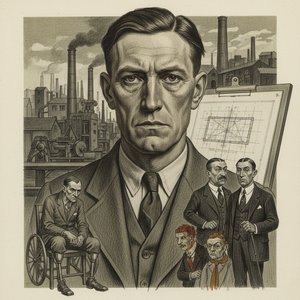
The Aftermath of War: Rejection of Expressionism and the Rise of New Objectivity
To understand the emergence of Neue Sachlichkeit, one must first walk through the scarred landscapes of post-World War I Germany. The Great War had left the nation in a state of profound psychological and political fragmentation. Before this era, the art world was dominated by German Expressionism, a movement characterized by swirling, distorted forms and an intense, subjective emotionality. While Expressionism provided a visceral scream against the horrors of conflict, by the early 1920s, a new generation of artists felt that such emotional abstraction had become insufficient. They no longer sought to paint the internal storm of the soul; instead, they felt a desperate need to document the external reality of a shattered society. The transition was not merely stylistic but existential, moving away from the feverish dreams of the subconscious toward a cold, unblinking observation of the present moment.
Defining Neue Sachlichkeit: The Pursuit of Unflinching Realism and Order
The term Neue Sachlichkeit, or New Objectivity, was famously coined by Gustav Friedrich Hartlaub, the director of the Kunsthalle Mannheim. It represented a pivotal shift toward a clinical, almost detached realism. This movement sought to strip away the romanticized layers of history and the distorted lenses of emotion to reveal the unvarnable truth of the Weimar Republic. There was an inherent pursuit of order amidst the chaos of hyperinflation, political assassinations, and social upheaval. The artists of this era utilized a sharp, precise technique that emphasized clarity and definition. By focusing on the tangible—the texture of a soldier's uniform, the gleam of a decadent ballroom, or the weary eyes of a street vendor—they created an archive of a civilization in flux. This was art as a mirror, reflecting both the structural stability they craved and the profound instability they inhabited.
Masters of Social Critique: George Grosz, Otto Dix, and the Weimar Soul
No discussion of this movement is complete without confronting the biting satire and social venom of its most formidable masters. George Grosz and Otto Dix stood as the dual architects of a profound social critique. Grosz, with his characteristic ability to blend the grotesque with the political, used his brush to attack the corruption of the German bourgeoisie and the hypocrisy of the military elite. His work, such as the powerful Self Portrait, Admonishing, serves as a haunting warning, where the artist's gaze confronts the viewer with the weight of historical responsibility. Similarly, Otto Dix brought an unflinching, often brutal realism to the depiction of the war's physical and psychological wreckage. His paintings of mutilated veterans and the decadence of Berlin's nightlife forced the public to witness the consequences of conflict and the hollow nature of post-war prosperity. Through their work, the Weimar soul was laid bare—vulnerable, scarred, yet intensely alive.
<_br>Verism vs. Magic Realism: Exploring the Movement's Aesthetic Spectrum
While unified by a commitment to realism, the movement possessed a fascinating aesthetic spectrum that ranged from the visceral to the ethereal. On one end of this spectrum lay Verism, a branch characterized by its raw, often ugly, and uncompromising depiction of reality. Verist artists sought to expose the grit, the decay, and the social injustices of their time with almost surgical precision, leaving no room for sentimentality. On the opposite end was Magic Realism, a more enigmatic and hauntingly beautiful approach. This style did not reject reality but rather infused it with an eerie, dreamlike stillness. In Magic Realism, everyday objects and landscapes are rendered with such hyper-clear detail and frozen composition that they take on a supernatural, almost unsettling quality. This tension between the brutal truth of Verism and the haunting stillness of Magic Realism provided the movement with its profound depth, allowing it to capture both the physical decay and the spiritual mystery of the era.
The Twilight of an Era: The End of New Objectivity and its Artistic Legacy
The era of Neue Sachlichkeit met a tragic conclusion with the rise of National Socialism in the 1930s. The very realism that had served as a tool for social truth was deemed "degenerate" by the Nazi regime. Many of the movement's most prominent artists were suppressed, forced into exile, or silenced, as the state sought to replace critical observation with idealized, heroic propaganda. However, the legacy of New Objectivity remains an indelible part of art history. Its influence can be seen in the continued use of realism as a vehicle for social commentary and in the way modern artists navigate the boundaries between objective documentation and subjective interpretation. The movement taught us that art possesses the power to look directly into the heart of darkness, to document the uncomfortable truths of our existence, and to find a profound, albeit haunting, beauty in the most unvarnished realities of the human condition.