Early Life & Influences: Forging a Unique Path
Milton Clark Avery, born in Altmar, New York, in 1885, wasn’t destined for the conventional path of an artist. His early life was steeped in practicality – factory work at sixteen to support his family, decades of blue-collar jobs undertaken out of necessity rather than artistic inclination. This grounding, however, proved unexpectedly formative. Unlike many of his contemporaries who benefited from formal patronage and bohemian lifestyles, Avery’s journey was one of quiet perseverance, a slow burn fueled by an intrinsic passion that refused to be extinguished. He attended classes at the Connecticut League of Art Students in Hartford, receiving a traditional education, but it was the weight of responsibility – supporting nine female relatives after his brother-in-law's death – that initially defined his artistic practice: painting became a clandestine pursuit, snatched moments carved out amidst the demands of daily life. It wasn’t until 1924, with the arrival of Sally Michel, who would become both his wife and an essential creative partner, that Avery could more fully dedicate himself to his art.
The influences on Avery were subtle yet profound. While he absorbed lessons from European modernists – the vibrant color palettes of the Fauves, the expressive distortions of German Expressionism – he never succumbed to direct imitation. Instead, these encounters served as catalysts, prompting him to forge a distinctly American sensibility. He wasn’t interested in replicating reality; rather, he sought to distill its essence, to capture the *feeling* of a place or moment through simplified forms and evocative color combinations.
The Avery Style: Simplifying Form, Amplifying Color
Color field painting (Colour field painting in Commonwealth English) is a style of abstract painting that emerged in New York City during the 1940s and 1950s. It was inspired by European modernism and closely related to abstract expressionism, while ...
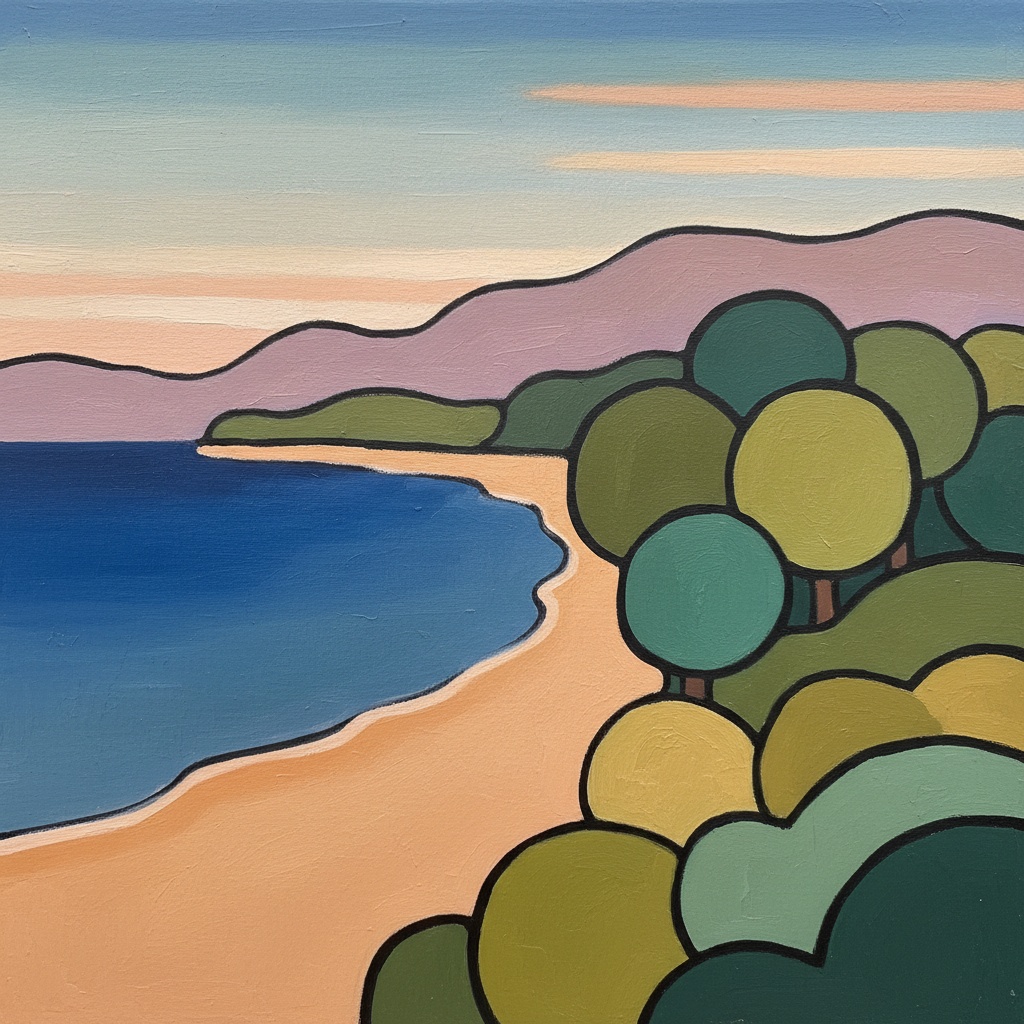
To describe Milton Avery's style as “simplification” feels almost inadequate. It wasn’t merely about reducing shapes; it was an act of distillation, a poetic stripping away of extraneous detail to reveal the underlying structure and emotional core of his subjects. He famously eschewed linear perspective, instead achieving depth through the interplay of color – the harmonious resonance of one hue against another. This approach, born from both necessity (a desire for clarity) and artistic conviction, resulted in compositions that are simultaneously grounded and ethereal. His figures often appear flattened, almost monumental, yet they possess a remarkable sense of presence.
The power of Avery’s color lies not just in its vibrancy but also in its subtlety. He wasn't interested in bombastic displays; his palette favored luminous tones – soft blues, muted greens, warm ochres – that created an atmosphere of serenity and harmony. This deliberate restraint allowed the forms to breathe, inviting viewers to contemplate the relationships between shapes and colors rather than being overwhelmed by technical virtuosity. He aimed for a timeless quality, a sense of enduring beauty that transcended fleeting trends.
Avery's Landscapes: Evoking Mood Through Abstraction
Landscapes were central to Avery’s artistic vision, particularly those encountered during summers spent in coastal Maine and the Gaspé Peninsula. However, these weren’t literal depictions; they were emotional responses translated onto canvas. He wasn’t concerned with topographical accuracy but rather with capturing the *feeling* of a place – the cool breeze on his skin, the vastness of the ocean, the quality of light filtering through the trees. Works like “Sandbar and Seabirds” exemplify this approach: simplified forms represent figures and natural elements, yet the overall effect is one of profound tranquility.
Avery’s landscapes often feature a distinctive horizontal format, emphasizing the relationship between earth and sky. He frequently employed a high horizon line, creating a sense of spaciousness and calm. The colors are carefully chosen to evoke specific moods – cool blues and greens for serene coastal scenes, warmer tones for sun-drenched fields. His ability to convey atmosphere through abstraction was remarkable, foreshadowing the Color Field paintings that would emerge in the decades following his most prolific period.
Influence on Abstract Expressionism and Beyond
American modernism, much like the modernism movement in general, is a trend of philosophical thought arising from the widespread changes in culture and society in the age of modernity. American modernism is an artistic and cultural movement in the Un...
Despite operating largely outside the mainstream art world during much of his career, Avery exerted a significant influence on a generation of American painters. In the 1940s, he befriended Adolph Gottlieb and Mark Rothko, who recognized in his work a kindred spirit – a shared commitment to color, form, and emotional expression. Rothko famously described Avery as “a great poet-inventor,” praising his ability to create “sonorities never seen nor heard before.”
Avery’s emphasis on the expressive power of color and simplified forms paved the way for Abstract Expressionism. While he himself remained committed to representation, his work encouraged younger artists to explore the possibilities of non-objective painting. He imparted a crucial lesson: that color could be freed from its descriptive function and become the subject itself. Later painters like Peter Doig continue to draw inspiration from Avery’s poetic sensibility, demonstrating the enduring relevance of his unique vision.
Key Works & Lasting Legacy
Throughout his career, Avery produced a body of work characterized by consistency and quiet innovation. “Steeplechase,” painted in the 1930s, offers a glimpse into his early style – a fusion of realism and abstraction depicting urban leisure. “Artist’s Wife” is a particularly poignant example of his signature approach: Sally Michel rendered with simplified forms and effusive color, radiating contentment and intelligence. “Two Figures on Beach,” from 1950, showcases his mastery of tonal color and foreshadows the Color Field movement.
Milton Avery’s legacy extends far beyond his individual paintings. He demonstrated that it was possible to create profoundly moving art without resorting to grand gestures or overt symbolism. His work is a testament to the power of simplicity, the beauty of restraint, and the enduring allure of color. Today, Avery is recognized as a pivotal figure in American Modernism, an artist whose poetic vision continues to inspire and captivate audiences worldwide.
Discover more exceptional works by Milton Avery and explore our extensive collection of museum-quality reproductions at OriginalUniqueArt.com.