The Genesis of Lithography: Senefelder’s Innovation & Early Development
Printing emerged as early as the 4th millennium BCE in the form of cylinder seals used by the Proto-Elamite and Sumerian civilizations to certify documents written on clay tablets. Other early forms include block seals, hammered coinage, pottery impr...
The story of lithography, a cornerstone of modern printmaking, begins not with grand ambition but with a practical problem. In 1796, Alois Senefelder, a Bavarian playwright and actor, found himself facing financial hardship and a need for an efficient way to reproduce his plays. Existing methods – engraving and etching – were costly and time-consuming, demanding skilled artisans and significant resources. His search for a more accessible technique led him down a path of experimentation that would revolutionize the world of art reproduction. Senefelder’s initial attempts involved carving text into stone, but it was a fortuitous accident—forgetting to clear greasy ink from a limestone slab before attempting to etch – that revealed the core principle: the immiscibility of grease and water. This simple observation unlocked a process where an image drawn with a greasy substance would repel water, allowing ink to adhere only to the desired areas, creating a print.
The early years were marked by relentless refinement. Senefelder meticulously documented his findings in Vollständiges Lehrbuch der Steindruckerey (A Complete Course of Lithography), published in 1818, solidifying his claim as the inventor and laying the groundwork for future practitioners. Initially, lithography was embraced primarily for its affordability and speed – a boon for producing sheet music, posters, and affordable editions of plays. However, it quickly became apparent that this new technique offered artistic possibilities beyond mere replication. The directness of drawing onto stone, akin to sketching on paper, appealed to artists seeking greater control over their work and a more intimate connection with the printing process. The inherent tonal qualities achievable through varying pressure and ink density opened up avenues for nuanced expression previously unavailable in traditional printmaking.
Technical Foundations: The Science Behind Grease, Water & Stone
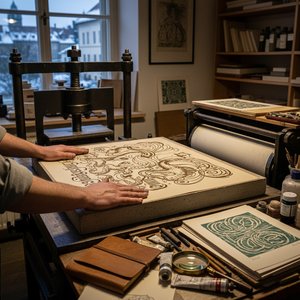
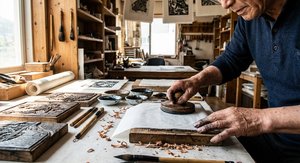
At its heart, lithography is a beautifully elegant application of scientific principles. The foundation lies in the unique properties of limestone – specifically, its porous nature and ability to hold both grease and water. The process begins with preparing a smooth, highly polished stone surface. An artist then applies an image using a greasy medium—tusche, a carbon-based ink, being the most common choice. This tusche adheres to the stone’s surface, creating a hydrophobic (water-repelling) area. The stone is then treated with a solution of gum arabic and nitric acid. This crucial step etches around the grease image, strengthening its resistance to water and preventing unwanted ink adhesion.
The magic happens during inking. A dampened roller applies an oily ink that selectively adheres to the greasy image areas while being repelled by the moistened non-image regions. This creates a precise transfer of the design onto paper when pressure is applied, typically using a lithographic press. The quality of the stone, the composition of the tusche and gum arabic solution, and the skill of the printer all contribute to the final result. Variations in these elements can produce dramatically different effects – from delicate, watercolor-like washes to bold, graphic lines. Understanding this interplay between chemistry and craftsmanship is essential for appreciating the artistry inherent in lithography.
Lithography in the 19th Century: A Flourishing of Artistic Styles and Chromatic Possibilities
The 19th century witnessed a remarkable flourishing of lithographic art, driven by technological advancements and an expanding market. While initially used for functional purposes, artists quickly recognized its potential as a medium for original expression. Romanticism found a natural ally in the technique’s ability to capture atmospheric effects and emotional intensity. Artists like Goya utilized lithography to create powerful social commentaries and haunting depictions of war and human suffering. The directness of the process allowed for a rawness and immediacy that was difficult to achieve with other methods.
Perhaps one of the most significant developments of this era was chromolithography – the technique of printing in multiple colors. While Senefelder envisioned color lithography early on, it wasn’t until the mid-19th century that it became commercially viable. This involved using separate stones for each color layer, meticulously aligning them to create a vibrant and complex image. The process was labor-intensive and expensive, reserved for high-quality prints like posters, illustrations, and reproductions of paintings. Chromolithography transformed advertising and popular culture, bringing colorful imagery into the homes of a wider audience. The technique also spurred innovation in color theory and printing techniques, paving the way for modern color reproduction methods.
Key Masters of the Lithographic Press: Haghe, Gavarni & Hoover
 joseph frank hoover
Joseph Hoover (1830-1913) was a prolific American lithographer known for vibrant chromolithographs, parlor prints & decorative scenes. Explore his popular 19th-century works featuring genre scenes, landscapes, and still lifes.
Several artists stand out as pivotal figures in the development and popularization of lithography. Louis Haghe (1806-1885), a Belgian artist, was a pioneer in Victorian topographical lithography. His detailed depictions of architecture, historical events – notably his work documenting ‘The Holy Land’ – showcased the technique's ability to capture intricate detail and atmospheric perspective. Haghe’s meticulous approach and mastery of color printing established him as a leading figure in the field.
Paul Gavarni (1804-1866), a French caricaturist and illustrator, embraced lithography for its expressive potential and social commentary. His series “Les Enfants Terribles” evokes melancholy through poignant scenes of everyday life rendered with intricate cross-hatching and a Romantic sensibility. Gavarni’s work demonstrated the power of lithography to convey complex emotions and narratives.
Across the Atlantic, Joseph Frank Hoover (1830-1913) became renowned for his vibrant chromolithographs, parlor prints, and decorative scenes. His popular 19th-century works featuring genre scenes, landscapes, and still lifes brought a touch of elegance to American homes. Hoover’s prolific output and skillful use of color made him one of the most commercially successful lithographers of his time.
Beyond Fine Art: Lithography’s Impact on Commercial Printing & Popular Culture
While celebrated for its contributions to fine art, lithography's influence extended far beyond galleries and museums. The technique played a crucial role in the burgeoning world of commercial printing during the 19th century. The affordability and speed of lithography made it ideal for producing posters, advertisements, sheet music, and illustrated books. This democratization of imagery had a profound impact on popular culture.
Advertising, in particular, benefited immensely from chromolithography. Colorful posters featuring eye-catching designs and persuasive slogans became ubiquitous, shaping consumer tastes and promoting new products. Sheet music covers were transformed into miniature works of art, attracting buyers with their vibrant illustrations and romantic imagery. Lithography also facilitated the mass production of illustrated books, making literature more accessible to a wider audience. The technique’s ability to reproduce photographs – through processes like photochrome – further expanded its reach, blurring the lines between art and commerce.
The Enduring Legacy: Modern Applications & Future Directions in Lithographic Technique
Despite the advent of digital printing technologies, lithography continues to thrive as a vibrant art form. Contemporary artists continue to explore its unique qualities – the directness of drawing on stone, the nuanced tonal possibilities, and the inherent texture of the printed image. While traditional stone lithography remains practiced, modern variations have emerged, utilizing materials like zinc plates and aluminum sheets.
Next-generation lithography, a term used in integrated circuit manufacturing, demonstrates the technique’s ongoing relevance in cutting-edge fields. Although focused on microchip production, it highlights the fundamental principles of lithography – precise image transfer and pattern creation – as essential components of technological innovation. The enduring appeal of lithography lies in its unique combination of artistic expression, scientific precision, and historical significance. At OriginalUniqueArt, we celebrate this legacy by offering high-quality reproductions of iconic lithographs, allowing you to experience the beauty and artistry of this remarkable technique firsthand. Explore our collection today and discover the timeless appeal of lithography.