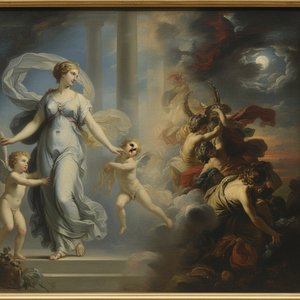
Early Life & Academic Foundations: A Budding Talent
Karl Pavlovich Bryullov, born Carlo Brulleau in 1799 to a family steeped in artistic tradition, was destined for greatness from an early age. His father, Pavel Ivanovich Briullo, a skilled academician specializing in woodcarving and engraving, instilled in his son not only a love of art but also a rigorous work ethic and technical foundation that would prove crucial throughout Bryullov’s illustrious career. Though descended from French Huguenots who found refuge in Russia, the young Karl felt an almost magnetic pull towards Italy – a land he perceived as the cradle of artistic excellence. This early fascination foreshadowed a journey that would fundamentally shape his style and secure his place among the most celebrated painters of the Romantic era.
Bryullov’s formal training began at the Imperial Academy of Arts in St. Petersburg in 1809, where he immersed himself in the prevailing Neoclassical aesthetic. While excelling under masters like Andrei Ivanovich Ivanov and Alexei Yegorovich Yegorov, a subtle rebellion simmered beneath his diligent studies. He absorbed the principles of classical composition and anatomical precision but yearned for something more – a dynamism, an emotional intensity that seemed absent from the Academy’s rigid formalism. This inherent romantic sensibility, coupled with exceptional talent, quickly distinguished him as a promising student, earning him early recognition and ultimately sponsorship for travel to Italy in 1823.
The Italian Years: Mastering Technique and Romantic Sensibility
Rome proved to be the crucible where Bryullov’s artistic vision truly blossomed. Surrounded by the masterpieces of Raphael, Michelangelo, and Titian, he embarked on a period of intense study and experimentation. He wasn't merely copying the Old Masters; rather, he was dissecting their techniques, absorbing their understanding of light, form, and narrative power. Early works from this period, such as “Italian Midday” (1827), reveal a growing confidence in his ability to capture vibrant life and sun-drenched landscapes with a freshness that moved beyond strict Neoclassical conventions.
However, it was portraiture that initially sustained him during these formative years. Commissions from aristocratic patrons allowed Bryullov to hone his skills in capturing not just physical likeness but also the inner character of his sitters. Portraits like that of Princess Zinaida Volkonskaya demonstrate a remarkable ability to convey personality and psychological depth – qualities that would become hallmarks of his later work. This period wasn’t simply about technical refinement; it was about developing an artistic voice, one that blended classical precision with a burgeoning Romantic sensibility.
The Last Day of Pompeii: Achieving International Acclaim
Bryullov's career reached its zenith with the creation of “The Last Day of Pompeii” (1830-1833), a monumental historical canvas that irrevocably cemented his reputation as one of Europe’s leading painters. Commissioned by Anatoly Demidov, the painting depicts the catastrophic eruption of Mount Vesuvius in 79 AD with breathtaking scale and dramatic intensity. The subject matter – a moment of utter devastation and human tragedy – resonated deeply with the Romantic fascination for sublime natural forces and the fragility of existence.
The sheer ambition of the work is staggering. Measuring approximately 4.6 by 6.5 meters, “Pompeii” is a whirlwind of emotion, meticulously researched detail, and dynamic composition. Bryullov’s masterful use of light and shadow creates a palpable sense of chaos and impending doom, drawing the viewer directly into the heart of the disaster. When exhibited in Italy and subsequently in Russia, the painting caused a sensation, earning comparisons to the works of Rubens and Van Dyck from none other than Pushkin and Gogol. It wasn’t merely a technical triumph; it was an emotional experience that captivated audiences and established Bryullov as a true master.
Portraiture and Beyond: Capturing Character and Grandeur
 Portrait of Countess Yu. P. Samoilova and Her Ward Amacilia Pacini Leaving a Ball
Admire Brulloff’s "Portrait of Countess Samoilova" – a stunning 1842 Russian Romantic painting! Explore elegance, detail & historical grandeur at The Hermitage.
Despite the overwhelming success of “The Last Day of Pompeii,” Bryullov continued to explore other genres throughout his career. While he revisited historical subjects, it was portraiture that remained a constant source of inspiration and income. His portraits from this period are characterized by their elegance, psychological insight, and meticulous attention to detail. He possessed an uncanny ability to capture not only the physical likeness of his sitters but also their inner lives – their hopes, fears, and aspirations.
“Portrait of Countess Yu. P. Samoilova and Her Ward Amacilia Pacini Leaving a Ball” (1842), for example, is a stunning depiction of aristocratic society, showcasing the opulence and refinement of the era. The painting’s vibrant colors, intricate details, and dynamic composition create a sense of movement and energy, while the subtle interplay between the Countess and her ward reveals a complex relationship filled with affection and social nuance. Even in smaller works like “Fountain in Bakhchi-Sarai” (1849), Bryullov’s mastery of detail and his ability to evoke atmosphere are readily apparent.
Legacy and Influence: Bryullov's Impact on Russian Art
Karl Bryullov’s influence on Russian art is profound. He successfully bridged the gap between Neoclassicism and Romanticism, injecting a new level of emotional intensity and dynamism into historical painting. His emphasis on technical proficiency, combined with his ability to capture psychological depth in portraiture, set a new standard for artistic excellence in Russia.
Beyond his paintings, Bryullov was also an influential teacher at the Imperial Academy of Arts, where he inspired generations of artists to embrace their own creative visions. His students carried on his legacy, pushing the boundaries of Russian art and paving the way for future movements. Though his health began to decline in the 1840s, forcing him to seek warmer climates, Bryullov continued to paint until his death in 1852. Today, his works are celebrated in museums around the world, a testament to his enduring genius and lasting impact on the history of art.
Exploring Bryullov’s Style: A Synthesis of Classicism & Emotion
Bryullov's artistic style is best understood as a synthesis of classical training and Romantic sensibility. He possessed an unparalleled mastery of anatomy, composition, and perspective – skills honed during his rigorous education at the Imperial Academy of Arts. However, he didn’t simply replicate classical forms; rather, he infused them with a new level of emotional intensity and dynamism.
His paintings are characterized by their dramatic lighting, vibrant colors, and meticulous attention to detail. He wasn't afraid to embrace bold compositions and unconventional subject matter, often depicting moments of intense emotion or historical upheaval. The Last Day of Pompeii, for example, is a testament to his ability to combine classical precision with Romantic fervor, creating a work that is both visually stunning and emotionally powerful. His portraits reveal a similar blend of technical skill and psychological insight, capturing not only the physical likeness of his sitters but also their inner lives. Bryullov’s legacy lies in his ability to elevate Russian art to new heights, forging a unique style that continues to inspire artists today.
Discover more about Karl Bryullov's captivating works and explore museum-quality reproductions at OriginalUniqueArt.com, where the masterpieces of history are brought to life with exceptional craftsmanship and attention to detail.