
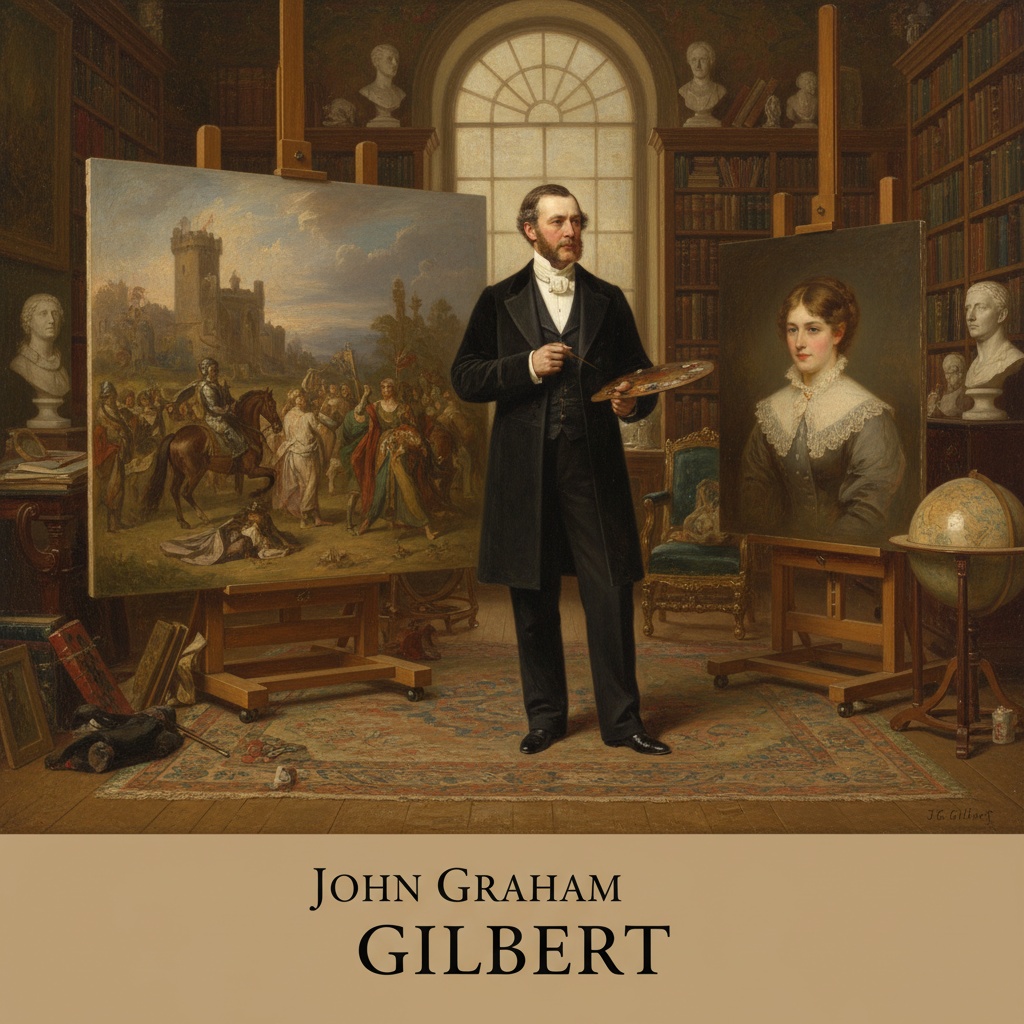
Early Life & Royal Academy Training: The Foundations of a Scottish Artist
 Wikipedia: John Graham-Gilbert
John Graham-Gilbert (1794 – 4 June 1866) was a Scottish portrait painter and art collector. == Life == Graham-Gilbert was born in Glasgow as John Graham, the son of David Graham a West India merchant and co-owner of Graham, Milne & Co who owned a ...
John Graham, born in Glasgow in 1794, initially followed a pragmatic path dictated by his family’s mercantile interests. His father, David Graham, co-owner of the firm Graham, Milne & Co., envisioned a future for his son within the counting house walls. However, the allure of artistic expression proved too strong to resist. A journey to London in 1818 marked a pivotal shift, as Graham secured admission to the prestigious Royal Academy. This wasn’t merely a change of profession; it was an immersion into a world steeped in tradition and aspiration. The Academy, under the enduring influence of Sir Joshua Reynolds, championed a classical ideal—a pursuit of nobility and idealized form. Graham excelled within this framework, earning a silver medal in 1819 for his drawing skills and a gold medal in 1821 for his historical painting, ‘The Prodigal Son.’ These early successes signaled a burgeoning talent, yet they also foreshadowed the artistic journey that would lead him beyond strict academic confines.
Venetian Influences & Genre Painting: Gilbert's Distinctive Style Emerges
 john graham gilbert
John Graham-Gilbert (1794-1866) was a Scottish portrait & genre painter known for his Venetian-influenced style, captivating depictions of female figures, and copies after Correggio. Discover his art & legacy!
While initially grounded in the Academy’s principles, Graham’s true artistic voice began to blossom during a sojourn to Italy. It was in Venice, a city brimming with color, light, and a rich painterly heritage, that he found his enduring inspiration. The works of Titian, Veronese, and Tintoretto captivated him, instilling a love for luminous palettes, dynamic compositions, and a sensual approach to form. This Venetian influence permeated his subsequent work, distinguishing him from many of his contemporaries. He wasn’t solely drawn to grand historical narratives; Gilbert increasingly turned towards genre painting – scenes of everyday life. This was a deliberate choice, reflecting a growing desire to capture the nuances of human experience beyond the confines of mythology or portraiture. His early genre works, though often modest in scale, reveal a keen eye for detail and an emerging talent for storytelling.
Portraiture & Patronage: Capturing the Victorian Elite
 Mrs John Jarvie
Admire 'Mrs John Jarvie' by John Graham Gilbert (1859). A stunning Victorian portrait showcasing realistic detail & Venetian-influenced style. Explore this elegant piece of art history.
Upon his return to Britain, settling first in London and later in Edinburgh, Graham established himself as a sought-after portrait painter. The burgeoning middle class of the Victorian era created a demand for representations that reflected their status and aspirations. Gilbert skillfully navigated this market, producing portraits that were both technically proficient and aesthetically pleasing. However, his artistic ambitions extended beyond mere likenesses. He imbued his sitters with dignity and personality, capturing not just their physical appearance but also a sense of their inner lives. A significant turning point came in 1834 with his marriage to Jane Gilbert, an heiress who brought both financial security and social connections. This union allowed him to focus more fully on his art, free from the pressures of constant commercial demands. The addition of her name – becoming John Graham-Gilbert – also signified a new chapter in his career.
The Illustrated London News & Popular Appeal: A Prolific Illustrator
Genre art is the pictorial representation in any of various media of scenes or events from everyday life, such as markets, domestic settings, interiors, parties, inn scenes, work, and street scenes. Such representations (also called genre works, genr...
Despite his success as a portrait painter, it was through his work with the Illustrated London News that Graham-Gilbert achieved widespread recognition. Beginning in the 1840s, he became one of the publication’s most prolific contributors, producing an astonishing estimated 30,000 drawings over the course of his career. This wasn't simply a matter of quantity; it was a testament to his versatility and ability to adapt his style to diverse subject matter. He illustrated historical events, literary scenes, and contemporary life, bringing news and stories to a rapidly expanding readership. This work broadened his appeal beyond the elite circles who commissioned portraits, establishing him as a household name. While some critics dismissed illustration as a lesser art form, Graham-Gilbert embraced it, recognizing its power to reach a wider audience and shape public perception.
Legacy and Rediscovery: Assessing Gilbert’s Place in Victorian Art History
By the latter half of the 19th century, Graham-Gilbert's star had begun to wane. Changing artistic tastes favored bolder experimentation and a rejection of his more traditional style. His later works were often met with lukewarm reception, leading him to donate a substantial portion of his collection to municipal art galleries in 1893 – a gesture that ensured their preservation but also hinted at a sense of diminished recognition during his lifetime. For decades, he remained largely forgotten, overshadowed by the Pre-Raphaelites and other more celebrated Victorian artists. However, recent scholarship has begun to reassess his contribution, recognizing him as a skilled painter, a prolific illustrator, and a fascinating figure who bridged the gap between academic tradition and popular culture. His ability to blend Venetian influences with genre painting and portraiture created a distinctive style that deserves renewed attention.
Exploring Gilbert’s Works Today: Themes, Techniques, and Accessibility
Today, works by John Graham-Gilbert offer a captivating glimpse into Victorian life and artistic sensibilities. Paintings like ‘Mrs John Jarvie’ (1859) showcase his mastery of portraiture, capturing the elegance and refinement of the era. ‘The Bandit’s Bride’ (1866), with its mysterious subject and picturesque landscape, exemplifies his romantic inclinations. His portraits of prominent figures, such as Thomas Graham, reveal a keen understanding of character and social status. Examining his techniques – the luminous layering of oils, the attention to detail in costume and setting – reveals a painter deeply committed to his craft. Fortunately, many of his works are now accessible to the public through museum collections, offering opportunities for appreciation and study. OriginalUniqueArt.com provides high-quality reproductions of Graham-Gilbert’s paintings, allowing art enthusiasts to bring these Victorian masterpieces into their own homes and experience the beauty and narrative power of this often-overlooked artist.



