The Life & Times of Johannes Vermeer: A Delft Master
 Wikipedia: Johannes Vermeer
Johannes Vermeer ( vər-MEER, vər-MAIR, Dutch: [joːˈɦɑnəs fərˈmeːr]; see below; also known as Jan Vermeer; October 1632 – 15 December 1675) was a Dutch painter who specialized in domestic interior scenes of middle-class life. He is considered one of t...
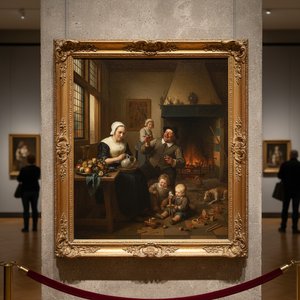
Johannes Vermeer, a name synonymous with serene domesticity and luminous light, remains one of the most enigmatic figures of the Dutch Golden Age. Born in Delft in 1632, his life was remarkably unassuming for an artist whose work now commands such reverence. Unlike many of his contemporaries who enjoyed bustling workshops and extensive patronage networks, Vermeer operated on a smaller scale, primarily serving local clientele while simultaneously managing a modest art dealership – a necessity born not from ambition but from the economic realities of 17th-century life. Records suggest he was a devoted family man, deeply involved in the civic affairs of Delft, and a quiet observer of the world around him. This intimate connection to his surroundings profoundly shaped his artistic vision, focusing almost exclusively on scenes of middle-class life within the confines of his home.
The Netherlands of Vermeer’s time was undergoing a period of unprecedented prosperity following its hard-won independence from Spain. The burgeoning merchant class fueled a demand for art that differed significantly from the religious commissions and aristocratic portraiture prevalent elsewhere in Europe. This new market favored genre paintings – depictions of everyday life, still lifes, and landscapes – offering a window into the comforts and values of a rising bourgeoisie. Vermeer’s ability to capture this world with unparalleled sensitivity and technical skill quickly established him as a respected, though not overwhelmingly famous, figure within Delft's artistic community.
Vermeer’s Artistic Technique: Mastering Light, Perspective, and Detail
In art, chiaroscuro (English: kee-AR-ə-SKOOR-oh, -SKURE-, Italian: [ˌkjaroˈskuːro]; lit. 'light-dark') is the use of strong contrasts between light and dark, usually bold contrasts affecting a whole composition. It is also a technical term used by ...
To describe Vermeer’s technique is to delve into the meticulous precision of a true craftsman. He wasn’t prolific; his output numbered only around 34 paintings – a testament to the painstaking care he invested in each work. Central to his artistry was an extraordinary understanding of light. Unlike the dramatic chiaroscuro employed by artists like Caravaggio, Vermeer’s light is soft, diffused, and remarkably naturalistic. He didn't merely *represent* light; he seemed to capture its very essence, allowing it to gently caress surfaces, revealing textures and creating a palpable sense of atmosphere.
Scholars believe Vermeer may have utilized a camera obscura – a darkened room with a small hole projecting an inverted image onto the opposite wall – as an aid in achieving his astonishing accuracy. While debate continues regarding the extent of its use, it’s clear he possessed a keen eye for perspective and spatial relationships. He wasn't simply copying what he saw; he was meticulously analyzing and reconstructing reality on canvas. This dedication extended to his pigments, often employing expensive ultramarine derived from lapis lazuli, further emphasizing the quality and refinement of his work. The subtle layering of paint, combined with a deliberate choice of colors, resulted in surfaces that seem to radiate an inner glow.
Domestic Interiors & Symbolic Realism: Decoding Vermeer's World
 The Milkmaid
Explore Vermeer’s ‘The Milkmaid’! A serene 1658 Dutch Golden Age masterpiece showcasing domestic life & masterful light. Discover realism, symbolism & timeless beauty.
Vermeer’s paintings are not merely snapshots of Dutch life; they are carefully constructed narratives imbued with subtle symbolism. His interiors, often featuring women engaged in quiet domestic tasks – reading letters, pouring milk, weighing gold – appear deceptively simple. However, a closer examination reveals layers of meaning woven into the composition. Objects were rarely chosen at random. A map on the wall might allude to geographical exploration and trade; a musical instrument could represent harmony or transience; even the arrangement of furniture held significance.
Consider The Milkmaid, perhaps his most iconic work. The seemingly mundane act of pouring milk is elevated through Vermeer’s masterful use of light and composition. The warm tones, the tactile quality of the fabrics, and the quiet dignity of the figure create a sense of timeless beauty. Yet, beneath the surface lies a subtle commentary on labor, sustenance, and the everyday virtues of Dutch society. Similarly, Girl Reading a Letter at an Open Window invites contemplation on themes of love, longing, and the complexities of human emotion. The letter itself remains unseen, leaving the viewer to imagine its contents and the emotional weight it carries.
Key Works & Lasting Influence: ‘The Milkmaid’, ‘Girl with a Pearl Earring’, and Beyond
 Girl Reading a Letter at an Open Window
Experience Vermeer’s ‘Girl Reading a Letter.’ A Dutch Golden Age masterpiece of light & intimacy. Explore its serene beauty, meticulous detail & historical context.
Beyond The Milkmaid and Girl with a Pearl Earring, Vermeer’s oeuvre includes masterpieces such as Allegory of Faith, showcasing his ability to imbue religious themes with a uniquely Dutch sensibility, and View of Delft, a breathtaking depiction of his hometown that demonstrates his skill in landscape painting. Each work is characterized by its meticulous detail, harmonious composition, and profound sense of tranquility.
Vermeer’s influence on subsequent generations of artists has been immense. His mastery of light and perspective inspired Impressionists like Monet and Degas, while his quiet intimacy resonated with 20th-century painters such as Hopper. He remains a touchstone for artists seeking to capture the beauty and complexity of everyday life. The enduring appeal of his work lies not only in its technical brilliance but also in its ability to evoke a sense of timelessness and universal human experience.
The Dutch Golden Age Context: Prosperity, Patronage, and Artistic Innovation
Dutch Golden Age painting is the painting of the Dutch Golden Age, a period in Dutch history roughly spanning the 17th century, during and after the later part of the Eighty Years' War (1568–1648) for Dutch independence. The new Dutch Republic was th...
Understanding Vermeer requires situating him within the broader context of the Dutch Golden Age. The 17th century witnessed an unprecedented flourishing of art, science, and commerce in the Netherlands. This prosperity was fueled by a thriving merchant class who increasingly commissioned artworks not for religious or aristocratic purposes but as symbols of their wealth and status. Unlike the centralized patronage systems found elsewhere in Europe, Dutch artists often relied on a more diverse clientele – merchants, lawyers, and other members of the middle class.
This shift in patronage led to the development of new genres and styles. Genre painting, portraiture, still lifes, and landscapes became increasingly popular, reflecting the values and interests of this burgeoning bourgeoisie. The specialization within these genres was also remarkable; artists often focused on a narrow range of subjects, honing their skills to an extraordinary degree. Vermeer’s dedication to domestic interiors exemplifies this trend, showcasing his mastery of light, composition, and symbolic realism.
Rediscovery & Legacy: From Obscurity to Global Icon
Despite enjoying modest recognition during his lifetime, Vermeer fell into relative obscurity after his death in 1675. For nearly two centuries, his work was largely forgotten, overshadowed by the more prolific output of other Dutch masters. It wasn’t until the 19th century that he was “rediscovered” by art historians like Gustav Friedrich Waagen and Théophile Thoré-Bürger, who championed his genius and brought his paintings back into the public eye.
Today, Vermeer is celebrated as one of the greatest painters of all time. His work graces the walls of museums around the world, captivating audiences with its serene beauty and timeless appeal. The enduring fascination with Vermeer stems from his ability to capture not just what he saw but how it *felt* – the quiet dignity of everyday life, the subtle nuances of human emotion, and the transformative power of light. At OriginalUniqueArt.com, we are proud to offer high-quality reproductions of Vermeer’s masterpieces, allowing you to experience the beauty and tranquility of his world in your own home.