Early Life & Architectural Foundations: Shaping a Landscape Vision
 Wikipedia: Jasper Francis Cropsey
Jasper Francis Cropsey (February 18, 1823 – June 22, 1900) was an American architect and artist. He is best known for his Hudson River School landscape paintings. == Early years == Cropsey was born on his father, Jacob Rezeau Cropsey's farm in Ros...
Jasper Francis Cropsey, born in 1823 on Staten Island, New York, embarked on an artistic journey initially shaped by necessity rather than pure passion. Recurring bouts of illness during his youth kept him from formal schooling, yet inadvertently fostered a burgeoning talent for drawing – sketches filling notepads and the margins of textbooks with architectural designs and nascent landscapes. This early inclination towards architecture would prove foundational, imbuing his later paintings with a unique sense of structure and order rarely seen amongst his Hudson River School contemporaries. He wasn’t immediately drawn to the wild abandon of untamed nature; instead, he received formal training under Joseph Trench in the 1840s, honing skills that would later allow him to meticulously construct idealized visions of the American countryside. This period also saw exposure to watercolor techniques through Edward Maury, further refining his observational abilities and sensitivity to light – a crucial element that would define his mature style.
The Hudson River School & Cropsey’s Emergence: A New American Aesthetic
The mid-19th century witnessed the rise of the Hudson River School, America's first truly cohesive artistic fraternity. While often characterized by dramatic depictions of the vast and untamed wilderness, the school represented more than just topographical accuracy; it was a burgeoning national identity expressed through landscape. Cropsey’s arrival on the scene in the late 1840s coincided with this movement’s flourishing. He quickly absorbed the aesthetic principles championed by Thomas Cole – though he didn't directly apprentice under him, Cole’s influence was pervasive. After a formative sojourn to Europe in 1847, settling briefly in Rome within the very studio once occupied by Cole himself, Cropsey returned to New York with a renewed sense of purpose. His election as a full member of the National Academy of Design in 1851 solidified his position amongst the leading landscape painters of the era. He wasn’t merely replicating scenes; he was interpreting them through a distinctly American lens, imbued with a romantic sensibility and a growing fascination with the interplay of light and atmosphere.
Mastering Luminism: Light, Atmosphere, and the Pastoral Scene
Luminism is a style of American landscape painting from the 1850s to 1870s, characterized by effects of light in a landscape, through the use of aerial perspective and the concealing of visible brushstrokes. Luminist landscapes emphasize tranquility,...
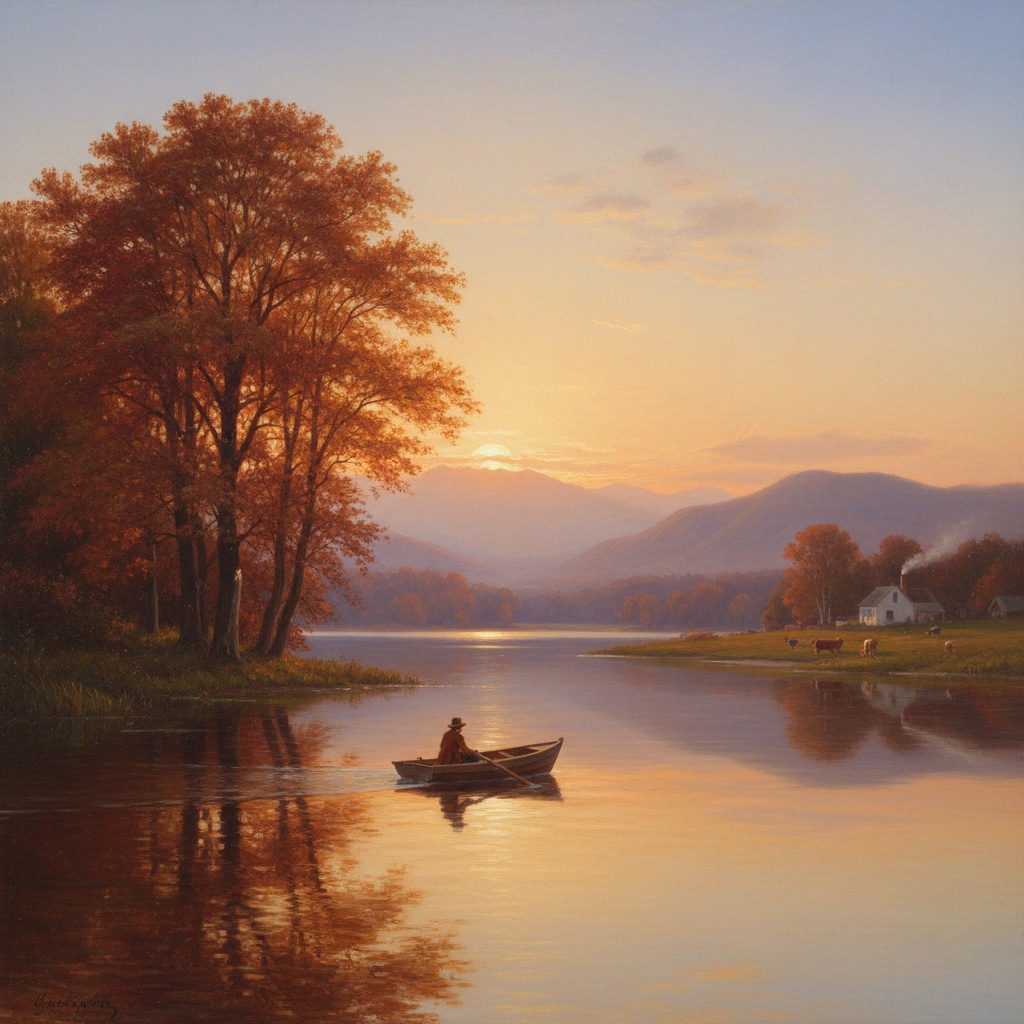
Cropsey's artistic evolution led him towards Luminism, a style characterized by its exquisite rendering of light effects in landscape. Unlike the grand panoramas favored by some of his peers, Cropsey’s Luminist works focused on tranquility and serenity. His paintings weren’t about conquering nature; they were about experiencing it – capturing the soft glow of sunrise over calm waters, the hazy warmth of an autumnal afternoon. This emphasis on atmospheric perspective and the concealing of visible brushstrokes created a sense of depth and realism that was both captivating and emotionally resonant. Works like “Farm Along the River” exemplify this mastery, showcasing idyllic rural beauty with soft light and autumnal hues. He wasn’t simply painting what he *saw*; he was conveying a feeling – a sense of peace, harmony, and the inherent beauty of the American countryside. This pursuit of luminous effects often involved careful layering of glazes to achieve subtle gradations of color and tone.
Cropsey's Signature Style: Autumnal Hues and Detailed Composition
While Cropsey embraced Luminist principles, he never fully abandoned his architectural background. His landscapes are notable for their meticulous composition – a deliberate arrangement of forms that lends a sense of order and balance to the natural world. This is particularly evident in his autumnal scenes, which became his signature subject matter. He possessed an extraordinary ability to capture the vibrant colors of fall foliage, employing a rich palette of reds, oranges, and golds to evoke a feeling of warmth and abundance. “Autumn Foliage” beautifully illustrates this talent, showcasing warm hues and atmospheric detail within a serene oil-on-canvas masterpiece. Beyond color, his attention to detail was remarkable – from the texture of bark on trees to the reflections in still water, every element was rendered with precision and care. This commitment to realism, combined with his romantic sensibility, set him apart as a unique voice within the Hudson River School.
Later Years & Rediscovery: Legacy of an American Landscape Painter
Cropsey’s career took an interesting turn in 1857 when he moved to London for seven years. His landscapes found considerable success amongst British audiences, and he exhibited at the International Exhibition of 1862 with his ambitious “Autumn on the Hudson,” a work that cemented his reputation as “America’s painter of autumn.” Upon returning to the United States after the Civil War, Cropsey continued to specialize in autumnal scenes, often idealized representations of the northeastern landscape. However, changing artistic tastes and financial difficulties led to a period of relative obscurity later in life. He was forced to sell his grand estate, *Aladdin*, and relocate to Hastings-on-Hudson. Despite this decline, his work experienced a remarkable rediscovery in the 1960s, with galleries and collectors recognizing the enduring beauty and significance of his paintings. Today, Cropsey’s works are held in major American museums – including the Metropolitan Museum of Art and the National Gallery of Art – and continue to inspire awe and admiration for their masterful depiction of light, atmosphere, and the idyllic American pastoral scene. His legacy endures as a testament to the power of landscape painting to capture not just what we see, but how we *feel* about the world around us.