
Early Life & Apprenticeship: Forging a Path in Edinburgh
The story of Henry Raeburn is inextricably linked to the burgeoning cultural landscape of late 18th and early 19th-century Scotland. Born in 1756 in Stockbridge, then a village on the Water of Leith just outside Edinburgh, his origins were humble – the son of a manufacturer. Orphaned at a young age, Raeburn’s trajectory wasn't immediately set for artistic renown. Supported by his older brother William, he was enrolled in Heriot’s Hospital, receiving an education that, while solid, offered little indication of the painter he would become. His initial path led him to an apprenticeship with James Gilliland, a goldsmith. This seemingly unrelated beginning proved formative; the meticulous detail required in jewelry making honed Raeburn's hand and eye for precision – qualities that would later distinguish his portraiture. It was through this early work, crafting miniature portraits adorned with delicate ivory details, that his artistic talent began to surface. A pivotal moment arrived when a medical student, Charles Darwin (not the famed naturalist, but a contemporary), commissioned a memorial locket from Gilliland, and Raeburn’s skill in capturing likeness and emotion was recognized by Andrew Duncan, a prominent physician who encouraged the young artist.
Raeburn's Artistic Style: A Synthesis of Realism, Romanticism & Neoclassicism
Romanticism (also known as the Romantic movement or Romantic era) was an artistic and intellectual movement that originated in Europe towards the end of the 18th century. The purpose of the movement was to advocate for the importance of subjectivity...
To categorize Henry Raeburn neatly into a single artistic movement is to do him a disservice. His style was remarkably fluid, absorbing influences from various schools while forging its own distinct identity. While initially grounded in the realism championed by artists like Allan Ramsay, Raeburn’s work quickly evolved beyond mere imitation. A period of study in London exposed him to the grand manner of Sir Joshua Reynolds and the principles of Neoclassicism – a focus on order, clarity, and classical forms. However, it was his subsequent travels to Italy that truly broadened his artistic horizons. There, he encountered the works of Michelangelo and other Renaissance masters, absorbing their mastery of anatomy and composition. Yet, Raeburn didn’t simply replicate these styles; he infused them with a uniquely Scottish sensibility. A growing undercurrent of Romanticism – an emphasis on emotion, individuality, and the power of nature – began to permeate his work, evident in the psychological depth of his portraits and the dramatic use of light and shadow. This synthesis created a style that was both technically accomplished and emotionally resonant.
Portraiture and the Scottish Enlightenment: Capturing an Era
Raeburn’s career coincided with the height of the Scottish Enlightenment, a period of intellectual and cultural flourishing. Edinburgh became a hub for thinkers, writers, scientists, and lawyers – a vibrant society that Raeburn expertly documented through his portraits. He wasn't merely painting faces; he was capturing the spirit of an era. His subjects included prominent figures like Sir Walter Scott, Hugh Blair, and Henry Mackenzie, individuals who shaped the intellectual landscape of Scotland. These weren’t simply commissions for wealthy patrons; they were acts of cultural preservation, immortalizing the leading minds of their time. Raeburn possessed a remarkable ability to convey not just physical likeness but also the character and intellect of his sitters. His portraits are imbued with a sense of dignity, intelligence, and often, a subtle hint of melancholy – reflecting the complexities of the Enlightenment ideals themselves. He understood that portraiture was more than representation; it was an exploration of identity and societal values.
The Power of Light and Shadow: Raeburn’s Technical Brilliance
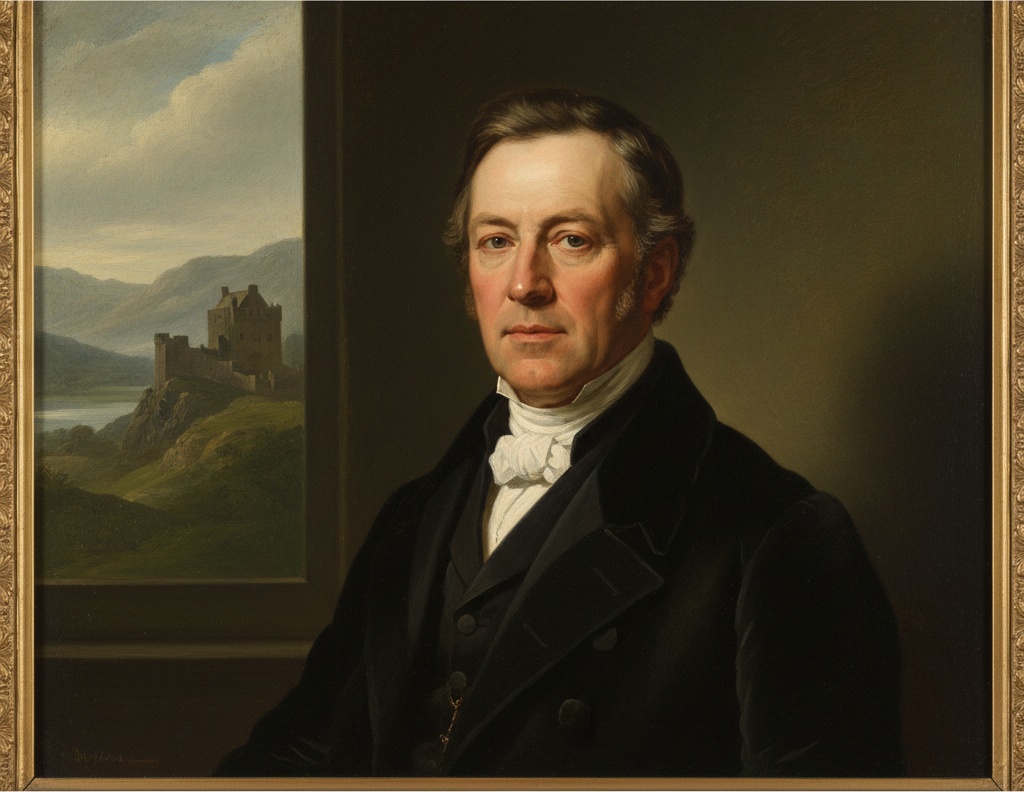
 Samuel Anderson
Henry Raeburn’s 1811 portrait of Samuel Anderson – a striking Neoclassical study in dark tones & dramatic light. Explore this masterful oil painting's dignified subject & historical context.
Perhaps the most striking characteristic of Raeburn's work is his masterful use of light and shadow. He wasn’t simply illuminating his subjects; he was sculpting them with light, creating a sense of depth, drama, and psychological intensity. This technique, reminiscent of Rembrandt and Caravaggio, elevated his portraits beyond mere likenesses to become powerful statements about character and personality. Consider his 1811 portrait of Samuel Anderson – a study in dark tones punctuated by dramatic highlights that draw the viewer’s eye to the subject's face. The subtle gradations of light reveal the texture of skin, the folds of fabric, and the intensity of Anderson’s gaze. Raeburn wasn’t afraid to embrace darkness; he understood its power to create mood and emphasize form. This technical brilliance was not accidental. He meticulously studied anatomy and composition, constantly refining his skills through observation and practice. His self-portraits offer a fascinating glimpse into this process – revealing a painter deeply committed to understanding the nuances of light and shadow.
Legacy and Influence: Raeburn's Enduring Impact on Scottish Art
Henry Raeburn’s impact on Scottish art is undeniable. Appointed Portrait Painter to King George IV in Scotland in 1822, he received knighthood the following year – a testament to his artistic achievements and national importance. His work not only captured the spirit of the Enlightenment but also helped define a distinctly Scottish aesthetic. He paved the way for future generations of Scottish artists, inspiring them to embrace their own cultural identity and explore new forms of expression. His influence can be seen in the works of Sir William Allan and others who followed in his footsteps. Today, Raeburn’s paintings are celebrated for their technical brilliance, psychological depth, and historical significance. They offer a window into a fascinating era – a time of intellectual ferment, artistic innovation, and national pride. His legacy continues to inspire artists and art lovers alike, reminding us of the power of portraiture to capture not just likeness but also the essence of the human spirit. Explore his masterpieces at the Scottish National Portrait Gallery and discover why Henry Raeburn remains one of Scotland’s most beloved and enduring artists. OriginalUniqueArt offers high-quality reproductions of Raeburn's iconic works, allowing you to bring a piece of Scottish history into your home.



