
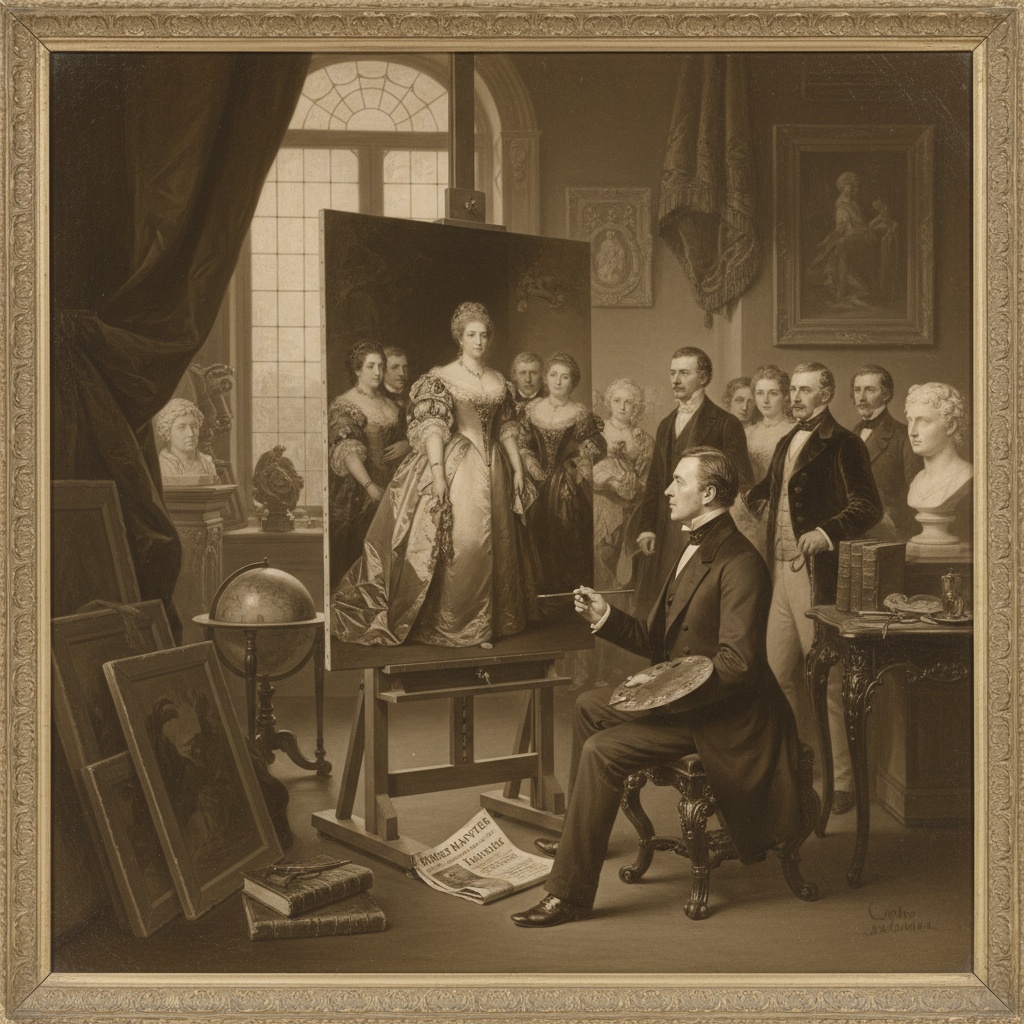
Early Life & Artistic Foundations: The Hayter Dynasty
 Wikipedia: George Hayter
Sir George Hayter (17 December 1792 – 18 January 1871) was an English painter, specialising in portraits and large works involving sometimes several hundred individual portraits. Queen Victoria appreciated his merits and appointed Hayter her Principa...
The name Hayter resonates with a quiet authority within the annals of British portraiture, yet the story begins not with George himself, but with his father, Charles Hayter (1761-1835). A respected miniature painter and drawing master, Charles instilled in his son a foundational understanding of perspective and technique. More than simply a teacher, Charles was a conduit to the burgeoning artistic circles of London, securing appointments as Professor of Perspective and Drawing to Princess Charlotte – a connection that would subtly shape George’s future trajectory. This early exposure wasn't merely about skill; it was an immersion into a world where art served not just aesthetic purposes but also social ones, documenting lineage and solidifying status. However, the path wasn’t entirely smooth. A youthful rebellion saw George briefly abandoning his brushes for a life at sea as a Midshipman in the Royal Navy, a testament to a restless spirit before ultimately returning to the easel, albeit after a familial intervention that secured his release.
This initial foray into naval life, though short-lived, perhaps instilled a discipline and observational acuity that would later inform his meticulous portrait work. Back under his father’s tutelage, George entered the Royal Academy Schools in 1808, studying under Henry Fuseli. It was during this period that he began to forge his own artistic identity, balancing the traditional techniques learned from his father with a growing ambition for larger-scale compositions. The early years were marked by a quiet determination, a desire to not simply replicate but to innovate within the established conventions of portraiture.
The Rise of Historical Portraiture: Capturing Moments in Time
While initially successful as a miniature painter, George Hayter’s true ambition lay in historical painting – a genre demanding both technical prowess and narrative skill. He recognized that portraits weren't simply about likeness; they were about capturing character, social context, and the weight of history itself. This realization propelled him towards larger canvases, ambitious compositions depicting significant events and figures. His 1815 work, *The Prophet Ezra*, earned him a premium from the British Institution, signaling his potential in this demanding field. However, it was his willingness to tackle contemporary subjects that truly set him apart.
Hayter wasn’t content with depicting scenes from antiquity or mythology; he sought to immortalize the political dramas unfolding around him. This bold move – venturing into the realm of recent history – proved both lucrative and controversial. He understood the power of spectacle, the public's fascination with witnessing pivotal moments rendered in paint. His early success was fueled by a growing demand for paintings that not only documented events but also offered a particular interpretation of them.
Royal Patronage & 'The First Reformed House of Commons': A Monumental Achievement
 The First Reformed House Of Commons,
Explore George Hayter’s "The First Reformed House of Commons," a monumental oil painting capturing Victorian society. Admire its historical realism & intricate detail – a captivating piece for art collectors.
The turning point in Hayter’s career arrived with the patronage of Queen Victoria. Appointed her Principal Painter in Ordinary, he found himself at the heart of British society, entrusted with capturing the likenesses of its most prominent figures. This appointment wasn't merely a professional boon; it was a validation of his artistic skill and a testament to his ability to navigate the complex social landscape of Victorian England. However, it was *The First Reformed House of Commons* (1832) that cemented his reputation as a master of historical portraiture.
This monumental work, depicting the newly elected Parliament after the Reform Act of 1832, is a breathtaking feat of observation and composition. Featuring over three hundred individual portraits, it’s not simply a record of faces but a vibrant tapestry of Victorian society – a visual encyclopedia of power, ambition, and political maneuvering. The sheer scale of the undertaking demanded meticulous planning and execution, requiring Hayter to work with an army of assistants while maintaining overall artistic control. The painting's historical realism and intricate detail are captivating, offering viewers a glimpse into the inner workings of British politics during a period of significant change.
Scandal, Exile & the Pursuit of Style on the Continent
Despite his professional success, Hayter’s personal life was marked by scandal. A secret marriage at a young age and a long-term relationship with Louisa Cauty, conducted openly but outside the bounds of societal convention, raised eyebrows and ultimately led to ostracism from certain circles. The tragic death of Louisa in 1827, under suspicious circumstances, further fueled public speculation and forced Hayter to seek refuge on the Continent. This self-imposed exile wasn’t simply a retreat; it was an opportunity to refine his style and explore new artistic influences.
In Italy, he absorbed the classical elegance of Antonio Canova's studio, while in Paris, he embraced the burgeoning Romantic movement. His portraits from this period demonstrate a newfound sophistication, influenced by French masters like François Gérard. He continued to paint English society members, exhibiting at the Salon and cultivating a reputation for capturing aristocratic grace and refinement. However, the shadow of his past lingered, preventing him from fully reintegrating into British artistic circles.
Hayter's Legacy: Victorian Society Through a Painter’s Eye
Upon his return to England in 1831, Hayter continued to receive royal commissions, but his later works never quite reached the heights of *The First Reformed House of Commons*. Despite this, his contribution to Victorian portraiture remains significant. He captured an era of unprecedented social and political change, documenting the faces that shaped British history with meticulous detail and a keen understanding of character. While his unconventional personal life led to a degree of posthumous obscurity, recent scholarship has begun to reassess his work, recognizing his innovative approach to historical painting and his ability to capture the complexities of Victorian society.
Hayter’s paintings are more than just portraits; they are windows into a bygone era, offering viewers a glimpse into the lives, ambitions, and dramas of those who shaped British history. His legacy lies not only in his technical skill but also in his willingness to challenge conventions and capture the spirit of his time. Explore George Hayter’s masterpieces at OriginalUniqueArt.com, where history comes alive through the artistry of a remarkable painter.



