

Early Life and Influences: Forming a Dutch Master
 Wikipedia: Gabriël Metsu
Gabriël Metsu (1629–1667) was a Dutch painter of history paintings, still lifes, portraits, and genre works. He was "a highly eclectic artist, who did not adhere to a consistent style, technique, or one type of subject for long periods". Only 14 of h...
Gabriel Metsu, born in Leiden in 1629, emerged during the twilight of the Dutch Golden Age – a period defined by unprecedented prosperity, burgeoning artistic innovation, and a profound shift in societal values. While biographical details remain somewhat elusive, we know his father, Jacques Metsu, was a tapestry worker and painter, providing an initial grounding in visual arts. However, it was the intellectual and artistic climate of Leiden, coupled with later experiences in Amsterdam, that truly shaped the young artist’s trajectory. Leiden, though smaller than Amsterdam, possessed a vibrant artistic community, steeped in the traditions of realism pioneered by artists like Frans Hals and the meticulous detail championed by Gerrit Dou – an influence readily apparent in Metsu's early works. The precise nature of his training remains debated; some scholars suggest a period under Jan Steen, while others point to the impact of Rembrandt’s chiaroscuro techniques absorbed through exposure to his work. What is certain is that Metsu wasn’t merely replicating existing styles but synthesizing them into something uniquely his own – a blend of narrative clarity, psychological insight, and an almost photographic attention to detail.
Genre Painting as Social Commentary: A Window into 17th-Century Holland
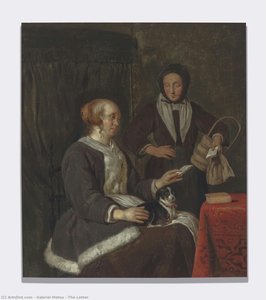 The Letter
Discover Gabriel Metsu’s "The Letter," a captivating 17th-century Dutch genre scene of quiet intimacy & subtle drama. Explore its realism, rich detail, & symbolic depth.
The rise of genre painting in the Dutch Golden Age wasn’t simply about depicting everyday life; it was a revolutionary act. With the decline of religious commissions, artists turned their attention to scenes of domesticity, commerce, and social interaction – subjects previously considered unworthy of serious artistic consideration. Gabriel Metsu excelled within this burgeoning field, transforming seemingly mundane moments into compelling narratives rich with symbolic meaning. His paintings aren’t merely pretty pictures; they offer a nuanced glimpse into the values, anxieties, and aspirations of 17th-century Dutch society. Consider “La Riboteuse”, for example – an elderly woman meticulously inspecting lace. On the surface, it's a portrait of quiet industry. Yet, beneath the detail lies a commentary on social status, female labor, and perhaps even the precariousness of financial security in a rapidly changing world. Metsu’s ability to imbue these scenes with such subtle layers of meaning is what distinguishes him from his contemporaries.
Metsu’s Signature Style: Realism, Light, and Compositional Harmony
Metsu's artistic prowess lay in his masterful command of realism, a quality he inherited from the Early Netherlandish tradition but refined with an almost modern sensibility. He possessed an extraordinary ability to capture textures – the sheen of silk, the roughness of wood, the delicate translucence of skin – rendering them with breathtaking accuracy. However, his realism wasn’t merely about technical skill; it was inextricably linked to his use of light and shadow. Influenced by Rembrandt, Metsu employed chiaroscuro to create dramatic effects, highlighting key figures and objects while subtly obscuring others, thereby directing the viewer's gaze and enhancing the narrative impact. Furthermore, his compositions are characterized by a remarkable sense of harmony and balance – carefully arranged elements that draw the eye inward, creating a feeling of intimacy and immediacy. He wasn’t interested in grand theatrical displays; instead, he focused on capturing fleeting moments with quiet dignity and understated elegance.
Key Works and Recurring Themes: Exploring ‘La Riboteuse,’ ‘The Letter,’ and Beyond
While Metsu produced over 130 known works, certain paintings stand out as exemplars of his style and thematic concerns. “La Riboteuse”, painted around 1655-1660, exemplifies his meticulous attention to detail and psychological insight. The woman’s focused expression, the rich textures of her clothing, and the carefully arranged objects in the background all contribute to a sense of quiet contemplation. “The Letter”, another iconic work, depicts a young woman receiving correspondence – a scene brimming with unspoken emotions and potential intrigue. Recurring themes throughout Metsu’s oeuvre include domestic interiors, scenes of courtship and marriage, and depictions of everyday labor. He often portrayed women engaged in activities such as sewing, reading letters, or tending to household chores, offering a glimpse into their lives and social roles. “The Weaponsmith”, though less frequently discussed, reveals his versatility – a dynamic depiction of a blacksmith’s workshop filled with dramatic lighting and symbolic labor. Across these diverse subjects, Metsu consistently demonstrates his ability to elevate the ordinary to the level of art.
Rediscovery and Legacy: Metsu's Place in the Dutch Golden Age Canon
Despite achieving considerable success during his lifetime, Gabriel Metsu’s reputation waned after his untimely death at the age of 38 in 1667. For centuries, he remained overshadowed by more celebrated contemporaries like Rembrandt and Vermeer. However, a renewed interest in his work emerged in the late 19th and early 20th centuries, culminating in significant exhibitions such as the one held at the National Gallery of Ireland in 2010 – an event that brought together some forty of his finest paintings from around the world. Today, Metsu is recognized as a pivotal figure in the Dutch Golden Age, celebrated for his exquisite technique, psychological insight, and ability to capture the essence of daily life with unparalleled realism and grace. His influence can be seen in the work of later artists, and his paintings continue to captivate audiences with their timeless beauty and enduring relevance. At OriginalUniqueArt.com, we are proud to offer high-quality reproductions of Metsu’s masterpieces, allowing you to experience the brilliance of this Dutch Master in your own home.



