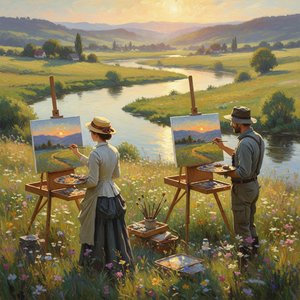
Early Life & Academic Foundations: The Genesis of a Painter
 Wikipedia: Frank Weston Benson
Frank Weston Benson, frequently referred to as Frank W. Benson, (March 24, 1862 – November 15, 1951) was an American artist from Salem, Massachusetts, known for his Realistic portraits, American Impressionist paintings, watercolors and etchings. He b...
Frank Weston Benson, born in Salem, Massachusetts, in 1862, emerged from a family steeped in New England tradition and prosperity – a background that would subtly yet profoundly shape his artistic trajectory. While not initially destined for the life of an artist, Benson’s early aptitude for drawing was recognized and nurtured, leading him to enroll at the School of the Museum of Fine Arts, Boston, in 1879. This marked the beginning of a formal education grounded in academic realism, a style then dominant in American art circles. His teachers, notably Otto Grundmann, instilled in him a rigorous understanding of anatomy, composition, and technique – skills that would serve as the bedrock for his later explorations into Impressionism. However, Benson’s ambition wasn't confined to Boston; he sought further refinement abroad, traveling to Paris and studying at the prestigious Académie Julian. This exposure to European artistic currents proved pivotal, broadening his perspective and introducing him to a world of color and light that would ultimately define his unique aesthetic.
The Boston School & American Impressionism: A Defining Influence
American Impressionism was a style of painting related to European Impressionism and practiced by American artists in the United States from the mid-nineteenth century through the beginning of the twentieth. The style is characterized by loose brushw...
Upon returning from Europe, Benson became deeply involved with the burgeoning Boston School movement – a group of artists who sought to reconcile European Impressionist principles with American sensibilities. Unlike their French counterparts, who often focused on fleeting moments and urban scenes, the Boston School painters tended towards more structured compositions and a celebration of domestic life and New England landscapes. Benson quickly became a leading figure within this circle, alongside contemporaries like Edmund Tarbell and Philip Hale. He wasn’t simply replicating Impressionism; he was *adapting* it, infusing it with his own meticulous technique and a distinctly American sense of realism. This adaptation manifested in a focus on capturing the subtle nuances of light and atmosphere, transforming ordinary scenes into moments of luminous beauty. The influence of Johannes Vermeer and Diego Velázquez – masters of light and shadow – is readily apparent in Benson’s early portraits, demonstrating a commitment to technical mastery even as he embraced the looser brushwork associated with Impressionism.
Mastering Light & Atmosphere: Benson’s Signature Style in Landscape and Portraiture
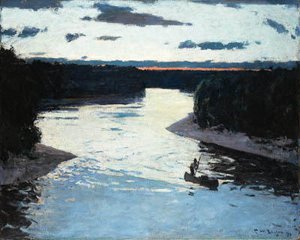 Dawn on the York
Discover "Dawn on the York" by Frank Weston Benson – a serene Impressionist landscape capturing twilight’s beauty. Explore this luminous oil painting's tranquility & artistic style.
Benson's true genius lay in his ability to render light. He didn’t merely depict illumination; he *captured* its essence, conveying a sense of warmth, depth, and atmosphere that breathed life into his canvases. This mastery was evident across both his portraiture and landscape work. His early portraits, often commissioned by prominent New England families, showcased a remarkable ability to capture not just likeness but also the personality and inner life of his subjects. He achieved this through careful observation of light playing on faces and fabrics, creating a sense of intimacy and realism. However, it was in his plein air paintings – works created directly outdoors – that Benson’s style truly blossomed. He sought out locations where he could observe the shifting qualities of sunlight, meticulously documenting its effects on water, foliage, and sky. Paintings like “Dawn on the York” exemplify this dedication, showcasing a serene landscape bathed in the soft glow of twilight. The luminous quality of these works is not accidental; it’s the result of painstaking observation and a deep understanding of color theory.
A Passion for Wildlife: From Etchings to Sporting Art Revolution
While renowned for his portraits and landscapes, Benson harbored a lifelong passion for wildlife, particularly birds. This fascination initially manifested in detailed etchings – a medium that allowed him to capture the intricate details of avian anatomy and plumage. “Eagle in the Sky,” created in 1918, is a testament to this early skill, showcasing an eagle in flight with remarkable precision and power. However, Benson’s engagement with wildlife evolved beyond mere documentation; he sought to elevate sporting art – paintings depicting hunting, fishing, and other outdoor pursuits – from its often-rustic origins into a realm of high art. He revolutionized the field by infusing his depictions of wildfowl and landscapes with heightened artistic sensitivity, moving away from purely realistic representations towards a more nuanced understanding of light, color, and composition. He realized that our perception of a bird isn’t about precise feather patterns but rather how light interacts with its form in a specific environment.
Wooster Farm & Family Life: Inspiration Behind the Canvas
Central to Benson's artistic development was his summer home, Wooster Farm, on North Haven Island, Maine. This idyllic setting became both a sanctuary and a source of endless inspiration. It was here, surrounded by his wife and daughters, that he created some of his most iconic works. His family wasn’t merely the subject matter; they were integral to the artistic process. Paintings like “Summer” depict his daughters enjoying simple pleasures outdoors – swimming, boating, or simply relaxing in the sun. These scenes weren't contrived; they captured genuine moments of familial joy and intimacy. The relaxed atmosphere of Wooster Farm allowed Benson to experiment with new techniques and explore themes of leisure, beauty, and the natural world. The light-drenched canvases from this period radiate a sense of warmth and optimism, reflecting the idyllic life he led.
Legacy & Enduring Appeal: Frank Weston Benson's Place in American Art History
Frank Weston Benson's contribution to American art is undeniable. He bridged the gap between academic realism and Impressionism, creating a unique style that celebrated both technical mastery and atmospheric beauty. His paintings continue to resonate with audiences today because they capture something timeless – a sense of peace, tranquility, and connection to nature. His influence can be seen in the work of countless artists who followed, and his legacy is preserved in major museum collections across the country. Beyond his technical skill, Benson’s enduring appeal lies in his ability to evoke emotion and transport viewers to a world of idyllic beauty. He wasn't simply painting scenes; he was capturing moments – fleeting glimpses of light, joy, and connection that continue to inspire and captivate generations. Explore the breadth of Frank Weston Benson’s work at OriginalUniqueArt.com, where museum-quality reproductions bring his masterpieces into your home.