
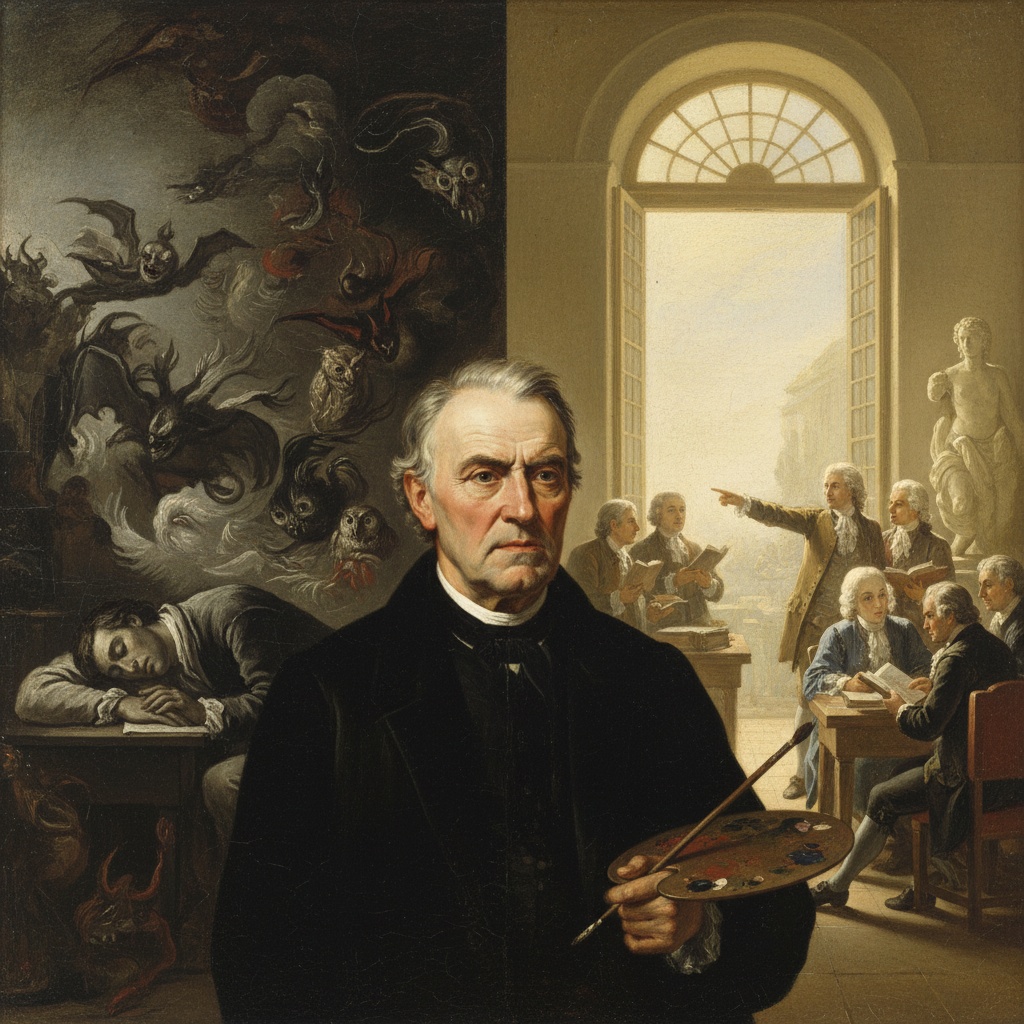
Early Life & Artistic Formation: Goya's Apprenticeship and Rise at the Spanish Court
 Francisco José de Goya y Lucientes
Francisco Goya (1746-1828): Explore the life & work of Spain's Romantic master. Known for portraits, dark satire & 'Disasters of War'. A pivotal figure in art history.
Francisco José de Goya y Lucientes, born in 1746 in the humble village of Fuendetodos, Spain, embarked on a journey that would irrevocably alter the course of art history. His beginnings were far removed from the opulent courts he would later immortalize. The son of a modest gilder and decorator, young Francisco received his initial artistic training under José Luzán y Martinez in Zaragoza, a foundation upon which he built an extraordinary talent for observation and meticulous technique. This early period instilled in him not only skill but also a keen awareness of the social strata surrounding him – a sensitivity that would later permeate his most powerful works. In 1763, Goya ventured to Madrid, seeking further refinement at the Real Academia de Bellas Artes de San Fernando, though initial attempts at competitive entry proved unsuccessful. His persistence led him to Rome, where he absorbed the influences of Italian masters and honed his skills in portraiture and historical painting. Upon returning to Spain, a pivotal moment arrived with his appointment as a court painter under Charles IV in 1786, marking his ascent into the heart of Spanish aristocracy.
The Tapestry Cartoons & Rococo Charm: A Foundation in Decorative Art
 Blind Man's Buff
Explore 'Blind Man's Buff' by Francisco Goya, a lively Rococo painting capturing a playful scene of camaraderie and youthful exuberance. A masterpiece of Spanish art.
Goya’s early success at court was largely defined by his creation of sixty-three tapestry cartoons for the Royal Tapestry Factory. These weren't merely decorative exercises; they were vibrant scenes of everyday life, brimming with a playful Rococo spirit that captured the leisure and vitality of Spanish society. Commissioned to adorn the palaces of San Lorenzo del Escorial and El Pardo, these works depict hunting parties, festive gatherings, and charming genre scenes filled with lively figures and dynamic compositions. The Blind Guitarist, though initially intended for a more complex tapestry design, stands as a testament to his evolving style – even in this early phase, Goya’s masterful use of color and composition hinted at the depth that would characterize his later work. While seemingly lighthearted, these cartoons provided invaluable experience in portraiture, capturing likenesses with increasing accuracy and nuance. They also allowed him to develop a sophisticated understanding of narrative and symbolism, skills he would later employ to far more profound effect.
A Descent into Darkness: The Impact of Illness, War, and Social Turmoil on Goya’s Vision
 Wikipedia: Francisco Goya
Francisco José de Goya y Lucientes (; Spanish: [fɾanˈθisko xoˈse ðe ˈɣoʝa i luˈθjentes]; 30 March 1746 – 16 April 1828) was a Spanish romantic painter and printmaker. He is considered the most important Spanish artist of the late 18th and early 19th ...
The trajectory of Goya's artistic career took a dramatic turn in 1793. A severe illness – the exact nature remains unknown – left him profoundly deaf, plunging him into a period of isolation and introspection. This physical affliction coincided with increasing political unrest in Spain and across Europe. The Enlightenment ideals that had initially fostered a sense of optimism began to give way to revolution and conflict. Goya’s work underwent a corresponding transformation. His palette darkened, his subjects became more unsettling, and a palpable sense of anxiety crept into his compositions. He moved beyond the purely decorative, exploring themes of madness, superstition, and the darker aspects of human nature. This period marked a crucial shift from portraying the world as he saw it to revealing the world as he *felt* it – a deeply personal and often disturbing vision.
The Caprichos & Disasters of War: Satire, Protest, and the Birth of Modern Political Art
 Poor Folly
Explore Francisco Goya’s ‘Poor Folly,’ a haunting 1819 etching revealing social injustice & masterful technique. Discover this powerful work of Spanish Romanticism.
Perhaps no works so powerfully encapsulate Goya’s evolving social consciousness as his series of etchings, Los Caprichos (1797-99) and The Disasters of War (1810-14). Los Caprichos, a collection of eighty aquatinted etchings, are a scathing indictment of Spanish society – its follies, superstitions, corruption, and abuses of power. Filled with grotesque figures, biting satire, and enigmatic symbolism, they represent a radical departure from traditional artistic conventions. The Disasters of War, created in response to the brutal Napoleonic invasion of Spain, are even more harrowing. These eighty-two prints depict the horrors of conflict – the violence, suffering, famine, and inhumanity inflicted upon the Spanish people. They stand as a powerful testament to the atrocities of war and a searing critique of political tyranny, prefiguring much of the modern political art that would follow. These series weren’t merely artistic statements; they were acts of defiance, challenging the established order and exposing the dark underbelly of power.
Goya's Late Period & Black Paintings: Isolation, Despair, and a Precursor to Expressionism
In his later years, Goya retreated into near isolation at his farmhouse, La Quinta del Sordo (House of the Deaf Man), on the outskirts of Madrid. Here, he created a series of fourteen paintings directly onto the walls of the house – the so-called Black Paintings. These works are profoundly disturbing and intensely personal, reflecting his disillusionment with society and his own internal struggles. Images of violence, despair, demonic figures, and haunting portraits dominate this collection. Saturn Devouring His Son, Witches’ Sabbath, and The Dog are particularly unsettling examples of his late style – raw, emotionally charged, and devoid of the Rococo charm that characterized his earlier work. These paintings weren't intended for public consumption; they were a private expression of Goya’s deepest fears and anxieties, foreshadowing the themes and techniques of Expressionism. They represent a radical break from artistic tradition, prioritizing emotional intensity over formal beauty.
Legacy and Influence: Goya’s Enduring Impact on Romanticism and Beyond
Romanticism (also known as the Romantic movement or Romantic era) was an artistic and intellectual movement that originated in Europe towards the end of the 18th century. The purpose of the movement was to advocate for the importance of subjectivity...
Francisco Goya's legacy is immense and far-reaching. He bridged the gap between the Old Masters and the modern era, influencing generations of artists with his innovative techniques, unflinching social commentary, and profound emotional depth. He is often hailed as the last of the Old Masters and the first of the moderns – a testament to his unique position in art history. His work profoundly impacted the Romantic movement, inspiring artists like Eugène Delacroix and J.M.W. Turner with its emphasis on subjectivity, imagination, and emotional intensity. Later artists, including Pablo Picasso and Francis Bacon, drew inspiration from Goya’s Disasters of War and Black Paintings, recognizing his pioneering exploration of violence, despair, and the darker aspects of the human condition. Today, Goya remains a towering figure in art history – a visionary artist whose work continues to resonate with audiences worldwide. At OriginalUniqueArt.com, we are proud to offer high-quality reproductions of his masterpieces, allowing you to experience the power and beauty of Goya’s vision in your own home.



